

You can find commercial buildings that need a maintenance vendor in five places. Public bid notices show the clearest need. Violation and new building records can show a need earlier.
- Public bid notices
- City violation records
- New building records
- Vendor registration portals
- Property manager networks
The first three are free. Public buyers must advertise bids by law. This article is for owners and sales reps at commercial maintenance vendors adding accounts. It uses Texas, New York, Chicago and Florida as examples. Other places publish similar records under different names.
Where Do You Find Commercial Buildings That Need a Maintenance Vendor?
You can look at public bid notices, city violation records, new building records, vendor portals and property manager networks. Each one catches a building at a different time. A bid notice shows a buyer who is ready to hire. A violation shows a repair the owner must make. A new building shows a site with no vendor.
| Source | What it finds | When the need shows | Cost |
| Legal bid notices | Public buyers with an open maintenance job | Days or weeks before the bid deadline | Free |
| Council agendas | Contracts with an expiration date | Before the contract ends | Free |
| City violation records | Buildings with open code problems | After an inspection | Free |
| Certificate of occupancy records | New buildings with no vendor history | When the building is finished | Free |
| Florida milestone inspections | Condo buildings due for a structural review | The year a building turns 30 | Free to read the rule |
| Vendor portals | Standing work with national firms and hospital purchasing groups | When you register | Check each portal |
| Property management companies and referrals | Multi-site owners and their bid lists | When a contract comes up | Free |
| Paid property databases | Owner and manager contacts at scale | Any time | Subscription |
Want commercial work for a small handyman business? Use the free sources at the top of the table first. Referrals, networking and trade groups like the Building Owners and Managers Association (BOMA) still help. Your competitors use them too, though. After you build a list of buildings, turn it into a facility manager prospect list with checked contacts.
Paid property databases sell owner and manager contacts. They cost money and give no timing. Save them for after the free sources. Timing matters more than volume. A short list of buildings with a real need beats a long list of cold names.
Where Can You Find Public Maintenance Bids?
Public buyers must advertise building maintenance bids. They post the jobs in newspapers and on buyer websites. Texas school districts post once a week for 2 weeks in the county paper. New York posts at least 5 days before. Each state has its own rules.
| State | Where the notice runs | How long before the deadline | Source |
| Texas (school districts) | County newspaper | Once a week for at least 2 weeks | Texas Education Code 44.031(g) |
| New York (local governments and school districts) | Official newspaper | At least 5 days before opening | New York General Municipal Law 103(2) |
That notice window is your lead list. Buyers may call the job a request for proposals (RFP) or an invitation to bid. Check your county paper’s legal notices each week. Florida papers also post on floridapublicnotices.com, which keeps 18 months of notices. New York has a state newsletter. Federal jobs over $25,000 go on SAM.gov, under FAR 5.101.
Bid Thresholds and Bidder Rules
Big jobs go out to bid, and small ones often don’t. Texas school districts must use a formal bid process for contracts of $100,000 or more a year. New York bids service contracts over $20,000 and public work over $35,000. Smaller jobs follow each buyer’s own buying rules. New York adds up every purchase of the same service over 12 months. It does not allow a buyer to split a job to stay under the limit. In Texas, splitting a school purchase is a Class B misdemeanor.
Both states let buyers skip bidding in a real emergency. Texas school boards can let the superintendent hire for urgent repairs. New York allows contracts that can’t wait for bidding. Emergency work goes to vendors the buyer already knows. So get known before it happens.
Two more rules decide who can bid. Texas state agencies send bid notices to vendors on the Centralized Master Bidders List (CMBL). It costs $70 a year. Texas cities also require a payment bond on public work over $50,000. They require a performance bond over $100,000. If your state isn’t listed, search its school and city buying laws for “notice” or “advertisement.”
Council Agendas Show When Contracts Expire
Council agendas show maintenance contracts being awarded, amended or extended, which points to the next bid. Houston’s January 4, 2023 agenda raised the maximum amount on an elevator and escalator maintenance and repair contract approved in 2020.
Read old agendas for the work you do. Houston keeps them in its city secretary archive. Note each contract number, initial term, renewal options and department. Call that department a few months before the end date. It is planning the rebid then. The agenda also names the current vendor. That is who you would replace.
Which Public Records Show a Building Needs Repairs?
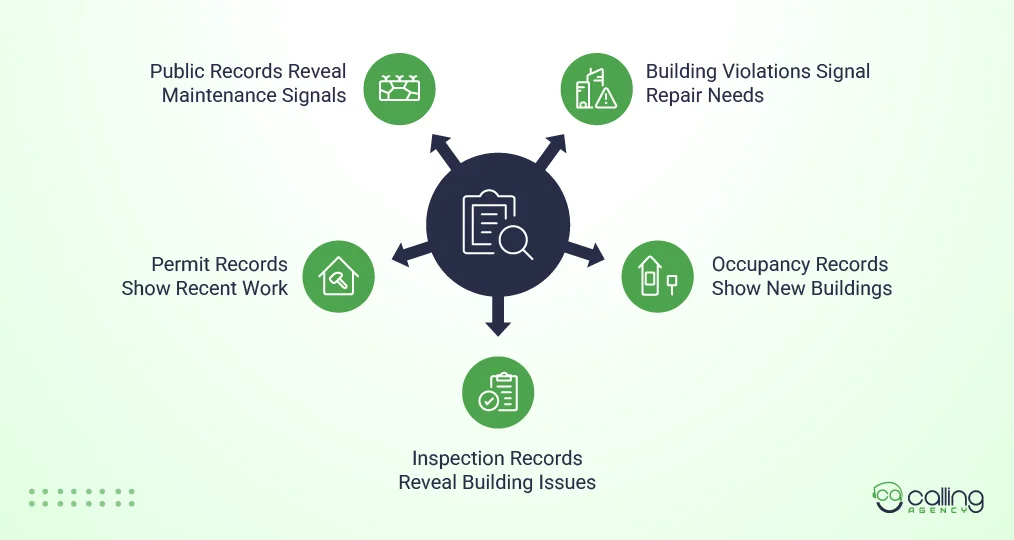
City violation records show buildings with open code problems. Certificate of occupancy records show new buildings that have no vendor history. Chicago posts its building violations as open data that you can search by address. New York City publishes certificate of occupancy and new building records on NYC Open Data.
In Chicago, find the Building Violations dataset. In New York City, find DOB NOW Certificate of Occupancy and DOB NYC New Buildings.
A violation indicates a repair is required. This does not mean the owner wants a new vendor. Use it to locate the property and relate the problem to your service. So before you assume a bid is open, get in touch with the owner or manager.
There is no vendor to replace in a new building. The first contract is open to anyone.
In your city’s open data portal, check for violations, inspections or occupancy certificates. Fetch the latest records every month.
Buildings on a Legal Repair Clock
Some laws set a date for a repair or inspection. In Florida, condo buildings with 3 or more habitable stories must get milestone inspections. The first one is due the year the building turns 30. After that, it is due every 10 years. Near salt water, local officials can move it to 25 years.
| Building age | Inspection due | Source |
| Turns 30 | By December 31 of that year | Florida Statutes 553.899 |
| Turns 25, near salt water | By December 31 of that year, if local officials require it | Florida Statutes 553.899 |
| After the first inspection | Every 10 years | Florida Statutes 553.899 |
Older buildings had last dates. Buildings that turned 30 before July 1, 2022 had to finish by December 31, 2024. Buildings that turned 30 between July 1, 2022 and December 31, 2024 had until December 31, 2025.
If phase one finds substantial structural deterioration, phase two testing follows with a deadline. The association pays for parts it maintains, so the board is your buyer. The rule covers co-op buildings too. Ask the association’s manager when the next milestone inspection is due.
Vendor Lists and National FM Firms
Property managers, national facility management (FM) firms and hospital purchasing groups all keep vendor lists. You can apply to join them. BrandPoint recruits trades through a vendor network application. Vizient runs an online bid platform and a supplier portal. National FM firms look after maintenance for many sites at once.
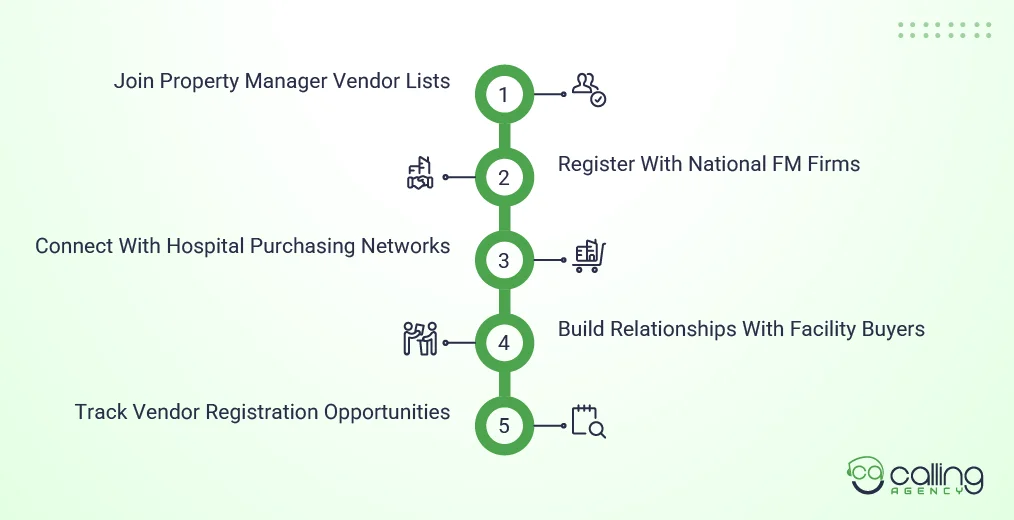
Want to get on a property manager’s approved vendor list? Call the property and get the manager’s name. Then ask how vendors join the bid list. Have your proof of insurance ready before you call.
National FM firms hire local trades through their own applications. BrandPoint says your insurance must be in order before you join its vendor network. USM takes subcontractor sign-ups through an online portal.
Hospitals buy work through group purchasing organizations (GPOs) like Vizient. A vendor on a GPO contract can sell to many member hospitals. To get on a Vizient contract, follow its own supplier steps.
- Check the public bid calendar for facilities categories.
- Sign up and send a proposal on its online bidding platform during an open bid.
- Sign up in its supplier portal so member hospitals can find you when they search for local suppliers.
Hospitals also buy some work locally. So ask the facilities team which jobs fall outside the GPO.
Who to Contact Once You Find the Building
The right person depends on the building. A board, building owner or supply chain team often signs big contracts. A facility or property manager usually runs the search. Public buyers follow bid rules. Condo boards vote. Your first call should go to the person who can sign.
In multi-tenant offices, the property manager signs up to the owner’s limit. At Texas schools, the board awards contracts of $100,000 or more a year. At hospitals, supply chain buys along with facilities. Florida condo boards must bid contracts over 5% of the annual budget.
In facility maintenance lead generation, the hard part comes after you find the building. You have to reach the signer before the contract goes up for rebid.
Frequently Asked Questions
How do I find commercial maintenance contracts near me?
Start with free records. Read your county paper’s legal notices weekly. Check your city’s open data site for violations and new certificates of occupancy. Then apply to vendor lists at property managers and FM firms.
Are public maintenance bids free to find?
Yes. Public buyers must post bid notices, mostly in newspapers. Some states post them online, like Florida. A few vendor lists cost money. The Texas CMBL is $70 a year. Check weekly. Some bids close fast.
How do I get on a property manager’s vendor list?
Call the building and ask for the manager. Ask how to join the bid list and what papers you need. Have your insurance papers ready. Call back when a contract is about to end.
Does my city publish building violation data?
Many big cities do. Chicago posts building violations. New York City posts certificates of occupancy. Look on your city’s data site for violations, inspections or permits. If you find nothing, ask your building department.
Which Florida buildings need milestone inspections?
Condos and co-ops with 3 or more floors for living. The first is due by December 31 of the year it turns 30, then every 10 years. Near saltwater, officials can make it 25 years.