

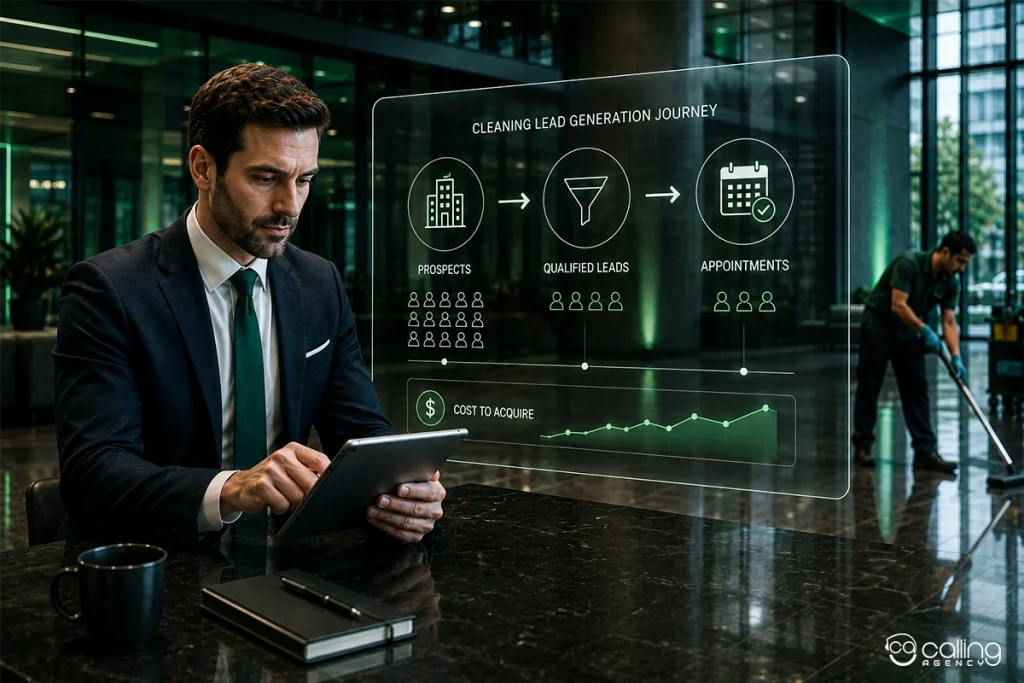
The cost of commercial cleaning lead generation depends on your chosen channel, ranging from $10 to $500 or even more. Shared leads are at the lower end of the range, approximately $15 to $50 each, but are distributed among multiple competitors. Exclusive leads and Local Services Ads run anywhere from $5 for the minimal cost to a few hundred dollars, but since the lead is not shared, you have greater close rates.
Higher buyer intent makes Google Ads skew higher, commonly $60 to $200 per lead. At the far end of the spectrum, retained agencies cost between $3k–10k a month, while an in-house sales rep = ~$50k/yr (base salary).
The right cost depends less on the price tag and more on how many leads actually turn into signed contracts. In this guide, we dissect each channel so you can choose the one that best fits your budget and closes the most business.
Commercial Cleaning Lead Generation Cost by Channel
Commercial cleaning leads cost between $10 and $500+ depending on the buying model. Shared leads range from $15 to $50, while exclusive leads cost $50 to $150 or more, and lead generation services charge monthly subscriptions starting at $50 to $500 for unlimited database access. Local Services Ads is usually the cheapest paid channel, while purchased lists and retained agencies suit different budget levels.
Below is a direct cost breakdown for each buying model.
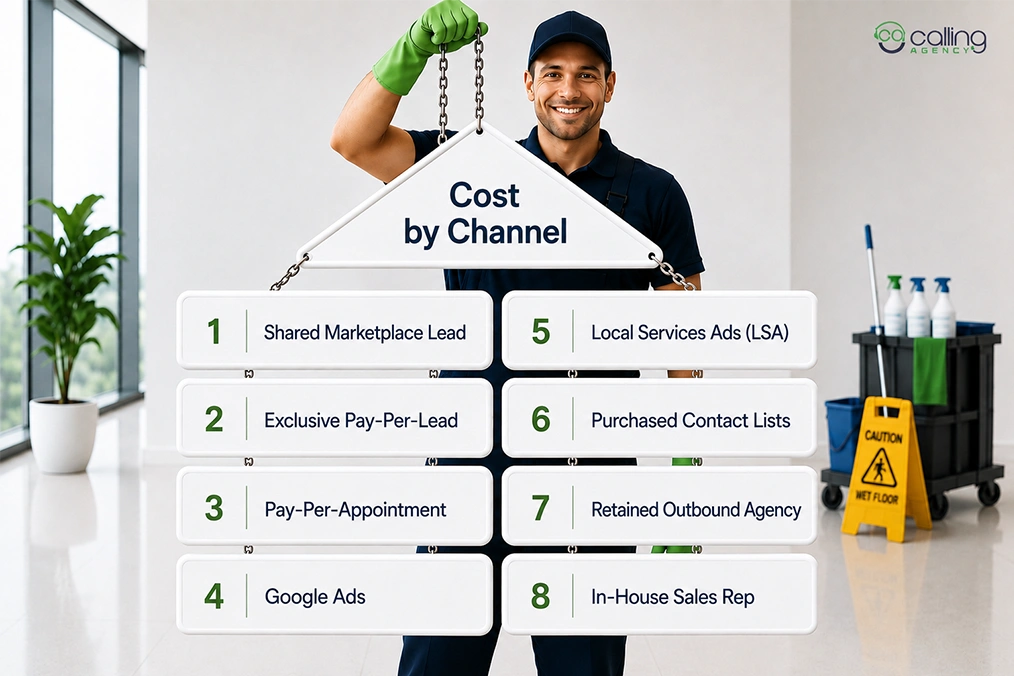
Quick Cost Comparison Table
| Buying Model | Typical Cost | Best For |
| Shared marketplace lead | $15–$50/lead | Filling capacity gaps fast |
| Exclusive pay-per-lead | $50–$150/lead | Reducing competitor overlap |
| Pay-per-appointment | $100–$300/booked appointment | Sales teams wanting qualified meetings |
| Google Ads | $60–$200/lead | High-intent search demand |
| Local Services Ads (LSA) | $5–$50/lead | Lowest-cost paid volume |
| Purchased contact lists | $50–$500/month | Building your own outreach list |
| Retained outbound agency | $3,000–$10,000/month | Predictable monthly pipeline |
| In-house sales rep | ~$50K base, $80K+ total comp/year | Long-term, owned pipeline |
Shared Marketplace Lead
Pay-per-lead platforms such as Service Direct sell shared, non-exclusive leads at $15–$50 each, with the same lead routed to 5–15 competing vendors simultaneously.
- Cheapest entry point per lead
- Requires fast callback speed (within 5 minutes) to compete.
- Slow response or a typical 5–10% close rate can push effective acquisition cost to $1,000–$3,000 per customer.
Exclusive Pay-Per-Lead
Exclusive commercial cleaning leads usually cost $50–$150 per lead depending on quality and exclusivity, and are not resold to competitors.
- Higher price than shared leads but stronger conversion.
- Regional providers price exclusive inbound leads around $54.99 each with no long-term contract.
Pay-Per-Appointment
Some vendors price by booked walkthrough rather than raw lead, offering pre-qualified meetings with verified decision-makers that can convert 40–50%.
- You only pay when a real meeting is confirmed
- Missed or unqualified walkthroughs are typically rescheduled or replaced by the vendor
Google Ads
Commercial or janitorial search leads cost an estimated $60 to $200, with clicks running $8 to $25 depending on market and landing page quality.
- Conversion rates average 10–15% click-to-lead on well-optimized campaigns.
- Best for businesses actively searching “commercial cleaning near me”
Local Services Ads (LSA)
LSA for cleaning runs on the Google Guaranteed program at $5 to $50 per lead with strong volume potential.
- Real tracked costs have gone as low as $9 per cleaner lead in some markets.
- You pay per qualified contact, not per click and can dispute invalid leads.
Purchased Contact Lists
Database-style lead plans typically cost $60–$500 with ongoing subscription terms, offering searchable business contacts instead of pre-qualified leads.
- Contacts are not verified for current interest
- Purchased leads rarely include a stated reason a business fits your service or confirmation that the contact info is current.
Retained Outbound Agency
Done-for-you outbound agencies typically charge $3,000–$10,000 a month with longer minimum commitments.
- Handles cold calling, email outreach and appointment setting
- Works best for operators with a $5K–$10K/month committed marketing budget
In-House Sales Rep
A Commercial Janitorial Sales Representative earns a base salary around $50K and total compensation around $80K+ including commission.
- Fixed monthly cost regardless of lead volume
- Highest long-term ROI once the rep builds a full pipeline
What Drives the Price Up or Down?
Lead price mainly depends on exclusivity, market competition and how ready the buyer is to close.
Factors That Raise the Price
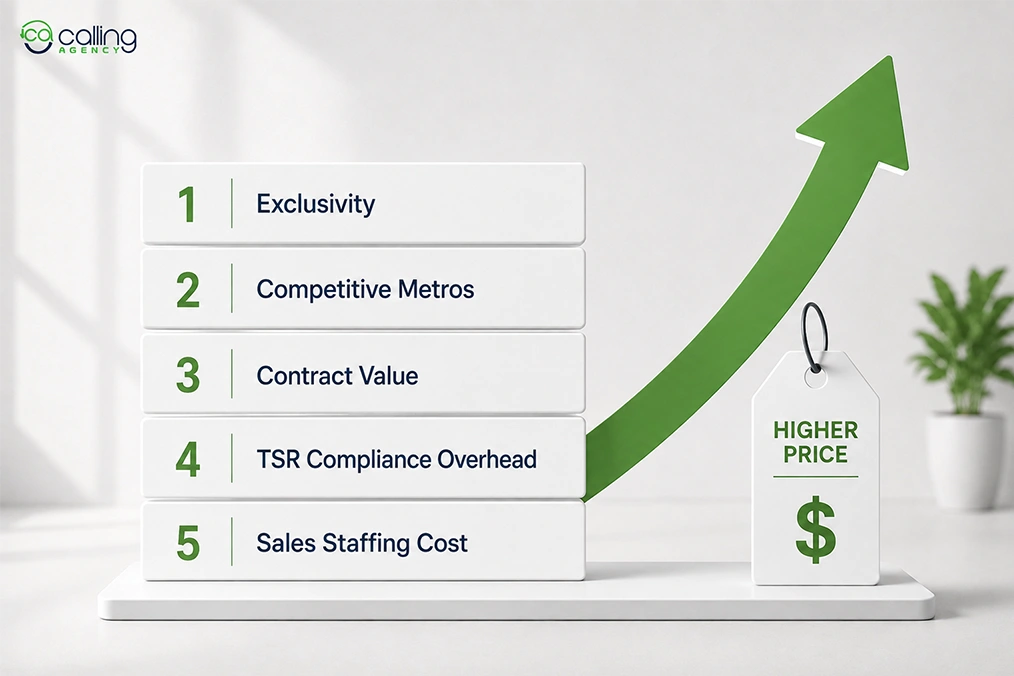
- Exclusivity: Exclusive pre-qualified walkthroughs cost more than shared leads but convert at 40–50%.
- Competitive metros: Costs run higher in competitive metro areas and lower in smaller markets.
- Contract value: A $5,000/year contract justifies paying $100 per lead.
- TSR compliance overhead: Sellers buying telemarketed leads must verify the generator followed FTC rules, adding vendor-vetting cost.
- Sales staffing cost: Median sales rep wages reached $66,780 in 2024, raising in-house acquisition cost.
Factors That Lower the Price
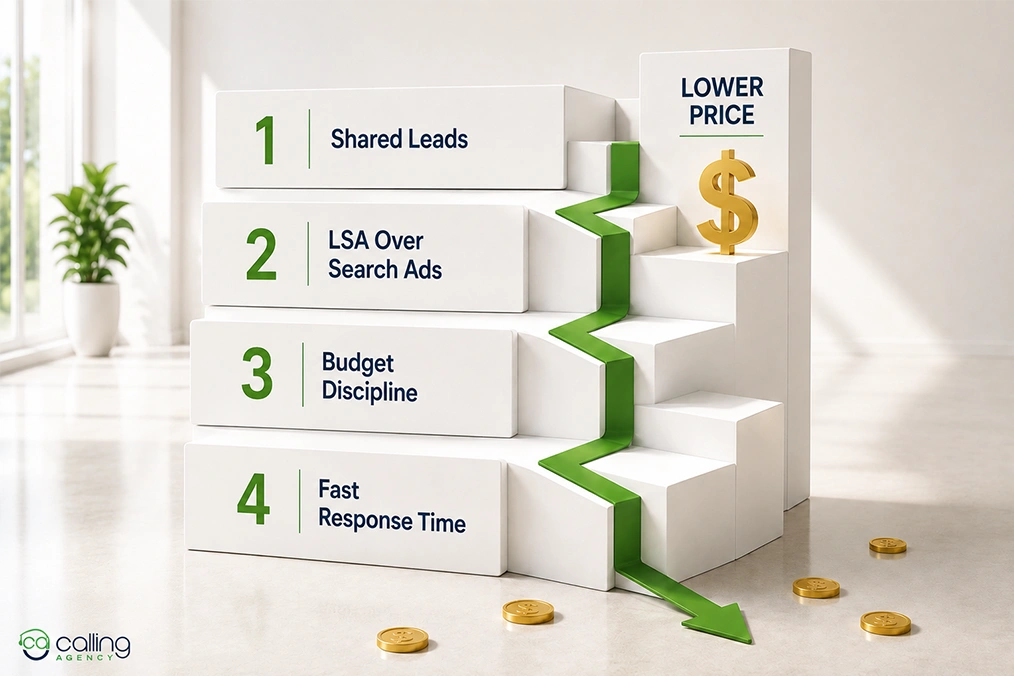
- Shared leads: Non-exclusive leads route to 5–15 vendors splitting cost.
- LSA over Search Ads: LSA CPL runs 30–40% cheaper than Search Ads.
- Budget discipline: SBA notes average businesses spend just 1.08% of revenue on advertising, keeping CPL targets realistic.
- Fast response time: Improves close rate, lowering effective cost per customer.
Cost Per Lead Is the Wrong Number to Optimize
Cost per lead (CPL) hides the real number that matters: cost per customer. A cheap lead that never closes costs more than an expensive lead that converts. If you are unsure how cost per lead is calculated, start there and come back.
The formula is simple: Cost Per Contract = Cost Per Lead ÷ (Lead to Walkthrough Rate × Walkthrough to Close Rate)
But the number alone does not tell you if a channel is actually profitable.
Why CPL Misleads
- Shared leads with slow response or low close rates can push effective acquisition cost to $1,000 to $3,000 per customer even if CPL looks cheap at $15 to $50.
- Bought leads sold to multiple buyers go stale fast and carry high bounce rates, while generating your own leads is often 80 to 95% cheaper per customer.
- ROI depends on contract value. Paying $100 per lead and $500 per customer is worthwhile when the contract is worth $5,000 a year.
- SBA guidance says businesses should compare marketing costs to the revenue generated, not the initial spend, to judge ROI.
Compare CPL vs. Real Cost Per Customer
| Metric | What It Shows | Why It Misleads |
| Cost per lead | Upfront spend per contact | Ignores close rate |
| Close rate | Percent of leads that become customers | Varies wildly by exclusivity |
| Cost per customer | True acquisition cost | The number to actually track |
| Contract value | Revenue per closed deal | Determines if CPL was worth paying |
Track cost per customer, not CPL, to judge any channel fairly. That gap is not caused by the price on the invoice. It is caused by the conversion rate underneath it, which is why customer acquisition cost beats cost per lead as a planning metric.
Track your own B2B lead conversion rates for two full quarters before you judge any channel on price.
Shared Leads vs Exclusive Walkthroughs
Shared leads cost less upfront but convert poorly because multiple companies chase the same contact. Exclusive commercial cleaning appointments cost more per unit but close at a much higher rate, making them the stronger buy for most commercial cleaning companies.
| Factor | Shared Leads | Exclusive Walkthroughs |
| Cost per unit | $15 to $50 per lead, routed to 5 to 15 competing vendors at once | $100 to $300 per booked walkthrough, sold only to you |
| Close rate | Typically 5 to 10% when response is slow | Up to 40 to 50% with pre-qualified, verified decision-makers |
| Competition | Same contact sold to multiple companies at once | Never resold, no competing bids |
| Speed needed | Must call within minutes to win the deal | No race against competitors after booking |
| Effective cost per customer | Can reach $1,000 to $3,000 once slow response and low close rates are factored in | Lower overall despite the higher per-unit price, due to stronger conversion |
| Qualification | Minimal, often just a name and a contact route | Verified for facility size, service scope, signing authority and contract end date |
| Vendor accountability | Rarely replaced if the lead is bad | Missed or unqualified walkthroughs get rescheduled or replaced |
| Compliance exposure | Higher, since the same contact is called by several vendors | Sellers buying telemarketed leads must confirm the generator followed FTC consent and Do Not Call rules, and exclusive vendors carry fewer overlapping calls to audit |
| Budget fit | Fits businesses testing a channel within the SBA’s benchmark of 1.08% of revenue on advertising | Fits businesses ready to commit a larger, predictable monthly spend |
How to Set Your Lead Generation Budget?
Set your lead generation budget as a percentage of revenue, then split it across channels based on close rate, not just cost per lead.
Start With a Revenue Percentage
- The SBA reports the average business spends about 1.08% of revenue on advertising, with variation by industry.
- The SBA recommends allocating 7 to 8% of gross revenue to marketing for businesses under $5 million in annual sales, with 10 to 20% of that going to paid advertising.
Budget Split by Channel Type
| Budget Tier | Monthly Spend | Best Channel Mix |
| Testing | $500 to $1,500 | LSA plus a few exclusive leads |
| Growth | $1,500 to $5,000 | LSA, Google Ads, exclusive pay-per-lead |
| Scale | $5,000 to $10,000+ | Retained agency plus in-house rep |
Step-by-Step Process
- Multiply annual revenue by 7 to 8% to get your total yearly marketing budget.
- Set aside 10 to 20% of that total for paid lead generation.
- Divide the yearly lead generation budget into monthly spend, keeping 1 to 2 months as reserve.
- Set a maximum cost per customer using contract value as the anchor, since paying $100 per lead makes sense when a contract is worth $5,000 a year.
- Pick a starting channel mix that matches your budget tier.
- Track cost per customer, not cost per lead, for each channel monthly.
- Compare marketing cost to revenue generated to confirm a positive return, then shift spend toward the channel with the lowest true acquisition cost.
Conclusion
From $5 per Local Services Ads lead to $10,000 a month for a retained agency, the cost to generate commercial cleaning leads is all over the place. There is no one right price. Which channel is best depends on your budget, how much you close, and your average contract value. Shared leads work when looking to fill gaps in capacity; exclusive leads and appointments are for companies who are willing to invest in quality over price, and in-house reps pay dividends in the long term.
Rather than hunting down the lowest CPAs, assess the cost per customer from every channel you experiment with. Which channel really drives your business, not just which channel is lowest cost on paper.
Frequently Asked Questions
Is commercial cleaning lead generation worth the cost?
Yes, when contract value justifies the spend. Paying $100 per lead and $500 per customer is worthwhile if a new contract is worth $5,000 a year. Track close rate, not just cost per lead.
What is a good cost per lead for a cleaning company?
LSA leads for cleaning run $5 to $30, the cheapest paid option. Exclusive leads cost $50 to $150. A good CPL depends on your close rate and average contract value, not a fixed number.
How much should a small cleaning company spend per month?
According to the SBA, averages suggest a marketing budget anywhere from 7–8% of gross revenue, with 10–20% of that on paid advertising. Small operators generally begin at $500 to $1,500 per month.
Is buying janitorial leads cheaper than hiring a salesperson?
Yes. A sales rep, for instance, is a fixed cost because they’re paid a median $66,780 per year in wages, independent of whether or not leads were closed. Purchased leads perform better or worse, but tend to be more expensive per acquired customer over time.