



The sales cycles in IT, however, seldom stall because buyers lose interest. They get stuck for familiar reasons: opaque decision-makers, missing compliance paperwork, open-ended pilots, slow legal review. In most B2B sales, this isn’t a sign of a broken sales process. It’s a sign of friction building up in the buying process itself.
The majority of IT and SaaS deals close over 3 to 6 months, as enterprise deals can often go over a year. That delay isn’t random. If you do not do the proper foundational work upfront, every stage, from discovery to signing a contract, can stall due to risk issues, and sales cycle time stretches out with it.
In this guide, learn exactly where IT deals stall, and how to speed up the process: through improved qualification, accelerated technical validation, compliance docs ready in advance, and a streamlined process for contracting. A strong IT lead generation strategy also helps keep the pipeline filled with qualified prospects while longer sales cycles run their course.
Rather than pushing buyers toward quicker decisions, the objective is to eradicate the friction that impedes them from the very beginning and to protect pipeline velocity at every stage.
Why Do IT Sales Cycles Run Long?
IT sales cycles drag on due to enterprise buyers needing consensus from multiple decision-makers, adhering to strict budgetary approvals and undertaking formal technical evaluations that place a high-risk burden on vendors. Understanding buyer behavior at each stage is the first step to fixing it.
Key Reasons why IT Sales Cycle Takes Longer than Average:
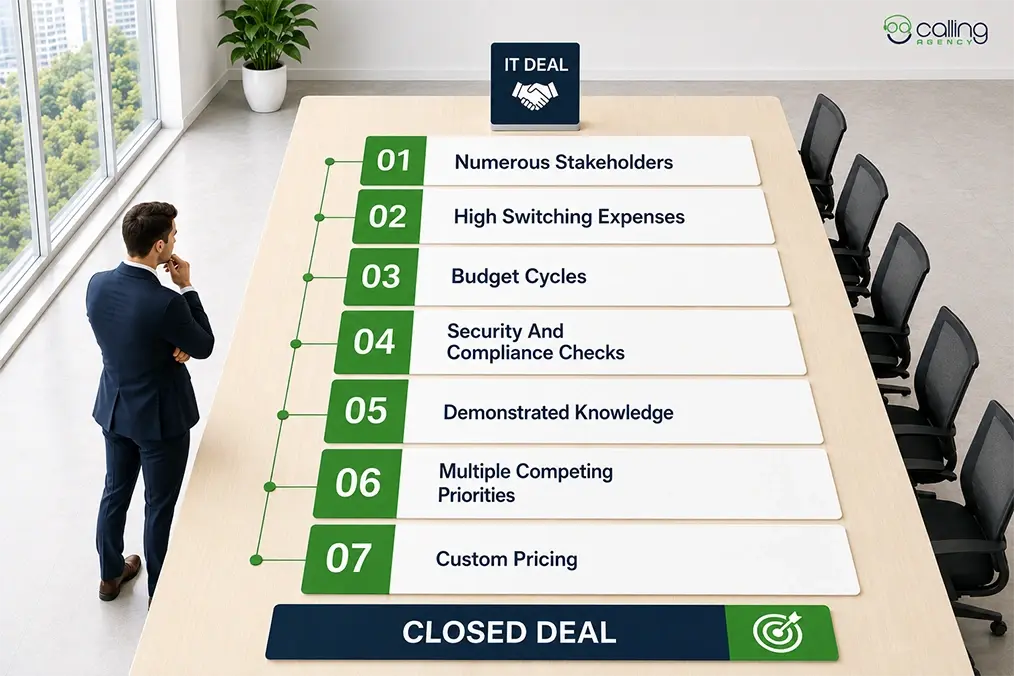
- Numerous stakeholders: IT purchases typically require sign-off from CIOs, procurement, finance and end-users. It adds one review step per person.
- High switching expenses: With new software or infrastructure, you will have to do extensive integration work, train staff and risk data migration. Potential buyers proceed with caution to avert expensive traps.
- Budget cycles: Most companies share IT budgets quarterly or annually. As a result, deals have to wait for the next approval cycle.
- Security and compliance checks: IT vendors usually complete a security audit, legal review, and due diligence for compliance (SOC 2 or GDPR depending on your locality) before signing.
- Demonstrated Knowledge: Buyers want a demo, pilot test or proof-of-concept before they let any new system into the core of critical operations.
- Multiple competing priorities: IT teams are busy with daily maintenance work as well as evaluating new tools, which leads to high response times.
- Custom pricing: Enterprise deals usually encompass more details, and contract terms need some extra rounds of negotiations before finalization.
Because of these layers, a new managed services provider often needs a structured lead-nurturing process to keep prospects engaged throughout the full decision process rather than losing momentum. MSP lead generation strategy can also help create a more predictable flow of qualified prospects.
IT Sales Cycle Length Varies By Segment
IT sales cycle length changes based on company size, deal complexity and buyer type. Here’s a segment-by-segment breakdown.
| Segment | Typical Sales Cycle | Main Reason |
| SMB (small business) | 2–4 weeks | Fewer decision-makers, faster budget approval |
| Mid-market | 1–3 months | Needs IT manager and finance sign-off, basic vendor checks |
| Enterprise | 6–12 months | Multiple stakeholders, legal review, security audits, pilot tests |
| Government/Public sector | 6 months–1+ year | RFPs, procurement rules, compliance requirements |
| MSP (managed services) | 1–3 months | Buyers want proof of reliability before switching providers |
| Startups | 1–2 months | Fast decisions, but budget constraints can cause delays |
| Healthcare/Finance (regulated industries) | 4–9 months | Extra compliance checks (HIPAA, SOC 2, etc.) slow approval |
Deal size, industry regulation and number of approvers are the biggest factors driving cycle length differences across segments.
The IT Sales Cycle: Five Phases Where Deals Stall
IT deals stall at five predictable points. Knowing where helps sales teams fix bottlenecks before they kill a deal. Regular pipeline reviews make these stall points visible before they turn into lost deals.
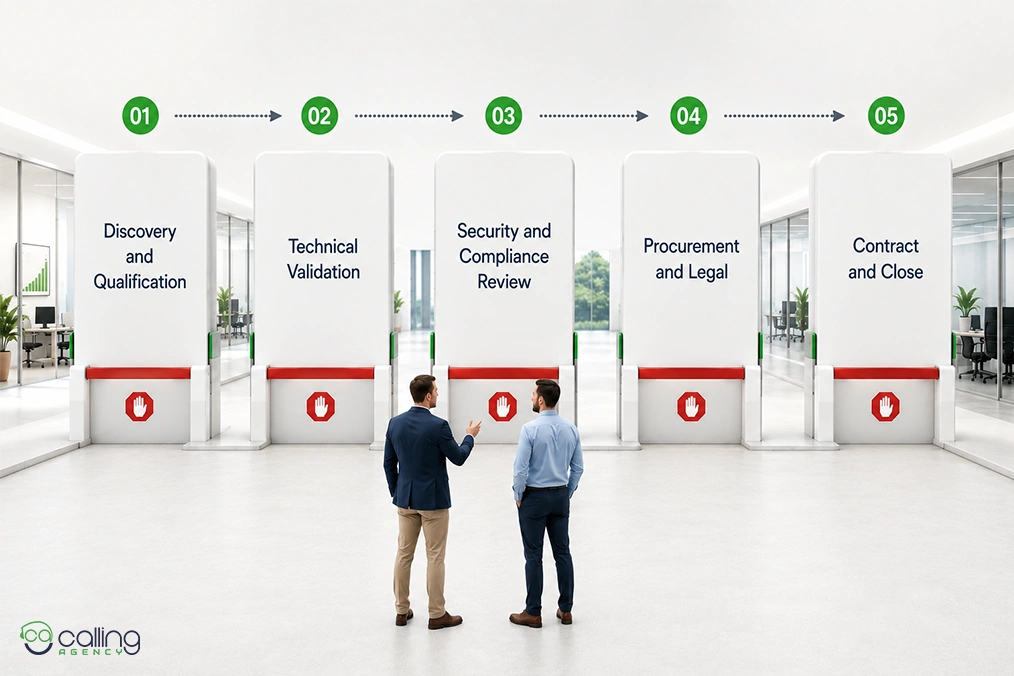
1. Discovery and Qualification
Deals stall when the buyer isn’t a real decision-maker or budget isn’t confirmed. Sales reps waste weeks pitching to people who can’t approve the purchase.
Fix: confirm budget, authority and timeline early.
2. Technical Validation
Demos and pilots stall when integration issues surface or testing drags without an end date. IT teams need extra time to test performance under real conditions.
Fix: set a testing checklist with a fixed deadline.
3. Security and Compliance Review
Regulated buyers need audits like SOC 2 or HIPAA before approving anything. Missing documentation causes major delays here.
Fix: keep certifications and paperwork ready in advance.
4. Procurement and Legal
Contracts stall over pricing terms, liability clauses and unclear SLAs. Multiple redline rounds slow negotiation down.
Fix: use standardized contract templates to cut back-and-forth.
5. Contract and Close
Deals stall waiting on final signatures from executives or procurement. Budget freezes near quarter-end add delay.
Fix: identify the final signer early and confirm availability.
Who Sits On The IT Buying Committee?
IT purchases rarely involve one person. Most deals need approval from 5 to 8 stakeholders, each checking the decision from a different angle.
Deep committees are standard in technology buying. More than 79% of B2B technology purchases reportedly involve 6 to 10 decision-makers.
| Role | What They Check | Main Concern |
| CIO/IT Director | Overall strategy fit | Does this align with long-term IT roadmap? |
| IT Manager/Sys Admin | Technical performance | Will it integrate with current systems? |
| CFO/Finance | Budget and ROI | Is the cost justified and within budget? |
| Procurement Officer | Vendor terms | Are pricing and contract terms competitive? |
| Legal/Compliance | Risk and regulation | Does it meet data privacy and compliance rules? |
| Security Officer (CISO) | Data protection | Are there security vulnerabilities or risks? |
| End Users/Department Heads | Daily usability | Will the team actually use this tool well? |
| CEO/Executive Sponsor | Final approval | Does this support business goals overall? |
Each stakeholder can slow or stop a deal if their concerns aren’t addressed early. A clear value proposition tailored to each role. Booking meetings with the full committee at once rather than pitching one person at a time helps sales teams achieve faster alignment and avoid last-minute objections.
The Security And Compliance Review Is A Distinct Phase
The security and compliance review is a distinct stage in the IT sales cycle that requires its own team, documents and approval from a decision-maker before any deal can run.
This phase verifies how the vendor manages data and meets regulatory requirements. It runs insulated from technical or financial scrutiny, frequently concurrently with procurement.
What buyers typically ask for:
- SOC 2 or ISO 27001 certificate
- Evidence for data privacy compliance like GDPR/HIPAA
- Vendor security questionnaires
- Information regarding data storage and encryption as well as access control
- Incident response and breach history
The lack of existing documentation really hampers vendors here. This is why cyber vendors targeting enterprise or regulated industries need pre-approved compliance packages in hand before outreach even starts.
Proof-of-Concept And Pilot Cycles Stall In Evaluation
Without a clear vision of where to go or consensus on who owns the decision once testing is over, proof-of-concept and pilot programs languish.
When buyers decide to keep piling new test scenarios on and leave pilots without a fixed end date, many tend to drag on indefinitely. IT teams juggle pilots with business as usual, so urgent issues lead to a knee-jerk action of deprioritizing testing.
Common reasons pilots stall:
- No clear success criteria: Teams begin testing with no common definition of what a pass means.
- Runs indefinitely: No (planned) finish date was set for pilots from the start.
- Distributed stakeholder testing: Different teams conduct independent tests rather than jointly evaluating results.
- No scheduled review: Results are left on the shelf because nobody decided on a date to talk about them.
- Adding things during pilot: New features or use cases created as realignment items mid-pilot after testing started.
Discussing clear metrics and a firm deadline before the pilot starts prevents evaluations from creeping into an indefinite trial.
How Do You Shorten An IT Sales Cycle?
Shortening an IT sales cycle means removing delays before they happen instead of pushing buyers to decide faster. Most delays come from missing information, not slow buyers. The goal is consistently higher sales velocity across the entire pipeline.
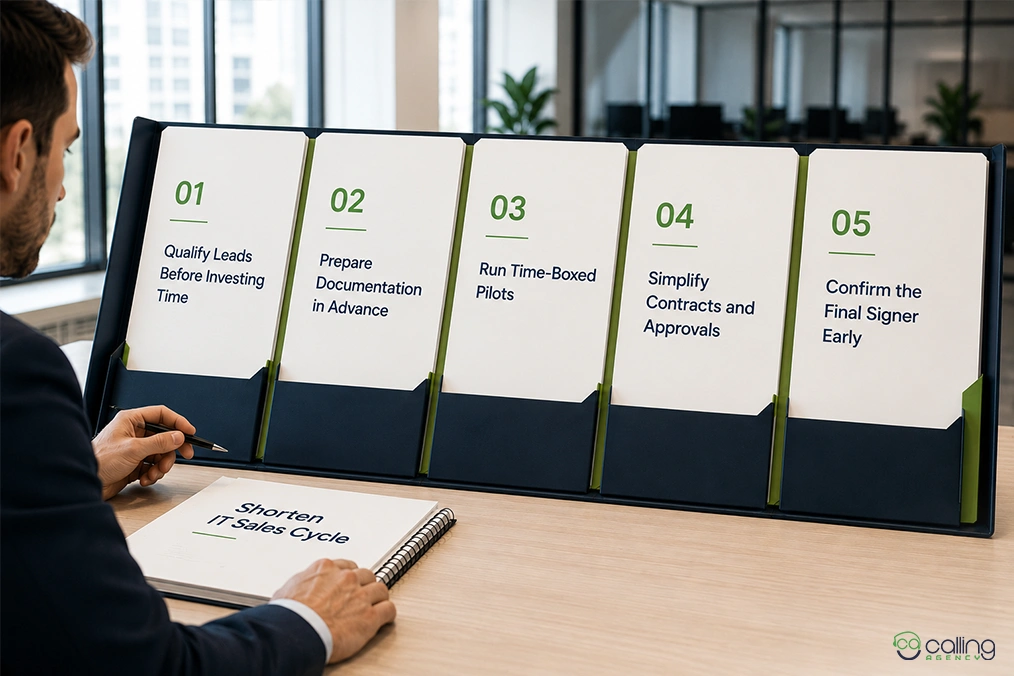
Qualify Leads Before Investing Time
Talking to the wrong person wastes weeks. Confirm budget, authority, need and timeline before building a full pitch.
- Ask about budget and approval process on the first call
- Identify the actual decision-maker early, not just the first contact
- Skip prospects who can’t commit to a timeline
Strong lead generation practices filter out unqualified leads before they ever reach a sales rep, which keeps the pipeline focused on sales-qualified meetings rather than early-stage guesswork.
Prepare Documentation in Advance
Vendors who wait until asked for security or compliance proof lose weeks. Have documents ready before outreach starts.
- Keep SOC 2, ISO 27001 or HIPAA reports on hand
- Pre-fill common security questionnaires
- Assign one contact to handle compliance questions quickly
Run Time-Boxed Pilots
Open-ended trials rarely end on their own. Set clear limits before testing begins.
- Define success metrics before the pilot starts
- Set a fixed end date, not an open trial
- Schedule the results review meeting in advance
Simplify Contracts and Approvals
Custom contracts create endless negotiation rounds. Standard terms move faster.
- Offer pre-approved contract templates
- Define SLAs (service-level agreements) clearly upfront
- Involve legal teams early instead of at the final stage
Confirm the Final Signer Early
Deals often stall right before closing due to unclear sign-off authority.
- Identify who actually signs the contract early on
- Avoid pushing deals into quarter-end budget freezes
- Set a clear signing deadline in the proposal
| Bottleneck | Fix |
| Wrong contact | Qualify decision-maker early |
| Missing compliance docs | Prepare documentation in advance |
| Open-ended pilots | Set fixed testing deadlines |
| Custom contracts | Use standardized terms |
| Unclear signer | Confirm authority before final stage |
In our appointment scheduling work for a cybersecurity firm, qualifying the right stakeholder before booking meetings cut wasted calls and moved deals through review stages faster, as a direct result of stronger pipeline oversight from first contact to close.
Final Words
Buyers aren’t slow; it’s IT sales cycles that stall. Stages are stalled by lack of information, poorly defined decision-makers and bad documentation. Correcting this begins before a single sales call is made, not after a deal has gone quiet.
Qualify leads correctly, have compliance documents prepared beforehand, run time-boxed pilots, simplify contracts and verify who the final signer is beforehand. Each remedy relieves friction at a stage, not accelerating buyers to accept an offer sooner than they are ready.
So it’s one of those things that you need to understand: another way of shortening the IT sales cycle is not through pressure. This is about eliminating the uncertainty that prevents action. Buyers get what they need at every step of the way, not left chasing answers, resulting in deals closing faster.
Frequently Asked Questions
How long is the average IT sales cycle?
At most, the average IT sales cycle is typically 3 to 6 months, yet it can vary based on deal size, where SMBs may close in just weeks, while enterprise or government deals could take over a year.
Why do enterprise tech deals take so long?
Enterprise deals are never a single-deal signature, but instead require many different people, security audits, legal review and budget approvals. It takes time to add each layer, particularly when compliance checks or bespoke contracts need to be negotiated.
How do you speed up a sales cycle without discounting?
Qualify leads early, prepare compliance documents in advance, set fixed pilot deadlines, and confirm the final signer upfront. Speed comes from removing friction, not lowering price.
What is the MSP sales cycle length?
MSP sales cycles typically run 1 to 3 months. Buyers want proof of reliability and service quality before switching providers, especially for ongoing support contracts.
Why do IT prospects go quiet after a good demo?
Silence usually comes from internal approval delays, competing priorities, budget freezes or unresolved stakeholder issues. That is rarely a sign of disinterest and more often a sign of friction in their internal processes.