

Think about going to a big store. You don’t buy everything you see, but pick what you need. Account targeting works in the same way. Account-Based Marketing helps you pick the right companies or prospects to work with.
In this strategy, you don’t try to sell to everyone but find the best matches first. Then you focus on them. This saves time and money. Your team works smarter, not harder. You talk to companies that really need what you offer.
The results are clear:
- Bigger sales deals
- Happier customers who stay longer
- Better teamwork between sales and marketing
- More money for your company
Account targeting isn’t just a trend but a proven way to grow your business.
What Is Account Targeting in ABM?
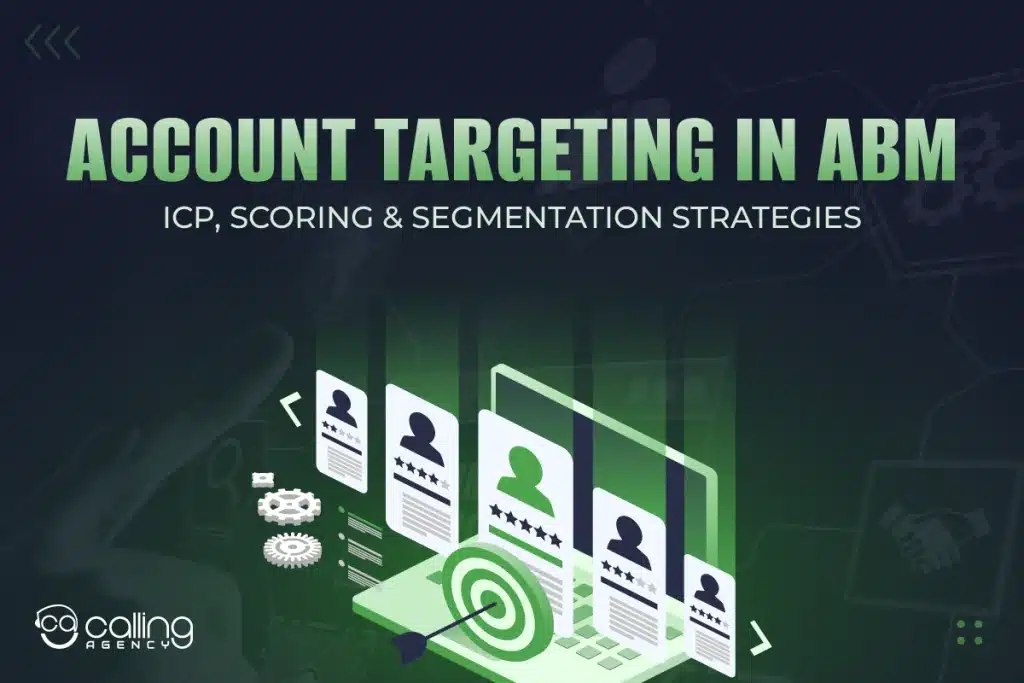
Account targeting means picking specific prospects or an ideal customer profile (ICP) before you start marketing. You choose who you want as customers first. Old marketing sends one message to thousands of people. Account targeting is different, like you pick 50 or 100 perfect companies. Then you make special messages just for them.
Why does this matter?
- Not every company needs your product
- Some are too small
- Some can’t afford it
- Some are in the wrong business
When you target accounts, you focus on companies that:
- Can use your product
- Have money to buy it
- Will benefit from it
- Match what you offer
Regular marketing gets lots of replies, but most go nowhere. Account targeting gets fewer replies, but they come from prospects that want to buy. So quality wins every time.
The Account Targeting Process in ABM
Getting account targeting right takes four main steps. Each step is important because they build on each other. In B2B lead generation, lead quality is most important, so you can’t skip one to move to another.
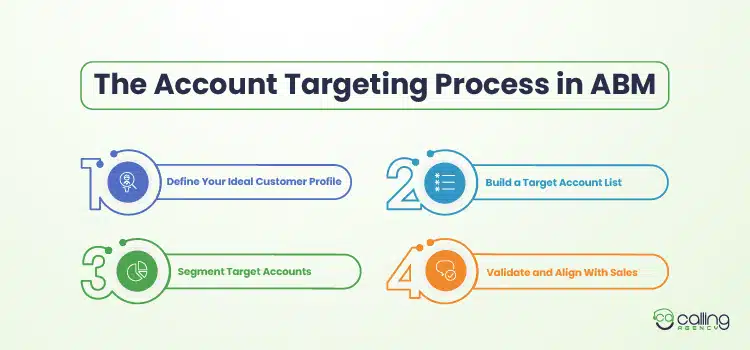
Step 1: Define Your Ideal Customer Profile (ICP)
Your ideal customer profile describes your perfect customer. Not who you wish would buy. But who actually gets the most value?
Look at your best customers now.
- Who pays on time?
- Who stays for years?
- Who tells friends about you?
These customers share things in common:
- Same industry
- Similar company size
- Same problems
- Similar goals
- Use the same tools
Write down these patterns because they help you find more great customers. Your ICP should include basic facts like company size, industry, location, etc. But add more details too. What challenges do they face? What are their goals?
Don’t make your ideal customer profile (ICP) too narrow. If it’s too specific, you will only find a few companies. Keep it focused but realistic.
Step 2: Build a Target Account List (TAL)
Now you know what your ideal customer looks like. Time to find real companies that match. This is your Target Account List.
Start your research using:
- LinkedIn to find matching companies
- Industry directories
- Your sales team’s dream accounts
- Companies that follow your competitors
- Business databases
Quality beats quantity here. A list of 50 perfect companies is better than 500, maybe. Each company should match your ICP closely. Think about timing, too. Some companies have just signed with your competitor.
They are not ready yet. Others are growing fast and might be ready to buy now. Your list isn’t set in stone. Review it every few months and add new accounts. Remove ones that don’t fit anymore.
Step 3: Segment Target Accounts
Not all target accounts are the same. Some are bigger opportunities, and some are ready to buy now. Tiered ABM or segmentation helps you treat each group right.
Most companies use tiers:
Tier 1 Accounts
- Your targeted customers
- Biggest opportunities
- Only 10 to 20 accounts
- Get personal attention
Tier 2 Accounts
- Still great opportunities
- Maybe 50 to 100 accounts
- Get customized attention
- Less personal than Tier 1
Tier 3 Accounts
- Good potential customers
- Hundreds of accounts
- Get automated marketing
- Less personal approach
You can segment in other ways, too:
- By industry
- By company size
- By location
- By buying the stage
- By potential value
Don’t create too many segments. Start with a few and add more only when needed. Account segmentation plays a significant role in reaching your desired prospects.
Step 4: Validate and Align With Sales
Your sales team must believe in your targeting. Get them involved early. Show your Target Account List to sales leaders and then ask what they think. They know things you don’t. They might know which accounts are already talking to competitors.
Make sure sales and marketing agree on what makes a good target. When both teams create the ICP together, everyone owns it. Set up regular meetings. Your sales team learns things about accounts, and marketing teams see patterns. This sharing keeps everyone aligned.
Account Scoring Models in ABM
Account scoring shows which accounts need attention right now. Not every account is ready to buy at once. Think of scoring like a thermometer. It tells you how warm an account is.
Cold Accounts:
- Not engaging with you
- Not visiting your website
- Not opening emails
Warm Accounts:
- Checking your content
- Visiting your website
- Opening some emails
Hot Accounts:
- Downloading pricing guides
- Asking for demos
- Multiple people engaging
You give points for different actions:
- Visit pricing page: 10 points
- Download case study: 5 points
- Attend webinar: 20 points
- Request demo: 30 points
Points add up to give an overall score. Score fit too, not just engagement. An account that perfectly matches your ICP starts with a higher score.
Use scores to take action:
- High scores: Sales calls immediately
- Medium scores: More marketing needed
- Low scores: Different approach or wait
ABM Segmentation Strategies
Account segmentation divides accounts into groups. Each group gets the right treatment.
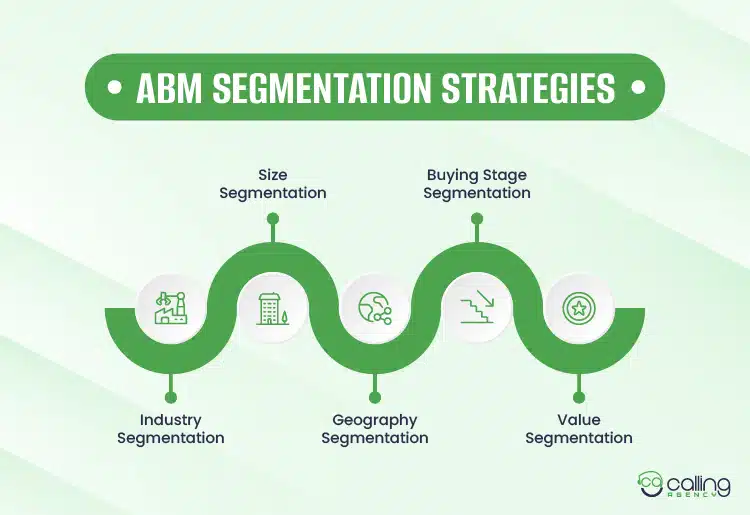
Industry Segmentation
Let’s talk about some examples. Healthcare companies care about patient safety, while manufacturing companies care about efficiency. Now you are supposed to speak to each industry’s concerns because that makes your way easier.
Size Segmentation
Small companies decide fast with few people. Large companies have long approval processes. Match your approach to their size.
Geography Segmentation
Different regions have different rules and cultures. Local knowledge matters. If you approach someone with something that conflicts with their regular manner and culture, then your chance may be reduced.
Buying Stage Segmentation
- Early stage: Need education about problems
- Middle stage: Comparing options
- Late stage: Ready for pricing details
Value Segmentation
Some accounts will become big customers. Others stay small and invest more in bigger opportunities.
Start with just a few segments. Each needs its own strategy and content. Too many segments mean you can not do any well. Even if you have a bigger team, it becomes much difficult.
Aligning Targeting, Scoring, and Segmentation
Targeting, account or lead scoring, and segmentation, these three things work together. You need all three to succeed.
Here is how it flows:
- Identify target accounts using your ICP
- Segment them into tiers and industries
- Use scoring to find hot opportunities in each segment
This alignment helps you know where to focus time and budget. No more spreading yourself thin.
Review regularly:
- Monthly: Check scores and segments
- Quarterly: Review entire Target Account List
Update as things change, and the best companies treat targeting, scoring, and segmentation as one system, not separate activities.
Tools and Platforms for Account Targeting
Advanced tools for account-based marketing campaigns make account targeting easier because the right technology helps you work faster and smarter.
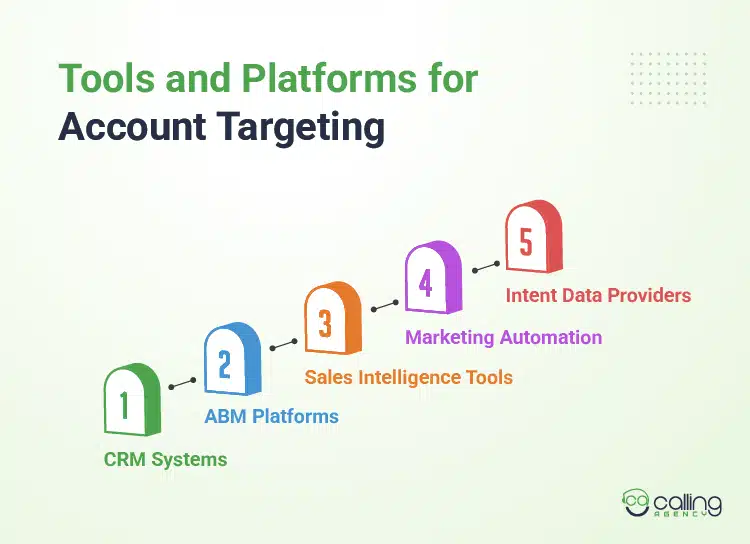
CRM Systems
Salesforce and similar tools hold all account data. They track every interaction. When sales and marketing use the same CRM, everyone sees the same information.
ABM Platforms
Tools like Demandbase, 6sense, and Terminus are built for account-based marketing.
They help you:
- Identify target accounts
- Track engagement
- Run campaigns across channels
- See when multiple people from one company visit your site
Sales Intelligence Tools
ZoomInfo and LinkedIn Sales Navigator help you:
- Find accounts matching your ICP
- Get contact information
- Learn about company details
- See recent company news
Marketing Automation
Marketo and HubSpot let you:
- Create campaigns for specific accounts
- Track engagement
- Score accounts automatically
- Get alerts when important things happen
Intent Data Providers
Bombora and G2 show which accounts are researching topics related to your product right now. The best approach connects all tools together. Your ABM platform talks to your CRM, and your CRM talks to marketing automation. Everything shares data.
You don’t need every tool on day one. Start with a good CRM and sales intelligence tool, and then add more as you grow.
Why Account Targeting Is Crucial in ABM?
Account targeting makes ABM work. Without it, you are just doing regular marketing with a new name.
Benefits of Good Targeting
Account targeting helps with focus. Your team can only do so many things well. Targeting gives permission to ignore everything else. Focus on what matters.
- Marketing messages hit home
- Sales conversations go better
- Deal cycles get shorter
- Win rates go up
- Deal sizes get bigger
- Customer acquisition costs less
Most importantly, targeting aligns your whole company. Sales, marketing, and customer success work toward the same goal. So you face no more fighting about bad leads.
Companies winning with ABM take targeting seriously:
- They invest time building their ICP
- They are thoughtful about which accounts make the list
- They segment carefully
- They score consistently
Get targeting right, and everything else falls into place. If you get it wrong, you will struggle with every campaign.
Ongoing Account Targeting Discipline
Account targeting is the foundation of ABM. Everything else builds on this.
Start with These Steps
- Build a clear Ideal Customer Profile based on your actual best customers.
- Create a focused Target Account List of companies that truly fit.
- Segment those accounts appropriately.
- Score them to know who needs attention now.
- Make sure sales and marketing align on everything.
The process takes work up front. But it pays off quickly:
- Stop wasting time on the wrong accounts
- Close more deals with the right accounts
- Make your sales team happy
- Improve your bottom line
Account targeting is not a one-time project. Markets change with time, and your company evolves. So, review your ABM strategy regularly.
What worked last year might not work today:
- Refine your ICP based on new data
- Update your Target Account Lists regularly
- Experiment with different segments
- Measure everything
- Improve over time
The best ABM companies treat targeting as an ongoing discipline. They never stop improving.
- Start simple
- Measure results
- Get better each month
That’s the path to success with account targeting.
Conclusion
Account targeting is the foundation of ABM success. Begin with a simple, focused approach, measure your results, and refine regularly. Over time, this discipline ensures you stop wasting effort on the wrong accounts, win more of the right ones, and build a stronger, more profitable business.