

Paying customers rarely drop out of nowhere. To truly fulfill their growth potential, modern go-to-market teams need to attract the attention of key prospects and effectively nurture their interest long before the deal is ready to close. This process is what we know as Lead Generation.
At its core, lead generation comes down to two essential key steps:
- Getting the right people to your website.
- Turning those visitors into leads by earning their contact information.
With a good lead generation system, your business can gain exposure in the marketplace, attract aligned prospects and guide them towards a purchase while freeing up more time and energy to envision the best version of your business.
There are a multitude of lead generation techniques available, and it may seem simple and easy, but in reality, executing them effectively can be a little difficult. Businesses need a highly operational and well-equipped strategy for lead generation to achieve favorable results.
Read our blog to find out how your business can leverage sales lead generators for maximum growth.
What is Lead? Understanding Prospective Customers
A lead is any person or organization that shows interest in a company’s product or service. This interest could have been depicted in multiple formats, such as downloading a resource, filling out a contact or subscription form, or even signing up for a newsletter or magazine. A detailed breakdown will include:
- Identification – Identify your target audience
- Engagement – This is where individuals will encounter your business, usually through a website or marketing materials and demonstrate interest by providing their contact information.
- Conversion – The aim is to convert these leads into paying customers.
For example, let’s say you took an online survey on how to purchase a property. And a day or two later, you receive a call from the real estate company that created the study. The piece of information that the real estate company collected about you from their survey helped them personalize their initial communication with you.
What is Lead Generation?
Lead generation is the process of attracting consumer interest for a product or service and converting the potential client into a paying customer. The three major components are:
- Identifying and Attracting -This technique uses multiple strategies to reach potential consumers who might be interested in the business’s offers.
- Capturing Information – Once a potential customer shows interest, their contact information is typically collected through the website’s forms or the landing page.
- Nurturing Leads – This is the ongoing communication and engagement with leads to educate them about the product or service, build trust and guide them through the purchasing process.
Lead generation is a lengthy process that will enable you to optimize your sales pipeline and subsidize sustainable growth.
Lead Generation Vs Demand Generation
Lead generation is about capturing contact information from buyers showing purchase intent. It’s deployed to capture primary prospect information. It is then used to qualify leads and serve them engaging, personalized experiences.
Lead generation nurtures leads with value-adding gated content. The goal is to move qualified prospects toward a sales conversation.
Key characteristics of lead generation include:
- Gated content: Captures contact information through forms and premium resources
- Qualification: Filters prospects based on fit and buying signals
- Intent-based: Delivers targeted content to buyers showing clear purchase intent
- Sales-ready: Focuses on conversion and handoff to sales teams
Demand generation is about creating market awareness and interest before buyers are ready to purchase. It’s the work that happens when your audience doesn’t yet know they have a problem or that your solution exists.
Key characteristics of demand generation include:
- Brand awareness: Educates the market on problems worth solving
- Ungated content: Creates category demand through thought leadership without friction
- Problem-focused: Draws attention to problem/solution fit rather than immediate conversion
- Broad reach: Targets a wide audience to expand total addressable market
| Aspect | Demand Generation | Lead Generation |
| Definition | Demand Generation centralizes on creating awareness and interest in a brand or solution across the entire market. | Lead Generation focuses on capturing contact information from interested prospects. |
| Funnel Position | Top-of-Funnel – creating awareness in the market and educating buyers. | Bottom-of-the-funnel– converting interested prospects into sales opportunities. |
| Primary Goal | Creating brand awareness, establishing thought leadership and generating interest. | Collecting qualified contact information for lead nurturing and sales follow-up. |
| Content Types | Educational blog posts, industry reports, podcasts, webinars, social content and ungated resources. | Gated ebooks, demos, free trials, contact forms, pricing pages and consultations. |
| Metrics and Measurement | Measured by metrics like website traffic, content engagement, brand awareness, social mentions and share of voice. | Measured by metrics like number of leads, MQLs, SQLs, conversion rates, cost per lead and lead quality scores. |
| Gate Strategy | This refers to the intentional decision when to require user information versus providing free access to marketing assets. | It remains as a cornerstone of lead generation, focusing on exchanging high-value resources for a prospect’s contact information. |
| Time Horizon | Results compound over time; sustained brand impact typically builds over months or even years. | Can show results in weeks with lead capture, but time-to-revenue varies by sales cycle length, customer readiness, and deal complexity. |
| Best Used When | Entering new markets, launching new products, building category awareness, or differentiating in crowded spaces. | Businesses that have strong brand awareness and need to convert interest into pipeline quickly. |
Successful marketing usually employs a demand-first approach. Demand generation acts as a first step to getting the audience ready, which in turn makes lead generation efforts economical. If there is no demand gen, lead gen is “cold”. That is to say it mostly results in high CPL; if there is no lead gen, demand gen buzzes but cannot generate measurable revenue.
These make clear how demand generation increases brand recognition, whereas lead generation obtains sales-ready leads.
The key to success lies in recognizing that lead generation and demand generation are interconnected and prioritizing one over the other is irrelevant.
The most practical approach to maximize marketing efforts is combining strategies. Businesses must focus on how these two approaches can be used in a pair to create a seamless customer acquisition plan.
What Are The Types Of Leads In Sales And Marketing?
You need to understand the differences between the types of leads so that you will be able to implement the best techniques for expanding your customer base. It is necessary for your sales team to be effective throughout the customer journey to guide them. There are three primary types of leads:
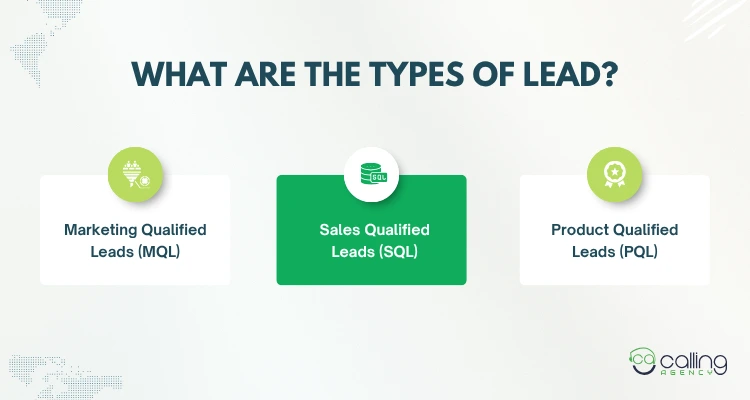
- Marketing Qualified Leads (MQL)
- Sales Qualified Leads (SQL)
- Product Qualified Leads (PQL)
Marketing Qualified Leads (MQL) – Definition and Role in the Funnel
Marketing Qualified Leads (MQL) are leads that the marketing team has presumed more likely to become customers when compared to others. This determination is based on the criteria such as web page visits, downloaded content offers, CTAs and engagement with social media posts.
You need to provide personalized content, use marketing automation for engagement tracking and timely follow-ups, and finally implement solutions that resonate with their needs, ensuring clear communication to convert these leads.
Sales Qualified Leads (SQL) – Identifying Sales-Ready Prospects
Sales-qualified leads are contacts who have taken specific actions that precisely demonstrate their interest in becoming paying customers. You can convert SQLs by reaching out to them via a sales pitch, scheduling a meeting to discuss the products and services you provide that can solve their problems, and conversing with them about the benefits of partnering with your business. SQLs are typically at a more advanced stage in the buyer’s journey, having met the criteria of the consumer.
Product Qualified Leads (PQL) – High-Intent Product-Driven Buyers
A Product Qualified Lead (PQL) is considered more sales-ready. They are the ones who have already used the product or service through a free trial or freemium version and are most likely to convert into paying customers. These behaviors include constant usage or engagement with the premium features.
Detailed Comparison of MQL, SQL, and PQL Across the Buyer Journey
The table below will help you get deeper insights into MQL Vs SQL Vs PQL. In sales and marketing, these terms categorize potential customers (leads) based on their engagement and intent to purchase within the customer journey.
| Parameters | Marketing Qualified Leads (MQL) | Sales Qualified Leads (SQL) | Product Qualified Leads (PQL) |
| Stage in Journey | Awareness/Top-of-funnel | Decision/Bottom-of-funnel | Consideration & Decision (Product-led) |
| Definition | A prospect who has shown interest through marketing efforts (e.g. downloading content) but isn’t ready for direct sales contact. | A prospect vetted by sales as having strong intent and the criteria (budget, need, timeline) to make a purchase. | A prospect who has actively used the product (e.g. free trial) and shown strong buying intent based on usage pattern. |
| Engagement Type | Consuming content/ marketing resources | In a deal-closing conversation | Active product usage and interaction |
| Conversion Rate | Low (leads nurturing) | Moderate | High (often 5x-8x higher than MQLs) |
| Primary Interaction | Marketing teams | Salespeople | IT support and salespeople for upgrades |
Where Lead Quality – Begins ICP, Personas, and Targeting
Lead quality starts with knowing who to target and who to avoid. In this part, we will explain ICPs, buyer personas, no-fit criteria, and proven places to find high-quality leads for your business.
Define Your Ideal Customer Profile (ICP)
An ideal customer profile is a description of a business’s perfect customer based on attributes such as demographics, behavior patterns, needs and pain points. The goal of an ICP is to authorize a business to align its marketing and sales efforts to the kind of customers that have the highest probability to convert.
Developing an ICP is a major activity for any company, no matter the scale. You may not have a huge marketing budget. But with an ICP, the marketing team can be really pinpointed in their work and find the right kind of content that is most appealing to target customers.
For a sales team, an ICP is a tool that aids in the identification and qualification of leads during sales prospecting. If sales reps clearly grasp the traits of the ideal customer, they can expedite their work by instantly discounting the leads that do not match the profile.
Defining Buyer Personas with Roles, Needs, and Motivations
A Buyer Persona is an imagined profile of your perfect customer, made from market research and actual data about people who have purchased from you previously.
Differentiating your ICP, which is the characteristic profile of the company that you target and a buyer persona, which is the characteristic profile of the person or people you are targeting within a company, is very important.
Both are outcomes of the research that you do periodically, which may include market trends, present customer demographics and behavioral data. One of the reasons behind a buyer persona development is to deeply understand the customer’s needs, wants and motivation.
Set “No-Fit” Criteria
Setting the “No-Fit” Criteria, which is also called negative personas or exclusionary targeting, plays a major role in filtering out the unqualified leads. It lowers the customer acquisition cost (CAC) and prevents the sales team from throwing their time away on deals that will never be closed.
A clearly defined “No-Fit” profile refines marketing return on investment (ROI) and secured continued customer satisfaction.
Here are the “No-Fit” criteria for ICP, Personas and Targeting
- “No-Fit” ICP criteria (Company)
- Company size/maturity
- Unsuitable industries
- Technographic mismatch
- Financial health
- Geographic limitations
- No-Fit Persona criteria
- The “Price-Only” buyer
- Non-decision makers
- High-support seekers
- Mismatch in expectations
- Low-engagement individuals
- No-Fit Targeting/ Operational criteria
- Job titles (Exclusionary)
- Website behavior
- Form field triggers
- Inactive/churned profiles
A Planned Approach to Finding and Analyzing Lead Sources
There is no universal answer to “Where to find leads?”.
Finding leads involves combining organic relationship building with use of cutting-edge artificial intelligence powered-tools and targeted paid strategies. If you want to know where to find leads, start understanding where quality leads can come from.
The best approach for B2B lead generation involves a mix of tactics. Consider your target audience, budget, time constraints and experiment to find the combination that works best for your business.
Let’s explore the most powerful ways and various lead sources where you can find high-quality leads.
- Use social media platforms
- Implement content marketing
- Use email outreach and marketing
- Optimize your website for lead capture
- Engage in networking events and trade shows
- Implement referral programs
- Use PPC Advertising
- Leverage LinkedIn Sales Navigator
What is a Lead Generation Funnel?
A lead generation funnel is a strategic framework that guides chaperons customers (leads) from initial awareness of a product or service to converting them into paying customers. The funnel should be parallel with the marketing team’s growth tactics. There are five primary stages of the lead generation funnel: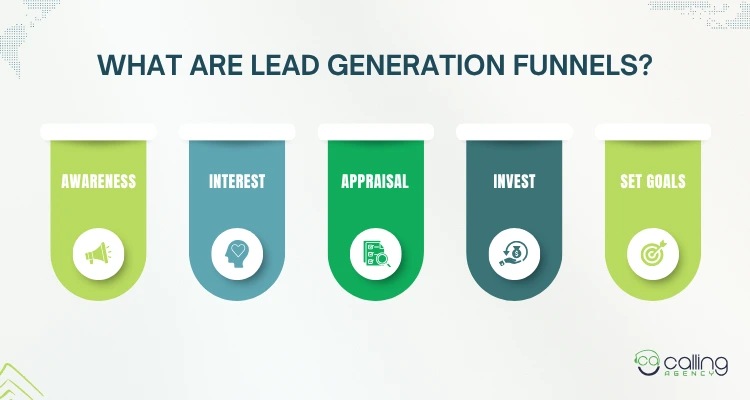
- Awareness
- Interest
- Appraisal
- Confirmation
- Conversion
What are the Types of Lead Generation Funnels?
Lead generation funnels are usually depicted by their framework and the number of leads they generate. This allows them to articulate and nurture leads before giving them on to the sales team. The most popular types of lead generation funnels are top-of-funnel (TOFU), middle-of-funnel (MOFU) and bottom-of-funnel (BOFU) frameworks.
Top-of-Funnel (TOFU) – Awareness-Driven Lead Generation
TOFU refers to content created for marketing actions at the initial stage of the consumer’s journey with the company. The principal intent of this stage is to create apprehension and generate enthusiasm in your offer. This includes content marketing, social media outreach, search engine optimization (SEO), paid advertising, and influencer marketing.
This approach is essential for establishing your brand awareness, generating leads, engaging with your audience, educating the market, differentiating your brand, building trust, and driving long-term growth.
Middle-of-Funnel MOFU – Lead Nurturing and Consideration
This phase is where existing consumers have moved beyond the initial alertness stage and are now earnestly considering your service or product. The main focus of MOFU is to provide worthwhile content that helps potential customers understand their pain points, establish the brand as trustworthy and reliable, and segment leads based on their interests, behavior, and preferences. The role of MOFU content aids in leading the journey from understanding the problem to exploring potential solutions.
Bottom-of-Funnel (BOFU) – Conversion and Revenue Generation
The term “bottom-of-funnel” (BOFU) refers to the final stage of a customer’s journey, where the viable customer has already been through the two previous stages of Tofu and MOFU and is now ready to make a purchase. BOFU is the final push needed to turn interested prospects into satisfied customers. This is where the marketing efforts convert to sales and revenue.
Best Calls-To-Action (CTA) By Funnel Stage
A high-converting Call-to-Action will have to be very closely related to the exact user intent at each stage of the funnel. A full funnel strategy generally leads to 45% higher returns than ones targeted at just a single stage.
CTAs are statements that take the form of buttons and links that instruct a user to go along a particular route and take a certain action.
Ads that are appealing to clicks start with a powerful CTA. Nevertheless, it is not the case that all the CTAs are suitable for each campaign. The funnel stage campaign targets determines the best CTA to use.
The sales funnel is a major factor in the decision of which CTA is the most suitable.
TOFU: Awareness Stage
At this stage, users are researching a problem and are not yet ready for a sales pitch. CTAs should be low-commitment, educational, and value-driven.
Example
- Find inspiration
- Discover
- Explore
- Investigate
- Research
- Get the free guide
- Read the report
- How to …
- Download the free guide
- Subscribe now
- Search now
MOFU: Consideration Stage
Prospects have identified their problem and are evaluating potential solutions. CTAs at this stage should highlight your unique selling proposition (USP) and build trust through deeper engagement.
Example
- Take the quiz (or survey)
- Reserve your seat
- Save your spot
- Download the case study
- Start the free course
- See our products
- See deals
- Join us
- Read reviews
- Get your free e-book
- Calculate your savings
- Follow us
BOFU: Decision Stage
Users are ready to commit and need a final push. CTAs here must be clear, create urgency, and focus on direct conversion.
Example
- Schedule a free consultation
- Get a free demo
- Get a quote
- Take a tour
- Start your free trial
- Get X% off your first month
- Join for free
- Compare pricing plans
- No obligation to try
- Request yours today
- Add to cart — save X%
- Shop the look
- Upgrade now
Best Practices for Calls-to-Action
- Keep it clear
- Match intent
- Create urgency
- Use design cues
- Test often
What Are the Types of Lead Generation Channels?
Lead generation is divided into inbound and outbound approaches. Understanding these types of lead generation channels is fundamental for constructing efficient marketing strategies.
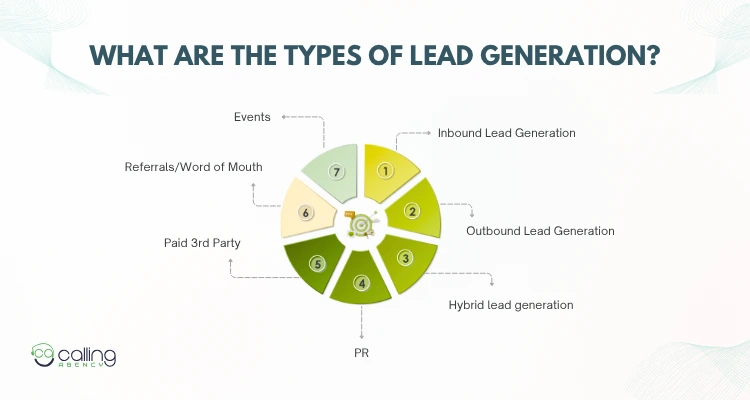
Attracting Leads Through Value with Inbound Lead Generation
Inbound lead generation captures possible customers by offering relevant and tailored content to their preferences. Businesses convert leads via calls, landing pages and lead capture forms by conveying the pain points and interests. This initiative ensures sustainable and cost-effective methods for acquiring qualified leads and nurturing them into loyal customers.
- Content Marketing: Content Marketing is making informative blogs, articles, and intriguing social media content to establish your brand in your industry.
- Search Engine Optimization (SEO): Using SEO boosts your content to rank higher on search engine result pages, making it more visible and engaging to potential consumers.
- Social Media Marketing: Social media platforms like Facebook, Instagram, LinkedIn and more will enable businesses to connect with their niche on a personal level, while developing brand loyalty and trust.
- Paid Advertising: Paid Advertising targets traffic to substantial content and offers, which helps in converting visitors into leads.
- Website Forms: These forms include contact forms, registration forms, newsletter sign-ups and subscription sign-ups. This initiative enables the company to capture leads and nurture them through the sales funnel.
- Lead Magnets: Lead magnets pull interested buyers with enticing offers. Lead magnets typically take the form of a free asset or a special offer in exchange for the recipient’s email address or other contact details. An influential lead magnet will encourage consumers to engage with the business.
- Landing Pages: Landing pages motivate website visitors to become leads by offering something valuable in exchange for their contact details. They are crafted to be targeted and focused, aligning with the campaign’s objective.
Dynamic Prospect Outreach with Outbound Lead Generation
Outbound Lead Generation is the process of gathering leads by using methods such as cold calling, cold emailing, and social outreach to enable targeted outreach to specific decision-makers. The fundamental aspect is to understand your niche of consumers and employ the intended outbound sales and marketing strategies.
- Cold Calling: Directly conversing with potential leads via a phone call, where the company representative will pitch the sales strategy to the decision-makers.
- Cold Emailing: A cold email is an unsolicited message sent to someone with whom you have no previous connection. Cold email lead gen focuses on using these targeted outreach messages to spark curiosity about your product or service, introduce your brand, and potentially foster new professional relationships.
- Direct Mail: Direct mail segments your audience based on their preferences and behavior and customizes your message and offer accordingly.
- Affiliate-Based: This involves merging with third-party promoters (affiliates) who earn commissions for driving traffic and generating leads for the business through affiliate marketing lead generation. Some examples of affiliate-based outbound lead generation include paid advertising campaigns, email marketing, content promotion, social media promotion, and influencer marketing.
Combining Inbound and Outbound Strategies through Hybrid Lead Generation
Hybrid Lead Generation is the process where we use both inbound and outbound lead generation strategies. In hybrid lead generation, you must be able to address to a diverse array of audience requirements, so that you can widen your reach and create meaningful relationships with your customers.
Webinars With Follow-Up Calls for Lead Conversion
Webinars are typically hosted to raise brand awareness or generate hype amongst the audience. Visitors attending the Webinar are usually targeted with a follow-up call so that the visitors can be nurtured and converted into loyal customers. Webinars consist of cohesive content that helps audiences engage with them effectively.
Some of the key points that you should include in your webinar are as follows:
- Know your target audience
- Provide an interactive and engaging context
- Content delivery
- Lead information capture
- Measurable results and analytics
- Positioning authority and expertise
- Networking and community building
- Effective nurturing and follow-ups
Online Advertising Integrated With Offline Events
This approach utilizes online platforms, including websites and social media, as advertising channels to boost visitor numbers and enhance communication. This initiation results in the physical, offline world. Linking online marketing efforts causes actions to generate in the real world.
Public Relations (PR) as a Lead Generation Channel
Public relations is building brand awareness, managing reputation and generating leads that convert in today’s fast-paced environment. PR professionals communicate effectively with their target audience, establish meaningful relationships and produce leads.
Press Releases for Brand Visibility and Lead Generation
A press release is a precise and compelling announcement issued by an organization to media outlets for immediate publication through digital advertising, broadcasting, newspapers, and other media channels. It is usually announced on occasions such as new product launches, product updates, mergers and acquisitions, grand openings, events, rebranding, new partnerships, executive promotions, new hires, and the release of survey results.
Editorials as Thought Leadership and Lead Drivers
Editorials are written to inform, analyze, or state an opinion on a significant matter which is usually from a neutral or authoritative perspective. The purpose of editorials is to communicate with the readers and offer them with analysis, objective commentary or insights on a specific topic. Editorials are typically categorized by three types:
- Interpretation Editorial
- Criticism Editorial
- Entertainment Editorial
News Coverage and Interviews for Credibility and Reach
News coverage captures any important piece of information and informs your local paper or news channels about it. The information could be anything, ranging from a product launch for a website or magazine to rumors about the organization. A single media mention will help your business grow, enhance credibility and increase the brand’s visibility and give it a competitive edge. This in turn, will also improve your company’s website ranking.
Speaking Opportunities for Authority-Driven Lead Generation
Speaking to relevant groups is highly effective and will impact your company’s reputation for industry leadership, as well as establish your team as expert leaders. Speaking engagements usually work in three ways. They are proactive, Reactive, and Consistent in their messaging.
Paid Third-Party Lead Sources
A lead purchase involves purchasing contact information and other necessary details of potential consumers from a third-party provider. The leads are typically divided based on geolocation and company size. They will provide you with the service in exchange for a certain amount of money.
Lead Brokers and Purchased Leads
Several enterprises and individuals collect customer information and sell it to companies looking for leads to generate revenue. The procedure occurs in real-time through a server-to-server communication between the lead seller, lead broker, and lead buyer.
Content Distribution Partners for Lead Amplification
You can have the best content on the internet, but if your content distribution network isn’t what it needs to be, your company won’t be able to reap all the revenue that it possibly could.
Content distribution refers to how your videos, blog posts and infographics will be visible to a broader audience. Content distribution platforms fall into three categories: Social media, paid advertising and posting to niche communities and groups.
An effective content distribution strategy will consider your industry, your business goals, marketing strategy and marketing resources. The basic checklist should include these key factors:
- Research all potential channels, especially those that are less traditional.
- Choose the proper promotional channels.
- Use consistent branding.
- Consider repurposing each piece of content appropriately.
- Coordinate content distribution across social, content, web, and comms teams.
- Make it easy for employees to share content.
- Test and learn on available channels
- Capture the correct metrics
- Revisit the strategy regularly.
Without a proper content distribution strategy and an appropriate partner, your content can get lost in the shuffle.
List Brokers as a Lead Acquisition Channel
A list broker is a company or person acting as the middleman between a business and the list owners. They sell leads for other organizations to use for their business purpose such as direct mail, telemarketing and email advertising campaigns. List brokers typically receive a commission or a small portion of the sales return.
Lead Generation Agencies and Telemarketers
A lead generation agency is an organization that specializes in helping businesses recognize and attract customers for their services or products. Lead generation telemarketers are individuals or teams that take on the task of identifying these potential consumers on behalf of the company.
Referrals and Word-of-Mouth Lead Generation
According to Neilson, 88% of global respondents trust recommendations from people they know rather than any other channel. As long as humans continue to seek out social hubs, referrals will be one of the most effective types of marketing.
Unlike word-of-mouth, which relies on people spontaneously sharing information about your product or service, referral marketing is a designed strategy that involves incentives and rewards for customers in exchange for successful referrals.
Customers as a Source of New Leads
A customer is an individual or an organization that purchases a company’s goods or services. They are the prime force that drives revenue into the business. Typically, there are five types of customers. They are as follows:
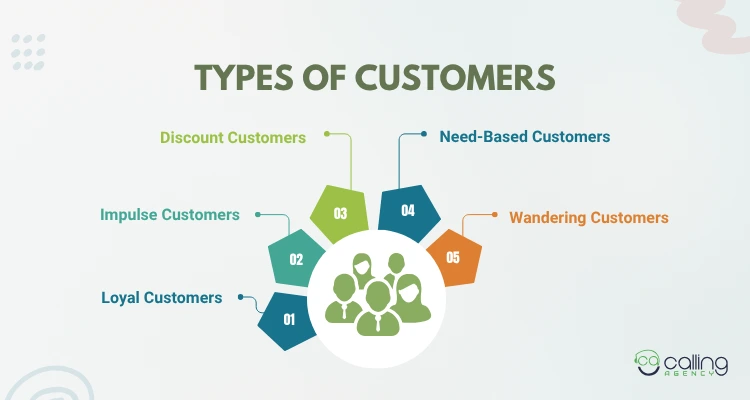
- Loyal Customers – Typically, 20% of customers are on this list and they generate a large share of the revenue.
- Impulse Customers – You don’t need a carefully planned strategy to attract these customers. They typically respond to recommendations and offers. As the name suggests, they purchase the product or service based on a spontaneous impulse.
- Discount Customers – These consumers are always on the lookout for discounts, seasonal and festive discounts, which contribute to the company’s cash flow. They are less likely to be loyal customers.
- Need-Based Customers – They tend to purchase products or services based on a specific need or requirement. If a competitor’s product or service meets their requirement, they will switch to it. To retain such customers, you need to establish a positive bond and foster an amicable interaction.
- Wandering Customers – These consumers don’t significantly affect the company’s cash flow. They don’t have a specific need; they just browse the stores for enjoyment or relaxation.
Technology Partners as Lead Sources
A technology partner maneuvers your organization toward innovation and growth by developing a competitive digital landscape. These technology partners offer technical services that are parallel to the organization’s corporate perspectives. This threshold to the cutting-edge technology and industry best practices enables businesses to use contemporary solutions and keep up with advanced market trends.
Service Delivery Partners in Lead Generation
A service delivery partner is a specialized third-party institution that partners with a Software-as-a-Service (SaaS) provider to support the delivery and implementation of their software solution to end customers. They bridge the gap between the software offering and the specific client requirements. Service delivery partners typically take on the following responsibilities:
- Needs assessments
- Service implementation
- Monitoring and management
- Training and support
Professional Networks and Relationship-Driven Leads
Building and maintaining mutual relationships within your industry is known as Professional Networking. This approach is an intentional and strategic move for the professionals. Professional networking is beneficial because it provides opportunities that support career advancement, knowledge sharing and more business opportunities. There are five types of networking:
- Expansive networks
- Nodal networks
- Operational networks
- Strategic networks
- Personal networks
Events as Lead Generation Opportunities
An event is a scheduled public or social gathering where people gather to participate in different activities, celebrate, learn, or discuss a specific topic or issue. These are the nine basic types of events:
- Corporate Events
- Private Events
- Entertainment Events
- Educational Events
- Fundraising Events
- Promotional Events
- Cultural Events
- Political Events
- Networking Events
Trade Shows for Industry-Specific Lead Acquisition
A Trade Show is an exhibition where businesses of a specific industry present their products or services to the general public and partners. These events are also used for product launches, displaying their latest innovations or even to conduct a market research. Trade shows usually have interactive activities including workshops, breakout sessions, media opportunities, networking events, awards and speakers.
There are substantial exhibitions held over several days in large venues, such as convention centers. The key elements of a trade show are:
- Exhibitors
- Trade Show Booths
- Attendees
- Seminars and Presentations
- Networking Opportunities
- Show Services
Seminars and Workshops for Education-Based Leads
Seminars bring people together to exchange ideas, gain insights, and develop new skills. Traditionally, seminars are held in person, but with the help of technology modernization, meetings are also being conducted online. There are three types of workshops:
- Academic Seminars
- Professional Seminars
- Webinars
Businesses can also use this platform to train employees, introduce new strategies, and drive engagement. This initiative will also help in enhancing the brand’s visibility.
Executive Briefings for High-Value Account Engagement
Executive briefings are highly tailored, customer-focused discussions between key decision-makers from potential accounts and subject matter experts from the host company who possess strong business acumen, technical skills, and a deep understanding of the customer’s business and markets.
The goal of an executive briefing is to provide an engaging and informative session specifically bespoke for senior leadership and executive teams. Executive briefing programs deliver significant outcomes, including:
- Expansion of the existing customer base
- Attracting new customers
- Beating the competition
- Strengthening customer relationships
- Growing your partnerships
- Increasing your deal’s size
- Accelerating your overall sales process
What is the Lead Generation Process? A Step-by-Step Overview
The lead generation process is a structured pathway for identifying and nurturing potential customers for a business’s products or services. It involves attracting, capturing, fostering, and qualifying leads to turn them into paying clients for b2b lead generation services. The process is further broken down into seven major segments:
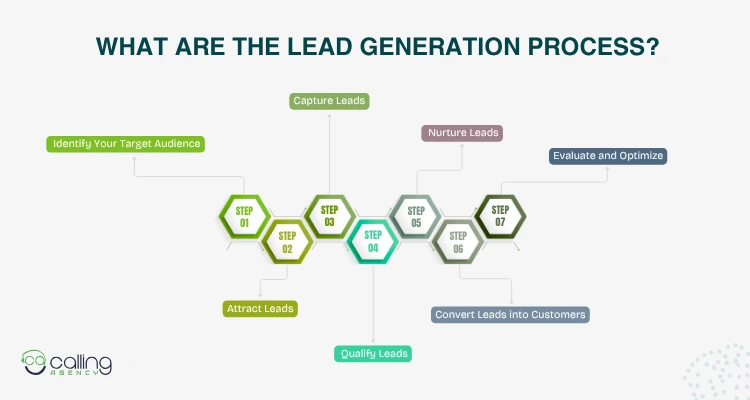
- Identifying your target audience
- Attract online visitors
- Capture lead information
- Nurture leads
- Qualify leads
- Convert leads to customers
- Analyze and optimize
Step 1: Identifying and Understanding Your Target Audience
A target audience is a specific group of people most likely to buy your product or service. Advertising campaigns are created around a target audience’s preferred requirements and pain points.
Define your ideal customer personas
Within the primary marketing target audience, there are sub-groups of the audience who share specific personas. There are seven most common types of audiences.
- Demographics – include age, gender, location, income, education, occupation, and other relevant factors.
- Behavior– online habits, purchasing patterns, media consumption, etc.
- Goals– How does your product or service help your consumers achieve their goals?
- Pain Points– What problems can your product or service solve?
- Motivations– What is the factor that drives their purchase decision?
- Personal Narrative- A story that brings the persona to life, including their background and daily life.
- Quotes- Actual or representative quotes from your customers about their goals and experiences.
Understand their pain points, goals, interests, and behaviors.
There are several methods for researching your audience and understanding their pain points, goals, interests, and behaviors:
- Create buyer personas
- Conduct keyword research
- Perform competitor analysis
- Use heatmaps and session recordings
- Run tests and experiments
You can personalize your pitch according to the pain points, goals, interests and behaviour of the consumers and demonstrate the value of your service or product.
For example, how would you select the target audience for a fitness brand? You would most likely consider the demographics, behavior and goals of your segmented audience. Hence, your target audience would be women between the ages of 25 through 40 who have a common interest in health and wellness.
Step 2: Attracting High-Quality Leads Across Multiple Channels
A unique lead generation procedure will make you communicate directly with your target audience. Create relevant content, optimize your website and use a multi-channel approach to attract leads. Some of the strategies to attract leads are:
- Content marketing
- Search Engine Optimization (SEO)
- Social Media Engagement
- Targeted Advertising
- Referrals
- Networking
- Lead Magnets
- Personalization
- Customer Care Calls
- Buyer Personas
- Landing Pages
- Webinars and online workshops
Content Marketing as a Lead Attraction Strategy
Content marketing defines your brand and tells you the benefits of its products or services. It consists of articles, blogs, social media posts, videos, infographics, podcasts, and other digital formats. With a focus on content marketing lead generation, the goal is to personalize your content so that consumers can relate to your product or service and are motivated to take action.
Social Media for Organic and Paid Lead Generation
Social media is an interactive technology that facilitates content marketing to interact, influence and build relationships with your audience. Leveraging it effectively can help you generate organic leads using social media while building brand authority. Social media includes platforms like websites, Facebook, Instagram, LinkedIn and more. You can generate significant revenue if you know which platform to use at what time.
Paid Advertising for Measurable Lead Acquisition
There are two ways to promote your business online. The first one is organic marketing and the second is paid advertising. The main aspects of paid advertising are targeting, ad copy, platform selection, ad formats and measurement and optimization. By making compelling ads and strategically placing them on the right platforms, you can effectively attract the attention of consumers, boost your paid ads lead gen, and achieve your goal.
Search Engine Optimization (SEO) for Organic Lead Reachout
Search Engine Optimization (SEO) enhances the brand’s online visibility and drives organic traffic. Integrating SEO means ranking higher in the search results page. This approach not only attracts more visitors to your website and social media platforms but also works as a powerful SEO lead generation strategy—bringing in high-quality prospects who are actively searching for your products or services. As a result, it improves your authority and trust amongst your audience.
Events as a Strategic Lead Attraction Channel
Hosting events is one of the most strategic approaches to acquiring leads. Events are hosted for the general public along with partners and existing customers. These events usually succeed in creating value propositions for their products and services which gain leads.
The primary steps to market your event include establishing a timeline, identifying your target audiences, reserving financial resources, defining your goals, building your event marketing team, utilizing media platforms with the most significant reach, customizing marketing content, and creating an event website.
Referral-Based Lead Generation
Referrals lead generation is usually driven by word-of-mouth or recommendations from existing customers to new potential customers. It is one of the most powerful tools when generating leads.
Content-Focused Lead Generation Tactics
Blog Articles – Your Business Needs a Blog. Your blog should cover relevant, industry-related content that is both interesting and useful to your target audience. Websites with blogs generate 67% more leads than those without. Bloggers employ an array of approaches in their blog articles to attract the anticipated leads. Here is a list of tactics that bloggers use:
- Create a valuable lead magnet.
- Create content for each stage of the funnel
- Offer exclusive content
- Use of keywords properly
- Use a chat widget
- Add a lead form to your content
- Understand the intent behind the audience’s search
- Share your blogs on various social media platforms
- Host surveys and giveaways
- Integrate useful tools in your content
Social media posts and ads – Social media platforms, including Facebook, Instagram, LinkedIn, X, and more, are among the most powerful tools to serve your purpose.
Running paid ads along with organic traffic will create awareness and generate leads more quickly. Social media marketing requires evolving strategies with goals that include:
- Maintaining and optimizing your profile
- Posting pictures, videos, stories, and live videos that represent your brand and attract a significant audience.
- Respond to comments, shares, likes, and keep monitoring your brand reputation.
- Following and engaging with followers, customers and influencers to build a community around your brand
Benefits of using social media platforms include humanizing your business, driving traffic, generating leads and customers, increasing brand awareness and building relationships.
SEO-Optimized Web Content for Higher Visibility
Content is the message that you want to convey to your audience. Optimization ensures that the message is fine-tuned to get maximum exposure. In today’s tech-centric world, search engines rank content according to its authenticity, trustworthiness and human expertise. Search engine algorithms love real and relatable content.
Here are nine essential tips for how to do content optimization and get top rankings on search engine results pages:
- Write great content
- Keep new content coming
- Use headings
- Optimize the text
- Optimize images
- Optimize videos
- Stop writing for search engines
- Use social media
- Keep it clean
Webinars and Events as Lead Generation Assets
| Webinars | Events |
| Webinars are usually virtual. | Events can be virtual, in-person or even hybrid. |
| Single session | Single or multiple sessions |
| Condensed agenda with no rooms, booths, tracks or breaks | Supports an extensive agenda with rooms, booths, tracks, breaks and numerous sessions. |
Once the event is over, you can publish a personalized, on-demand page with post-event assets such as:
|
Once the event is over, users can view the recording via the on-demand mode |
For the on-demand page, you can have different types of gate configurations for users to interact with on-demand content such as:
|
For the on-demand mode of events, there is no way to access the event without the specific link. It is always gated.
Registered users can use their existing links while new users can register for the event to acquire the link. |
| The on-demand player with AI-generated clips can be embedded on an external website. | Embedding on-demand recordings on external pages is not supported. |
| Post-event assets are automatically populated in the webinar dashboard. | To view and generate post-event assets, you must navigate to the content tab. |
| Can publish AI-generated post-event assets such as video clips, key takeaways and transcripts to the on-demand page. | The on-demand mode only includes the entire event recording. It does not support short video clips, takeaways and event transcripts. |
| Gets a separate dashboard to get insights about the clips embedded on the standalone on-demand page. | Gain insights into on-demand video plays and engagement. |
| Existing events can be converted to Smart Webinar, provided it meets the requirements. | Existing Smart Webinars cannot be converted into a regular event. |
Email Campaigns for Lead Attraction and Engagement
This approach involves customized and targeted email campaigns that engage leads by providing them with important information and benefits. Some of the most essential points used in email campaigns are crafting eye-catching subject lines, informative messages, keeping your design simple, only emailing people who have opted into your list, strategically timing your emails and regularly monitoring and running tests.
Paid Search Advertising (PPC) for Intent-Driven Leads
PPC attracts leads through targeted keyword bidding, compelling ad copy and landing pages, audience targeting, measurable results, optimization, and immediate impact. There are four primary ways to generate leads using PPC. They are targeting industry-related keywords, writing eye-catching headlines, using appropriate calls to action and incorporating ad extensions.
For example, a local artisanal bakery uses Google ads to display images and text ads on Search Engine Results Pages (SERPs) when users search for the terms “bakery near me” or “chocolate cake”. The bakery must pay a limited fee every time someone clicks on their ad, driving traffic to their website.
Step 3: Capturing Leads Through Optimized Touchpoints
Lead capture is the action that occurs on your website when visitors convert into leads.
This happens with the assistance of lead capture forms, lead capture pages, and e-commerce checkout pages. The forms are intended for the website visitors to enter their contact details in exchange for incentives.
This initiative will help nurture leads, personalize marketing efforts and improve revenue by building a database of customers and fostering direct communication. Hence, it will enhance your connectivity with clients and help you convert website visitors into clients by offering them a small incentive.
Common Lead Capture Methods
This involves using distinct methods to gather information about individuals who have shown interest in your product or service.
Landing Pages With Conversion-Focused Forms
These are web pages specifically designed for a marketing campaign. An effective landing page focuses on conveying the value of the offered resource, minimal copy with a compelling point and a clear call to action.
A good form will require a reasonable amount of information that matches the offered resource, will have a simple and straightforward layout, and will be appealing to consumers.
Newsletter Subscriptions for Ongoing Lead Capture
Newsletter Subscriptions are one of the most popular kinds of lead generation processes. It attracts and captures potential customers’ contact information through the forms. Several strategies that are used to generate leads are website placement, social media promotion, and content marketing.
Free downloads or content (e-books, whitepapers)
These resources, also known as “gated content,” offer helpful information in exchange for the individual’s contact information. The advantages of gated content are being able to obtain information about potential customers and making sales much easier. If used correctly, these sources are great lead magnets.
Webinar and Event Registrations as Lead Capture Tools
These lead capture methods attract potential customers with insightful content, gathering their contact information through registration. The key objective here is to build trust, showcase the business’s expertise and establish a connection with the audience.
Approximately 60% of companies across various sectors utilize webinars and event registrations for generating leads.
Observe the before-and-after pictures to capture the consumer’s attention. This will provide the consumer’s details while delivering the best results for the solution to their problems.
Step 4: Qualifying Leads to Identify Sales-Ready Prospects
A qualified lead is a prospect evaluated by the sales team and found to have the strongest chances of converting. This provides a quantitative and data-driven process by which to arrive at the best prospects. Most of the leads are not ready to make a purchase yet and that is alright. What you need to do is ensure that the maximum effort you put into those deals has a possibility of buying.
Types of Qualified Leads in the Funnel
These segments help enhance the sales revenue, which the marketing team strategizes according to the consumer needs.
- Marketing Qualified Leads (MQLs): Interested but not yet ready for sales. Marketing qualified leads are potential customers. They are usually generated through various marketing activities and remain further in the sales funnel. They are on the verge of interest.
- Sales Qualified Leads (SQLs): Leads vetted by sales teams ready for direct sales engagement. Sales-qualified leads indicate an intent to purchase. They are validated by the sales team and are prepared for a sales engagement.
Key Criteria for Lead Qualification
The criteria for qualifying as a lead are defined by key factors, including a need for the product or service, the ability to afford it, and the authority to make purchasing decisions.
- Budget – Budget is a crucial factor in determining the financial resources to consider when evaluating a qualified lead. You need to be able to identify the authoritative person behind the purchase to determine the budget.
- Authority to Purchase – You need to understand the lead’s position to help assess their ability to make the final decision on the purchase.
- Need for the product/service– Businesses need to understand the need for a product or service by communicating with their potential clients. They need to know the problems to create a solution. Research and surveys should be conducted in conjunction with checking demand for the product or service and understanding your competitors.
- Timeline of Purchase – A timeline of purchase is a roadmap that breaks down the purchase process into manageable steps. This will help the buyers remain organized and manage significant and complex purchases. The key elements of a purchase timeline are tasks, timelines, responsibilities, milestones, and contingencies.
Using Qualification Frameworks for Consistent Analysis
A lead qualification framework is a set of rules to weigh and categorize leads based on their behaviors and characteristics. There are several types of lead qualification frameworks. Each framework has its pros and cons depending on the industry, product or service and sales cycle.
The maneuver is to choose the framework that best aligns with your target market, value proposition and business goal. Frameworks are used for consistency, accuracy, efficiency, improved communication and data-driven decisions.
Common Lead Qualification Frameworks Clarified
- BANT (Budget, Authority, Need, Timing)- It provides a simple framework for qualifying prospects in a business-to-business (B2B) sales setting. BANT is a framework that comes into play right after the lead generation phase of the sales pipeline. This is used in a longer sales cycle when you are required to balance multiple prospects without wasting time.
- CHAMP (Challenges, Authority, Money, Prioritization) – This sales qualification framework helps reps uncover buyer pain points, identify decision-makers, assess financial capacity, and understand the urgency to prioritize deals. If the prospect has a meaningful problem to solve, they are more likely to take action, considering the budget factor later. This framework is more effective because it aligns with the buyer-first approach, supports early-stage engagement, and provides flexibility to build urgency and form buying intent over time.
- MEDDIC (Metrics, Economic buyer, Decision criteria, Decision process, Identify pain, Champion) – It is a sales qualification process that helps identify better quality prospects. By gathering information properly and tailoring your approach to the prospect, you can prioritize your leads, allocate resources effectively, and increase your success rate.
- ANUM (Authority, Need, Urgency, Money) – This framework takes the principles of the BANT framework and rearranges them to prioritize authority over money. This is how the sales team knows not to waste time on unqualified leads and focus on contacting the decision-makers.
Example: A sales representative attempting to sell a project management software to a mid-sized marketing agency might ask about their current budget for project management tools, identify the decision-makers, inquire about the challenges they are facing, and discuss how they intend to implement the solution.
Step 5: Nurturing Leads Through Relationship Building
Nurturing a lead means building a strong relationship with potential prospects by sharing essential information and relevant offers that will prove beneficial to them. This includes email campaigns, social media advertising, personalized content and websites. Nurturing leads will yield a higher conversion rate, which will contribute to the company’s overall profitability.
Result Focused Lead Nurturing Techniques
There are several types of nurturing techniques.
- Automated email drip campaigns are a series of automated marketing emails sent to people who have taken similar action on your website. The characteristics that make automated drip campaigns distinct are that they are pre-written and automated, sent on a preset schedule to people who have shown an interest in your website and marked as an essential engagement point.
- Personalized offers – This is a customized approach to meet specific requirements. Personalized offers need to be parallel with the consumer’s requirements and interests which will enhance customer engagement and increase the chances of conversion.
- Informative content and case studies – Informative content aims to enlighten consumers by providing factual information, detailed explanations, and practical guidance on a specific topic. Case studies are more like stories. They will contain accounts from your customers that showcase your service or product as it solves their problems.
- Follow-up calls or meetings – These actions are implemented after the initial interaction between the consumer and the sales team. The purpose of follow-up calls and meetings is generally to nurture the leads, address any questions, and aim to convert them into customers.
Example:
Personalized email campaigns are a demonstration of a nurturing technique. This is where you establish your brand value and company awareness with your potential consumer.
Step 6: Converting Leads Into Paying Customers
The procedure of turning leads into customers is known as lead conversion. Different strategies are employed in this step.
- Prompt leads to take action by clearly presenting your offer, pricing, and value.
You must define your offer clearly, be transparent about pricing, and emphasize the values. Prompts serve as a guiding framework that helps your team stay focused and cover all the essential points. The three main advantages of prompts are consistency, clarity and confidence.
Core Strategies for Improving Lead Conversion Rates
Conversion strategies are marketing strategies that concentrate on increasing the percentage of users. A variety of next steps could be desired, such as signing up for a newsletter or purchasing a product or a service.
- Clear calls-to-action (CTAs) – These are messages or buttons on a website that inspire visitors to take the next step in the process. These responses can be in the form of filling out a form, downloading an e-book, or making a purchase. The CTA on your website should be short and precise so that it is easy for people to understand.
- Free trials or demos – Product demos and free trials allow consumers to experience the product before making a purchase. This is a powerful marketing tool that can increase sales, generate leads and improve customer satisfaction. The limited time will allow them to make an informed decision before committing to the purchase of the product.
- Personalized consultations and business pitch demonstrates that you are aware of your consumer needs. By integrating this approach into your action, you can build trust and create strong connections which will help you close the deal successfully.
- Limited-time offers or incentives – This is a sales promotion that offers a product or service at a special deal for a limited time period to grab the attention of potential consumers. This technique succeeds in creating urgency and scarcity, attracts new customers, boosts loyalty through exclusivity and helps boost your sales.
Example:
88% of online consumers are more likely to buy a product or service if there is free shipping.
Step 7: Evaluating and Optimizing the Lead Generation Process
Evaluating leads determines whether your potential consumer will remain a lead or convert into a paying customer in the future. It is important to understand the sales efforts, improve sales and marketing strategies, optimize the sales funnel and increase return on investment while optimizing and evaluating.
- Track results, measure conversion rates, and continually refine your lead generation process.
Major Lead Generation Metrics to Monitor:
This refers to a specific and measurable value that is tracked and analyzed to assess the performance, health and progression of a particular area.
- Conversion rates refer to the percentage of leads that have been successfully converted into paying customers. Tracking conversion rates at different stages of the sales funnel helps recognize bottlenecks and areas for improvement in the sales and marketing process.
- Cost per lead (CPL)– This calculates the cost of acquiring a lead through marketing campaigns.
- ROI of lead-gen activities – It is calculated by dividing the net profit from leads by the total cost of lead generation, then multiplying by 100 to express it as a percentage.
- Lead-to-customer ratio – This measures the percentage of leads that convert into paying customers. A higher ratio means a better performance in converting potential clients into actual sales.
- Customer feedback and satisfaction– This signifies how well a company meets consumer needs and expectations.
Example:
By leveraging the insights derived from campaign analytics, businesses make data-driven decisions. This ensures that their marketing efforts are parallel with their objectives.
Regular Measurement, Attribution, and Continuous Optimization
Measurement, attribution and optimization forms a continuous feedback loop that is used to assess performance and get better outcomes.
Core Lead Generation KPIs
Lead generation KPIs are basically numbers that tell how well you are doing when it comes to attracting and converting potential customers into leads. These numbers give you a peek into different areas of your lead generation funnel. This will help you to know what to accentuate, what to fix and what new things you can attempt.
Cost Per Lead (CPL) with Definition and Calculation
This is a fundamental measurement that allows companies to determine how much it costs them to acquire a potential customer who is interested in their offering. CPL indicates the aggregate expenditure involved in obtaining one lead.
Calculation
CPL is calculated by dividing the total cost of a marketing campaign by the number of leads generated by that campaign:
Cost Per Lead (CPL) = Total Cost of Campaign / Number of Leads Generated
This straightforward formula provides immediate insight into the cost efficiency of lead generation efforts.
Cost Per Qualified Lead (CPQL)
Similar to CPL, CPQL on the cost of converting a lead into a qualified lead. High costs can point to inadequacies in the lead routing process. This can also indicate that an ad campaign is not driving enough qualified leads.
| Lead quality and buying intent | Track sales ready contacts, showing clear contribution to revenue and pipeline growth |
| Size efficiency and prioritization | Enables teams to focus on high-value leads, making efforts more efficient |
| Targeting strategy and campaign messaging | Campaigns shift towards intent-driven offers and high-fit audiences |
| Forecasting and revenue attribution | Qualified lead counts correlate with actual revenue, improving forecasting accuracy |
| Channel performance signals | Paid search often drives more qualified leads at a lower cost per qualified lead, signaling higher revenue potential |
Lead-to-Customer Conversion Rate
Lead-to-Customer Rate is an indicator of performance that reflects the percentage of potential customers (leads) that become actual customers. It is obtained by dividing the number of new customers by the total number of leads and multiplying the result by 100.
This metric reflects the ability of your marketing and sales campaigns in turning interest into money, a high rate signaling a good strategy and a low rate revealing problems either with the quality of the leads or the sales process.
Formula
- (Number of Leads Converted to Customers / Total Number of Leads) x 100%
Example Calculation
- If you generated 500 leads and 50 became paying customers: (50 / 500) x 100% = 10% conversion rate.
Pipeline Sourced From Lead Generation
Pipeline Source is the origin or the initial trigger of a potential customer or deal (pipeline), most commonly distinguishing between leads generated by marketing efforts(marketing sourced), those developed by sales representatives(self-sourced/sales sourced) or from alliances.
It helps businesses monitor which activities drive new business and understand sales/marketing productivity. It’s a key metric for revenue attribution, showing if leads come from campaigns, outbound prospecting, or other channels, to optimize growth strategies.
For lead generation, the pipeline sourced formula is very specific and should be framed around opportunities created from leads (not just raw leads).
Here is the correct, industry-standard way to calculate it
Pipeline Sourced (Lead Generation) — Core Formula
Pipeline Sourced = Σ (Deal Value of Opportunities Created from Lead-Gen Leads)
In plain terms:
Add up the expected deal value of every sales opportunity that came directly from your lead generation efforts.
Customer Acquisition Cost (CAC)
Customer acquisition cost (CAC) represents the money spent on getting a new customer. CAC is the total resources and expenses that go into obtaining one more customer. The cost to acquire a customer is an essential business metric that is often paired with the customer lifetime value (LTV) metric to analyze the value a new customer brings to a business.
Formula,
Customer Acquisition Cost (CAC) = Total Sales & Marketing Costs ÷ Number of New Customers Acquired
CAC expresses the return on investment of the total sales and marketing operations versus the new customers achieved through those methods. So, CAC turns out to be a good measure of how various sales and marketing strategies work.
Sales leaders use this among other metrics, to find out what aspects of their business model are currently working in the most useful way. This metric is particularly important to rapidly growing companies that are looking to scale up.
Lead Generation Velocity (Sales Velocity)
Velocity is one of the most important, forward-looking KPIs that indicate how smoothly internal processes are running and at what speed are revenues coming in.
In contrast to static metrics, such as total revenue, velocity offers real-time information about “health” of a system, e.g., a software development team or a marketing-to-sales pipeline.
Core Formula: Lead Generation Velocity (Sales Velocity)
Velocity = (Number of Opportunities × Average Deal Value × Win Rate) ÷ Sales Cycle Length
Simple Example:
- Opportunities: 40
- Average deal size: $12,000
- Win rate: 25% (0.25)
- Sales cycle: 60 days
Velocity = (40 × 12,000 × 0.25) ÷ 60
Velocity = $2,000 per day
Marketing Attribution Models for Lead Generation
Marketing attribution modeling gives credit to the marketing channels and touchpoints throughout the buyer’s journey that makes a lead convert. The purpose of this is:
- Identifying areas of the buyer’s journey that you can improve
- Determining the ROI for each channel or touchpoint
- Surfacing the most effective ways to spend your marketing budget
- Tailoring your marketing campaigns and content to your unique personas
Not all attribution models are created equal and there is no on-size-fits-all solution. Different models assign credits in different ways. Each has its own strength and limitations. Let’s break some of the most common models and when they might most useful for your business.
First-Touch Attribution Model
Known also as first-click attribution, this method attributes 100% credit to the very first interaction that a business has with a customer before they convert. If you want to find out what really attracts new customers at the top-of-the-funnel, use this model.
This model sheds light on the unnoticed marketing tactics that are working. Perhaps your PPC campaigns are not the direct source of sales, but they will certainly lead to awareness and engagement with your potential customers, which results in revenue.
If you only focus on the final conversion, you may decide to stop your PPC, which in turn may bring about a decrease in sales. Businesses with a longer sales cycle that are more focused on creating brand advocates rather than one, time customers will find this attribution model very relevant.
Last-touch Attribution Model
Last-touch (last-click) attribution refers to the model that is the direct negation of the first-touch model. It allocates 100% of the credit to the last touchpoint prior to conversion.
Last-touch attribution would have given the credit to the final marketing email that finally persuaded the customer to convert. It allows marketers to identify the channels that are most successful in closing deals, but it excludes all the lead generation and brand awareness and consideration building touch points that happened before the sale.
Google Analytics uses last-touch attribution as its default model, which may be a reason why it is one of the most popular methods.
It is simple to understand and apply, but it may result in having an excessive amount of money and resources spent on bottom-funnel efforts and neglecting top-of-funnel awareness campaigns.
Position-Based Attribution Model
This multitouch attribution model assigns different weights to different touchpoints. First and last touchpoints get 40% of the conversion credit, and all the middle touchpoints share 20%. The approach is intended to highlight the spots where the introduction was made and the action taken while also acknowledging the intermediate events.
Linear Attribution Model
Linear attribution equally rewards each customer journey touchpoint.
Returning to our example: under the linear attribution model, Google search, retargeting ad, and marketing email would each be credited with a third of the conversion.
This method recognizes that the sum of all interactions leads to conversion but it does not indicate the importance of each touchpoint relative to the others.
Compared to single-touch models, linear attribution offers a much better solution, particularly, for those businesses with longer sales cycles and involving multiple interactions. Still, by assigning equal value to all touchpoints, it can be an oversimplified presentation of reality.
Time-Decay Attribution Model
Time-decay attribution models attribute the conversion to all the touchpoints. But, they proportionally increase the share of conversion credit going to those touchpoints that are nearest to the conversion point.
So, if you consider the first touchpoint, the Google searchit may be given only 10% of the credit, whereas the retargeting ad might be given 30%, and the last touchpoint, the marketing email, might be given 60%.
The logic is that the closer a touchpoint to the conversion, the more it can be considered as having influenced the final customer decision to purchase. However, the other touchpoints are still recognized as being necessary for initially attracting the prospect and guiding them towards the top of the funnel.
Lead-Conversion Touch Attribution
This sophisticated multitouch system allocates the credit to the different interaction points that eventually led a prospect to become a customer. It is a combination of data gathering, scoring the touchpoints based on the perceived impact on conversion, weighted attribution for each touchpoint based on the first two factors, continual assessment, adjustments, and optimization.
Custom Customer Attribution Models
By means of custom attribution, a marketer has the ability to establish his/her very own preferences and priorities for which factors are given value and to what extent they are weighted.
This way, marketers can dive deeper into their analysis and examine such aspects as email campaigns, offline marketing, and website analytics. Even though it requires more time to set these up, custom attribution models can be the best way to know your unique customer path for making the right campaign decisions.
The Continuous Optimization Loop in Lead Generation
An optimization loop for lead generation refers to the ongoing cycle comprising stages such as Plan/Create, Amplify, Analyze, and Evolve (or Test/Measure/Learn in some cases). In such a cycle, marketing data are utilized to optimize strategies, content, personalization, and automation. AI is also often used to perform these tasks efficiently.
As a consequence, the number of quality leads increases along with ROI. It goes beyond conventional sales funnels, concentrating on changes made in real, time and internalizing the responses of all marketing channels.
Offers Optimization Loop
An offer optimization loop is a data-driven process that runs continuously and aims at achieving the highest conversion rate and lead quality. It does so by constantly improving the “offer” or value proposition through feedback from sales, analytics, and user behavior.
Core Components of the Optimization Loop
- Data Collection & Analytics
- Sales Feedback Integration
- A/B Testing
- Closed-Loop Attribution
Channel Optimization Loops
Channels refer to cyclical, analytics, guided activities that aim to enhance, experiment with, and raise the productiveness of customer acquisition tools (e.g., social media campaigns, email marketing, SEO, paid advertisements).
It contrasts a one-directional marketing flow as this system relies on instant output metrics to modify the tactics at every step. Thereby, making the most of the marketing avenues that generate the highest quality leads.
Key Channels to Optimize
- SEO & Content Marketing
- Paid Search & Social Ads (PPC/SEM)
- Email Marketing
- LinkedIn & Social Selling
Landing Page Optimization Loop
The landing page optimization loop is basically a never-ending circle of Analyze, Test, Refine, and Repeat. It revolves around main aspects like headlines, copy, forms, CTAs, visuals, and mobile responsiveness with the goal of turning website visitors into leads.
The whole thing is driven by data gained from A/B tests and user behavior, which are then utilized to make iterative improvements for a higher ROI.
It starts with figuring out what the visitors really want, then it goes on to removing any unnecessary obstacles and finally, it is about gaining the visitors’ trust, so that the users are smoothly directed to a single, clear goal.
Key Elements to Optimize
- Headlines & Copy
- Calls-to-Action (CTAs)
- Forms
- Design & UX
- Trust Signals
- Lead Magnets
Lead Scoring Optimization Loop
A lead scoring optimization is a endless process of tweaking your lead scoring model so that you keep marketing and sales teams aligned and focusing on the best leads at any given time.
The loop goes through stages (e.g., Nurture, Qualified, Sales, Ready) according to lead behavior and characteristics and helps to get higher conversion rates and better ROI. It is about deciding on the criteria, giving points, fixing threshold, utilizing automation, and always looking at the results together.
Key Components
- Data Points
- Point Values
- Thresholds
- Score Decay/Negative Scoring
- Sales-Marketing Feedback
Lead Routing Optimization Loop
It is a data-driven process that automatically assigns leads to the correct sales representatives based on predetermined rules (such as geography, product interest, or lead score), tracks performance (speed, conversion), and adjusts the logic to increase efficiency, fairness, and conversion rates. Hence, it provides quick and relevant engagement with prospects.It is a dynamic system of analysis and improvement using automation and AI to be on the same level as changing business needs and customer journeys.
Key Components of the Loop
- Capture & Categorize
- Define Routing Rules
- Automated Assignment
- Sales Execution & Tracking
- Monitor & Analyze
- Optimize & Refine
Lead Nurture Optimization Loop
A nurture optimization is a data-driven iterative process that revolves around enhancing ways to engage and educate prospects and move them down the sales funnel.
It depends on aligning marketing and sales, getting automation to deliver personalized content, and continuously fine, tuning strategies based on behavioral data to increase conversion rates. It may result in a 50% increase in sales-ready leads at a 33% lower cost.
Core Components of the Nurture Loop
An effective loop is not a one-time campaign but a “test-and-tweak” mechanism.
- Behavioral Triggers
- Progressive Profiling
- Multi-Channel Engagement
- Lead Scoring & Routing
Sales Lead Generators Tools, Data, And Services
Sales lead generators help businesses find, capture, and turn potential customers into real sales opportunities. In this part, we will tell you what sales lead generators are, the main tools and services used, and how they support the sales process from first contact to closing deals in a clear and simple way.
What Are Sales Lead Generators? Meaning and Purpose
Sales Lead Generators refer to the strategies, tools and processes adopted to draw the attention of potential customers (leads), captivate their interest, get their contact details, and convert them into sales opportunities.
This is mostly achieved through various digital channels such as content marketing, SEO, social media and email campaigns. The main objective is to continually feed the sales funnel with qualified and nurtured prospects for conversion.
In fact, these techniques exclude the simple list buying and focus on problem, solving and offering value while optimizing the sales process.
Category 1: Lead Capture And Conversion Tools
Lead capture and conversion tools are about the first two steps of the sales funnel. They collect contact information through forms or chatbots, nurture leads with automated emails and content and keep track of them in ground-breaking CRM Systems such as HubSpot, Salesforce, Intercom, OptinMonster and more.
They are usually connected by means of constant workflow integration from from initial contact up to the qualified deal.
The main categories of such products and services are CRMS, Landing Page Builders, Email Marketing, Chatbots, and Prospecting Tools. These are great helpers in changing a nameless visitor into a paying customer.
Category 2: CRM And Marketing Automation
CRM and Marketing Automation are two of the strongest sales generators. When combined together, they increase sales significantly.
CRM allows you to manage the sales pipeline and customer data, while automation takes care of the top-of-funnel nurturing. This guarantees a smooth handoff and personalized journey from prospect to being a customer.
Automation increases efficiency, consistency and conversion rates by performing tasks without human involvement and provides the right data and information.
In essence, both of the systems complement each other. Marketing automation helps to bring in and filter the right leads before handing them over to the CRM. This, in turn, keeps a record of the interactions, evaluates the potential and initiates sales activities.
Category 3: Prospecting, Enrichment, And Intent Data
These three come together to energize sales lead generation by first finding potential customers (prospecting), then adding crucial details (enrichment) and finally identifying active interest (intent data). This enables the sales teams to customize outreach, prioritize hot leads and improve conversion rates.
This tends to result in a more proficient data-driven selling. Prospecting locates potential contacts, enrichment provides additional details (firmographics, tech stacks) and the intent data inidicates buying signals.
This approach converts the basic contacts into qualified opportunities for targeted engagement.
Category 4: Agencies / Outsourced SDR
Outsourced SDR providers are external and skillful sales teams conversant with lead tapping, lead generation, and appointment setting. It can fit into a company’s sales process and fill their sales pipeline with highly qualified prospects.
Outsourcing such activities gives the organization a faster lead generation scale, access to talent without the cost of internal recruitment, and the capability of the internal sales team being more focused on the turnover of sales. The cost is usually lower and more predictable than creating the whole function in-house.
Key Benefits
- Speed & Scalability
- Cost-Effectiveness
- Focus on Core Business
- Expertise & Best Practices
When to Use Them
- Immediate Pipeline Needs
- Testing New Markets
- Lack of Internal Capacity
Sales Lead Generator Selection Checklist
The selection checklist is made to help businesses evaluate and select the right lead generation strategies, tools or outsourcing partners by aligning them with core operational and strategic requirements.
- Goals & Objectives
- Define Clear Metrics
- Alignment with Strategy
- Purpose Alignment
- KPI Definition
- Budget
- Total Cost of Ownership (TCO)
- Pricing Model
- ROI Calculation
- Scalability
- Timeline
- Time-to-Value
- Sales Cycle Alignment
- Campaign Duration
- Team Capacity & Technical Expertise
- User Friendliness
- Implementation Effort
- Support & Training
- Workflow Integration
- Data Quality & Compliance
- Data Accuracy & Freshness
- Verification Tools
- Ideal Customer Profile (ICP) Alignment
- Compliance
- Integration Needs
- CRM Compatibility
- Tech Stack Harmony
- API Access
Common Sales Lead Generation Mistakes and How to Fix Them
Even the best lead gen plans can fail if small mistakes work in. In this section, we break down the most common sales lead generation errors businesses make and explain how to fix them in simple, practical ways.
Weak or Poorly Defined Ideal Customer Profile (ICP)
Mistake: Trying to appeal to a broader audience that results in generic messaging that does not resonate with anyone.
Fix: Clearly define your ICP and personalize your messaging exclusively to your intended audiences.
Wrong or Misaligned Lead Offers
Mistake
- Too Broad/Generic: Offering a “free company overview” or “general newsletter” instead of a specific solution.
- Low Value: Providing content that requires too much effort to consume or does not provide immediate value.
- Pushing Too Fast: Asking for a “Demo” or “Buy Now” on a top-of-funnel ad, rather than offering educational, low-friction content.
- One-Size-Fits-All: Offering the same lead magnet to different audience segments with different pain points.
- Ignoring the Buyer’s Journey: Offering a “Case Study” to someone just discovering your brand .
Fix
- Map the Offer to the Stage: Use educational content for awareness, and sales-focused content for decision-makers.
- Focus on One Pain Point: Create a specific, high-value asset that solves a “hair-on-fire” problem, such as a specialized calculator, checklist, or template.
- Personalize the Offer: Create different offers for different buyer personas or industries.
- Strengthen the CTA: Change “Submit” or “Click Here” to outcome-driven, clear language like “Download Your Free ROI Calculator”.
- Add Social Proof: Include testimonials, user numbers, or case study snippets directly on the landing page to boost trust.
- Test & Iterate: A/B test your headlines and lead magnet types to see which brings in higher-quality leads.
- Add Filter Questions: Ask 1-2 qualifying questions in the form to ensure the offer is attracting the right fit.
Poor Optimized Landing Page
| Mistake | Fix |
| Unclear CTAs | Make small changes to your CTAs. Changes like avoiding flashy colors and paying special attention to your CTA’s placement can improve your website visitor’s experience. |
| Lacks Social Proof | To make your landing page more trustworthy and enticing for your customers or visitors, add reviews and testimonials from your clients.
You can also add case studies to your website to convince your potential clients. Moreover, you must add your social media links to your landing pages to encourage customers to engage with your brand across multiple channels.
|
| Broken Links | Be mindful of adding limited links on your landing page. When you add them, make sure they are functional and properly sourced. |
| Lacks Mobile Optimization | To ensure your website visitors have a pleasant and fruitful experience interacting with your landing page, you need to:
|
| Poorly Written Content | Avoid adding oceans of text on your landing pages. Because no matter how much we deny it, our attention spans are shorter than ever. In fact the attention span of a person reading online content has dropped significantly to 2-3 seconds.
So, to make your landing page’s content more consumable and digestible, you must write personalized and skimmable content. Use words that trigger emotions in your reader. To do so, you must know what entices them the most.
|
Slow or Inconsistent Lead Follow-Up
Mistakes
- The “One-and-Done” Approach: Giving up after a single phone call or email.
- Ignoring the 5-Minute Rule: Waiting hours or days to respond, allowing leads to go cold.
- Generic “Just Checking In” Messages: Lacking value or personalization in follow-ups.
- Manual Lead Handling: Relying on manual processes to transfer leads from ads to CRM, causing bottlenecks.
- Lack of Multi-Channel Approach: Sticking only to email when the lead might prefer LinkedIn or phone.
Fix
- Instant Response & Automation
- Speed and Consistency
- Value-Added Follow-Up
- Technology & Tracking
Lack of Lead Nurturing Strategy
Mistakes
- Treating Nurturing as an Afterthought
- “Now or Never” Mindset
- No Educational Content
- Irrelevant, Non-Segmented Messaging
- Slow or No Follow-Up
Fix
- Immediate Post-Capture (First 24 Hours)
- The First Week (Building Trust)
- The Ongoing Nurture (Long-Term)
- Sales & Marketing Alignment
Tracking Vanity Metrics Instead of Revenue Metrics
Mistakes
- Prioritizing Volume Over Quality
- Celebrating Top-of-Funnel (ToFu) Metrics
- Measuring “Likes” and Social Followers
- Relying on Total Aggregate Numbers
- Ignoring Context and Ratios
Fix
- Define and Document Your ICP
- Replace “Total Leads” with “SQLs/Pipeline Value”
- Swap “Page Views” for “Conversion Rate”
- Measure “Velocity” Over “Volume”
- Implement Lead Scoring
- Audit Your CRM Data
- Shift to “Cost per Acquisition” (CAC)
- Track “Conversion Source,” Not Just “Source”
10-Point Lead Generation Best Practices Checklist
A 10-point lead gen checklist includes figuring out your audience, providing value through your content, optimizing the points where you capture leads, getting traffic from various channels , using automation for nurturing, implementing tracking & scoring, harnessing intent data, A/B testing, making sure that follow, up is quick, and continuously reviewing your results to improve your strategy.
Here’s a 10-point checklist for lead generation:
- Define Your Ideal Customer (Buyer Persona): Know who you’re targeting to tailor your efforts effectively.
- Create Valuable Lead Magnets: Offer high-quality content (guides, webinars, tools) in exchange for contact info.
- Optimize Conversion Points (Landing Pages): Make your website and landing pages clear, mobile-friendly, and action-oriented.
- Leverage Multi-Channel Promotion: Use content marketing, social media, and email to reach your audience where they are.
- Implement Marketing Automation: Automate lead assignment, nurturing sequences, and alerts to prevent leads from going cold.
- Track & Score Leads: Monitor interactions and assign points to qualify leads based on engagement and fit (MQL/SQL).
- Utilize Intent Data & Publisher Networks: Partner with trusted publishers and use intent signals to find buyers actively looking for solutions.
- A/B Test Everything: Continuously test headlines, CTAs, channels, and segments to improve performance.
- Ensure Rapid Follow-Up: Contact new leads quickly (ideally within 5 minutes) for the best connection rates.
- Analyze & Iterate: Track KPIs (CPL, conversion rates) and use data to refine your entire process.
Lead Generation Statistics and Benchmarks
By examining lead generation statistics, you will better understand how lead generation impacts businesses and why ot matters so much. Strategies are constantly evolving and buyer behaviours are shifting, exposing where opportunities are won or lost. Before we dive into different statistics, let’s look at the most important ones!
- Across industries, the average cost per lead stands at $198.44.
- 50% of marketers rank lead generation as a top priority in their marketing efforts.
- On average, organizations generate around 1,877 leads each month.
- Content marketing is used by 76% of marketers as a primary lead generation tactic.
- Cold calls are ignored by 97% of people, making them largely ineffective.
- Social media marketing helps 68% of marketers attract more leads.
- 44% of sales representatives report being too busy to properly follow up with leads.
Paid Media Lead Generation Statistics
- Paid social media ranks as the second most effective marketing channel, delivering strong ROI for B2B companies.
- Across all industries, the average cost per click (CPC) on Google Ads is $5.26, with Legal Services seeing the highest CPC at $8.58.
- The current average cost per lead (CPL) on Google Ads is $70.11, reflecting a 5.3% increase compared to 2024.
- The average cost per lead for B2B marketers using paid campaigns is $310.
Content Marketing Lead Generation Statistics
- 87% of marketers say content marketing is essential for generating and nurturing leads in 2024.
- According to HubSpot’s latest Demand Generation Benchmarks Report, the standard cost of lead generation through content marketing is $92.
- Content marketing delivers an average ROI of 14% for lead generation efforts.
- 74% of companies identify content marketing as the most effective strategy for generating leads.
- Video leads the way, with 58% of B2B marketers citing it as the most effective content format for lead generation.
B2B Lead Generation Statistics
- 76% of B2B marketers report successfully meeting their lead generation goals through content marketing.
- B2B sales representatives trusting on manual lead outreach spend 28% of their time researching prospects and sourcing contact information.
- When working with specialist agencies, B2B sales reps dedicate 73% of their time to pitching and closing deals.
- 98% of B2B marketers say virtual events are the most effective channel for generating high-quality leads.
- 90% of B2B marketers confirm that appointment setting is an effective lead generation strategy.
Email Lead Generation Statistics
- 41% of marketers say email marketing works best for finding prospects and growing sales.
- Email gives the best return on investment for B2C companies compared to other channels.
- 32% of marketers think email is the best way to get B2B leads.
- For 40% of marketers, the main goal of email marketing is getting qualified leads (MQLs/SQLs).
- 35% of companies earn $10–$36 for every $1 they spend on email marketing.
- Most marketing emails are opened by 20–30% of people.
- B2C emails get a 3–5% click rate, while B2B emails get 1–3%.
Social Media Lead Generation Statistics
- 53% of marketers use social media to get new leads, according to the latest Social Media Examiner survey.
- 44% of B2B marketers say LinkedIn is the best platform for lead generation.
- 51% of marketers successfully use YouTube to support and improve their marketing campaigns.
- A recent Social Media Examiner report shows that 79% of marketers use Instagram to promote their products and services.
- 38% of marketers rely on LinkedIn to generate leads and see real results.
AI Lead Generation Statistics
- Marketing automation software can increase qualified leads by 451%.
- 36% of marketers already use AI chatbots to manage their daily marketing tasks.
- 64% of marketers use generative AI for lead generation and other marketing activities, while 35% are testing it or plan to use it within the next 18 months.
Lead Nurturing and Conversion Statistics
- Lead nurturing emails get 4 to 10 times more responses than one-time email blasts.
- 56% of marketers say targeted content is the most important part of a lead nurturing program.
- Deals closed with nurtured leads have a 47% higher order value than non-nurtured leads.
- 80% of new leads never become sales, but using targeting, segmentation, and lead nurturing helps improve conversion rates.
Lead Conversion Rate with Definition and Formula
Lead conversion statistics are the rate at which potential customers become loyal paying customers. The primary metric, the lead conversion rate, is calculated by dividing the number of converted leads by the total number of leads and multiplying by 100.
(Number of Converted Leads / Total Number of Leads) x 100 = Lead Conversion Rate (%)
In the B2B Industry, conversion rates often range approximately ftom 5% to 10%. A rate of 15% or higher indicates effective lead conversion techniques.
To determine how many leads your business requires, it is important to establish clear revenue goals and understand the average sales price of your product or service.
- Nearly 85% of marketers use submission forms to generate conversions.
- Responding in under 5 minutes results in 9 times higher conversions.
- B2B Companies with a mature lead gen strategy see 133% greater revenue.
- The average lead generation conversion rate is 2.9%.
- 80% of leads never become actual customers.
- 95% of marketers know which channel generates the most leads.
- The average landing page conversion rate is 9.7%.
- 90% of marketers use websites to generate leads.
You and your business can take an informed approach to sustained growth, increased ROI and improved customer engagement with this statistical roundup. Being able to track the performance of your lead generation is the key to success. You can also engage the services of a partner who is experienced in drawing the right kind of leads.
Let’s say your company generates 1,500 leads through an inquiry form on your website. Of these, imagine 50 become customers who pay for your goods and services. Performing the calculations, you get a rate of 3.3% (1,500 / 50 x 100).
Lead Generation Trends and Benchmarks
The global lead generation solutions market is projected to balloon from 43.1billion to over $15 billion in annual revenue by 2031, signifying an important need to stay ahead as a marketer looking to expand lead generation goals.
Like any other industry, the lead generation industry has also been evolving for the better with time. The personalized approach on every level of sales and marketing is more evident than ever. To evaluate the success of lead generation in any industry, some benchmarks are more important than others, including:
- Lead Quality
- Conversion Rate
- Cost Per Lead
- Acquisition Cost
- Sales Velocity
The top lead generation trends include:
1. Sales-As-A-Service Accelerates Pipeline Without Hiring
Outsourced lead generation delivers faster results and up to 70% lower costs than building internal SDR Teams, making it a top brand for B2B growth.
2. AI Boosts Prospecting Efficiency and Personalization
AI Tools reduce research time by 50% and improve response rates up to 300% by enabling personalized and scalable outreach and smarter lead scoring.
3. Intent Data Enables Smarter Targeting
Using buying intent signals helps teams identify in-market prospects and prioritize outreach, leading to 77% more accurate lead qualification.
4. ABM Delivers Higher ROI With Fewer and Better Leads
87% of marketers see better returns from Account-Based Marketing by focusing on key accounts and delivering personalized campaigns across decision-makers.
5. Omnichannel Outreach Outperforms Single-Channel Efforts
Campaigns that integrate email, LinkedIn and calling generate 40% higher response rates and 30% lower cost-per-lead than email strategies only.
6. Value-Driven Content Builds Trust and Converts Faster
88% of B2B buyers trust vendors more when they offer helpful and relevant content, creating educational engagement as a lead generation priority.
7. Human and AI Collaboration Wins Over Automation Alone
Combining AI-powered automation with human creativity and oversight leads to better results, improved engagement and a stronger lead quality.
8. Quality Over Quantity
B2B leaders are shifting away from volume-based lead generation towards high-quality and sales-ready opportunities that align with buyer intent and timing.
Where Lead Generation Delivers Measurable Revenue Growth?
Lead generation helps multiple industries in different ways, such as longer sales cycles, high-value purchases, and various benefits that come from the process. Specifically for the b2b sectors, which involve IT services, SaaS, manufacturing, cybersecurity, industrial suppliers, construction, logistics, financial services, medical services, Merchant service and more.
That improves trust and improves the sales pipeline. Also for B2C sectors like home services (HVAC, roofing, solar, remodeling), elective healthcare (vascular, dental, cosmetic), education/bootcamps, auto dealers/service, real estate, insurance, financial advisors, and more.
A structured lead generation plan helps to attract the buyers who are focused on in-depth research before purchasing, like high-ticketing or recurring, as well as competitive relevancy, like high CPC and crowded SERPs. Effective lead generation channels are SEO content, webinars, ABM, LinkedIn, local SEO, Google Ads, and short-term video for both B2B and B2C. These method, coupled with well-designed landing pages and CRM driven nurturing, helps to improve the growth and revenue of the business.
Take Your Lead Generation to the Next Level With CallingAgency
We have a proven track record of enhancing brand awareness and generating leads through data-driven strategies, including SEO, SEM, and social media marketing. Our expertise in market analytics allows us to optimize your campaigns for maximum ROI continuously. Try our lead generation services and grow with CallingAgency.
Lead generation is not about chasing more leads. It is about attracting the right people, guiding them through the journey, and converting them at the right time.
Throughout this guide, we explored how lead generation connects marketing, sales, data, and process into one system that drives growth.
We covered the full lead generation framework, including:
- What lead generation is and why it matters
- The difference between lead generation and demand generation
- Lead types such as MQLs, SQLs, and PQLs
- The role of ICPs, buyer personas, and no-fit criteria
- Inbound, outbound, and hybrid lead channels
- The complete lead generation funnel and process
- Lead qualification, nurturing, and conversion strategies
- Measurement, attribution, and continuous optimization
- Tools, agencies, and common mistakes to avoid
The key takeaway is simple. Strong lead generation starts with clear targeting, consistent follow-up, and ongoing improvement. When done right, it creates predictable pipeline, better conversions, and long-term revenue growth.
FAQ
What Are the Most Effective Lead Generation Strategies?
The most effective lead generation strategies include content marketing, social media marketing, email marketing, paid advertising, referral programs and community building. By implementing these strategies and continuously monitoring the approach, you can generate leads effectively.
Why is Lead Generation Important in Digital Marketing?
Lead generation is the hub of digital marketing, providing fuel for business growth, increased sales and stronger customer relationships. It helps build a pipeline of qualified prospects, leading to increased sales and revenue.
How Do B2B Companies Generate Leads?
Companies generate leads through a mix of inbound and outbound marketing strategies. Inbound methods focus on attracting leads through content marketing, search engine optimization and social media engagement. Outbound method includes direct outreach like cold emailing, paid advertising and attending industry events.
What Tools Help With Online Lead Generation?
Several types of tools help with online lead generation including marketing automation platforms, CRM Systems, Landing Page Builders and social media tools. Specific examples include HubSpot, Pipedrive and Mailchimp.
What’s the Difference Between Lead Generation and Demand Generation?
Lead generation focuses on identifying and capturing individuals who are interested in purchasing and demand generation aims to create overall interest and awareness for a product or a service.
How Does Content Marketing Support Lead Generation?
Content Marketing substantially enhances lead generation by attracting, engaging, and converting potential customers through valuable and relevant content.
What Are Inbound and Outbound Lead Generation Methods?
Inbound lead generation focuses on attracting customers through valuable content and a strong online presence. Outbound lead generation involves actively reaching out to potential customers usually through sales and marketing.
How Can Social Media Be Used for Lead Generation?
Social media creates engaging content, utilizes targeted advertising and fosters community engagement.
What is a Qualified Lead in Lead Generation?
A qualified lead in lead generation is a potential customer who has been identified as a good fit for a product or a service and is most likely to convert into a paying customer. The key characteristics of a qualified lead are interest, fit, buying intent, budget, authority and timeline.
How Do Lead Magnets Help With Lead Generation?
Lead Magnets offer something of value to potential customers in exchange for their contact information such as an email address or a contact number. This exchange allows businesses to capture leads and build a database of interested prospects, which can then be nurtured through marketing efforts to convert them into paying customers.
What Role Does SEO Play in Lead Generation?
SEO increases online visibility and drives relevant traffic to a website. SEO acts as a powerful tool for businesses to attract, engage, and convert potential customers through strategic online presence and content optimization.
How Do You Measure Lead Generation Success?
Lead generation success is measured by analyzing key metrics that indicate how effectively your marketing efforts are attracting, engaging and converting potential customers into leads. The metrics include lead quantity, quality, cost per lead (CPL), conversion rate and return on investment.
What Industries Benefit Most From Lead Generation?
Industries that depend heavily on building relationships and targeted outreach like technology, financial services, manufacturing, healthcare and professional services benefit the most from lead generation.
How Does Lead Generation Work in Email Marketing?
It is the process of collecting email addresses from potential customers (leads) through various online strategies to build a list of contacts that can be nurtured into paying customers.
What Are Common Mistakes in Lead Generation Campaigns?
Common mistakes in the lead generation campaigns include failing to define a target audience, not optimizing websites and landing pages, neglecting content marketing, lacking a proper follow-up strategy, reliance on a single channel, not nurturing leads, and not measuring or optimizing results.