
Nurturing commercial insurance leads must be strategic because it involves more financial aspects and business requirement-centric decisions.
That’s why we are going to discuss with you the proper segmentation of commercial insurance leads and how to use communication channels like email, phone, voicemail, and LinkedIn for better nurturing.
Also, you will be able to know the best tactics to transition leads from nurturing to appointments. So let’s explore them one by one.
What Does Lead Nurturing Mean in Commercial Insurance?
Commercial insurance lead nurturing involves supporting a lead before the sale. Most companies do not purchase insurance quickly. They need time to learn about and gain trust in the provider.
Lead nurturing focuses on:
- Sharing useful insurance information.
- Answering common business risk questions.
- If it’s not, you need to keep the connection open until your lead is ready.
Cold outreach connects you to get on a call immediately. It often feels rushed. The caring over a relationship’s expectations is slower, but more useful. It builds trust over time.
- Commercial insurance, too, needs education and compliance awareness.
- Businesses must stick to the rules set by states and industries.
- Coverage choices can be confusing.
- The timing is crucial, especially when you approach policy renewal.
When you take care of the leads well, appointments increase. You speak with people who know what they need. These leads ask better questions. It also helps to close rates since the commercial insurance leads will be warm and well-informed.
How To Segment Commercial Insurance Leads Effectively?
For segmentation of commercial insurance leads, you have to focus on three segmenting factors like business profile, buying stage, and engagement signals.
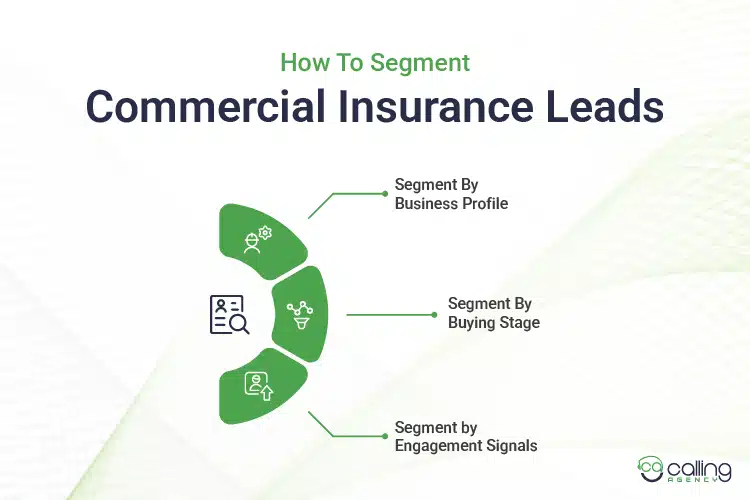
Segment By Business Profile
Each business is unique for insurance purposes. Segmenting by business profile allows you to get the message right.
Key profile factors include:
- Industry, for example, construction, healthcare, retail, or logistics.
- Size, revenue, and number of employees in the company.
- Risk exposure and coverage complexity.
A construction company is more at risk than an office business. Larger companies need more coverage. Your content feels relevant when you group leads by profile. That makes it more likely that leads will respond to your advice and trust you in return.
Segment By Buying Stage
Not all leads are ready to buy. Some are just learning. Others want quotes.
You can segment leads by:
- Awareness stage leaders who need simple education.
- Options are looking to lead the comparison stage.
- Renewal-focused leads with urgent needs.
- First-time buyers who need guidance.
Each stage needs different messages. Urgent leads want quick help. Early-stage leads need simple explanations. Aligning your message with those intentions drives engagement and booking.
Segment by Engagement Signals
Engagement is an indicator of interest in a lead. It allows you to focus your attention on the right people.
Important engagement signals include:
- Email opens, clicks, and replies.
- Website visits and quote requests.
- Content downloads.
- Call responses and LinkedIn activity.
Leads who interact more are closer to booking. Knowing when to make contact and being able to take the first step in a timely manner, while neither chasing cold leads nor dropping hot ones, is crucial.
Best Communication Channels For Nurturing Commercial Insurance Leads
There are multiple channels available for nurturing commercial insurance leads. Those channels are email, phone calls & voice mails, LinkedIn, and professional outreach.
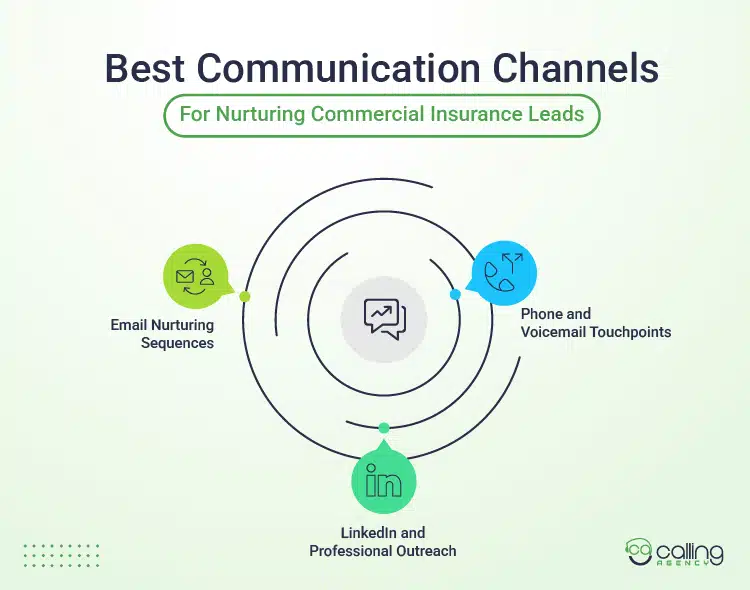
Email Nurturing Sequences
Email is perhaps the most straightforward way to keep your leads warm. It is useful for education as well as follow-up.
Effective email nurturing includes:
- Educational emails that explain coverage
- Consultative emails that offer help
- Case studies and real examples
- Compliance tips and renewal reminders
Keep emails simple and helpful. Do not send too many. Refer to the name and type of business for the lead. Write clear subject lines.
It is good email nurturing that keeps your brand remembered until the lead is ready.
Phone and Voicemail Touchpoints
Phone calls are more human conversation-centric. They’re best for serious leads or time-sensitive ones.
Use phone calls when:
- A policy renewal is near
- A lead asks detailed questions
- Email responses are slow
Voicemails should:
- Be short and clear
- Focus on value, not selling
- Invite a simple callback
Knowing when to time the call helps turn possibilities into success. Mid-week mornings often work best.
LinkedIn and Professional Outreach
LinkedIn connects you to the people who make business decisions. It’s good for gentle outreach.
Best LinkedIn nurturing steps:
- Send polite connection requests
- Like and comment on posts
- Share helpful insights
Avoid selling too soon. Build trust first. When the lead replies, take it to private messaging. Then suggest a short call. This is organic and results in better appointments.
How to Transition From Nurture to Appointment?
To transition from nurturing to appointment, carefully focus on identifying appointment-ready signals, low-pressure appointment CTAs, and the right scheduling practices.
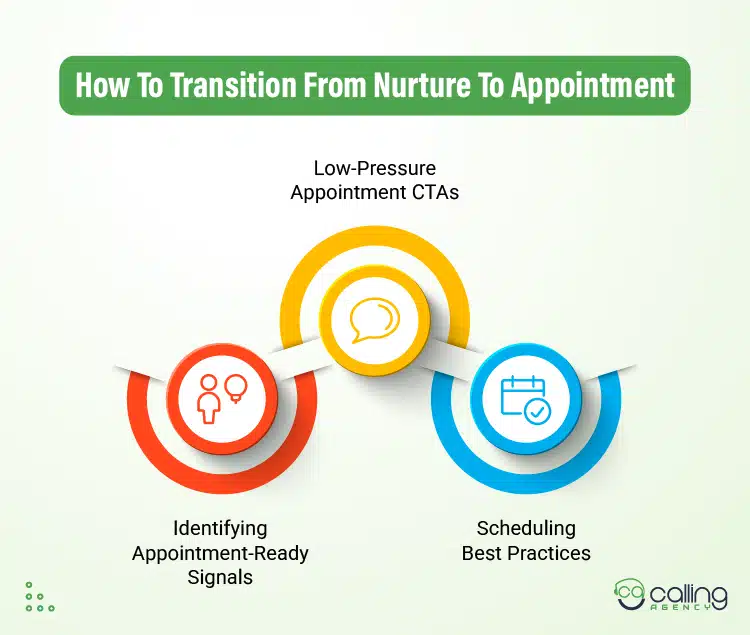
Identifying Appointment-Ready Signals
Those leads aren’t all ready for meetings. You have to wait for hard evidence. One strong signal is the repeated.
This signifies that the lead opens or clicks regularly, at least. Direct questions are another sign. If somebody asks about price, coverage, or limits, they are for real.
It’s critical that there be no hesitation on expiration questions. They show urgency.
There are some policy comparison or coverage clarification requests that also convey the lead is seeking help now. It means not a minute before and, equally important, not too late.
Low-Pressure Appointment CTAs
The call-to-action (CTA) you use makes all the difference.
- Avoid saying “sales call.” It creates fear. Use soft, supportive language like “quick coverage review.”
- You can also call it a “risk check” or a “policy audit.” These sound safe and useful. Keep the tone friendly and calm.
- Explain that the call is brief and friendly. Call it what it is, learning, not selling.
This easy task language reduces stress and anxiety and helps build trust. When people don’t feel pressure, they are more likely to say yes.
Scheduling Best Practices
Keep scheduling easy for the lead. Provide choices of times they can select what suits them best.
Take advantage of calendar links to bypass back-and-forth emails and save time. Send reminders before the call.
This reduces no-shows. Always send an explicit confirmation. Communicate what the call will cover in informal language.
If necessary, tell them to bring some basic policy details. Good preparation helps both sides. A stable scheduling process demonstrates respect and confidence before the call even begins.
Final Words
Structured nurturing allows leads to feel prepared and safe.
- Segmentation is such an easy concept, but when not done correctly, it’s very hard to implement campaigns effectively.
- Picking the right channel and timing builds trust over time. Focus on quality appointments, not quantity. One good meeting is worth a lot of bad ones.
- Stay on it in a helpful way. Consistent and friendly follow-up builds your pipeline slowly but persistently.
This premise converts to long-term success and strong client relationships.