


Selling payment processing to eCommerce and CNP merchants is different from selling to physical stores. You are not just selling a lower rate. You are selling safer payments, fewer chargebacks and a setup that works with their platform.
Just follow these 7 steps:
- Check risk, volume and platform.
- Find the payment decision-maker.
- Build a targeted lead list.
- Review recent statements and recurring payments.
- Compare their real processing costs.
- Offer the right gateway, pricing and fraud tools.
- Make switching easy and expand the account.
This guide is for ISO agents and payment consultants selling to eCommerce and CNP transactions.
What Should You Check Before Pitching an Ecommerce Merchant?
Before pitching an ecommerce merchant, check risk, chargeback management, average order value and platform. This tells you if the merchant is worth contacting and what to discuss.
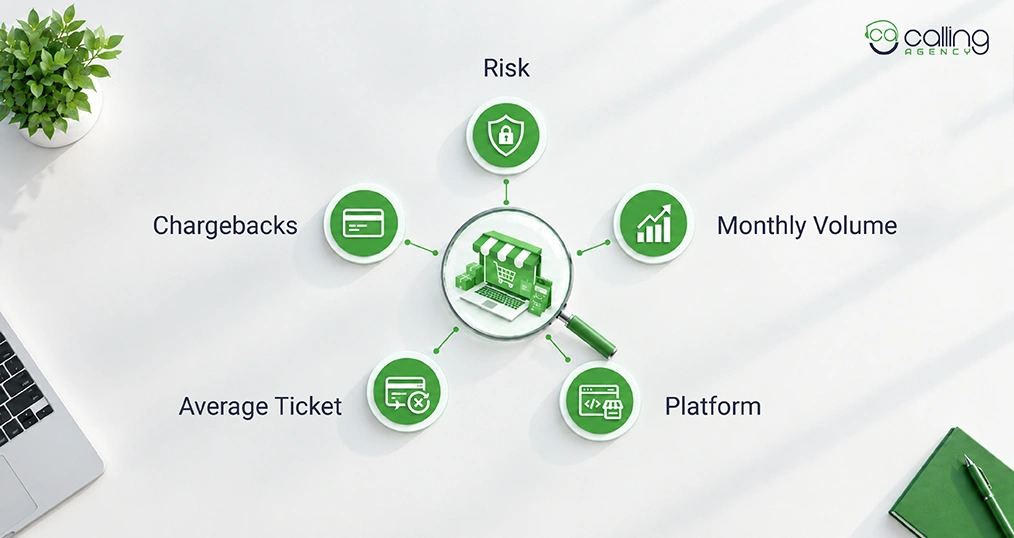
- Risk: Is the business standard or high-risk?
- Chargebacks: Check the last 3–6 statements. High levels, including around 1.5%, may require more risk checks.
- Monthly volume: Higher volume may create more pricing opportunities.
- Average ticket: Larger CNP transactions can mean higher fraud and chargeback disputes.
- Platform: Check whether they use Shopify, BigCommerce, WooCommerce or Magento.
What Chargeback and Fraud Ratios Should You Check?
Check the merchant’s chargeback ratio, chargeback count and dollar value across the last 3-6 statements. A 1.5%+ ratio can indicate serious card-brand monitoring risk. But the exact VAMP or ECM requirements depend on the credit or debit card brand, region and transaction security and count.
For Visa, check Visa’s Acquirer Monitoring Program (VAMP). Mastercard’s ECM program also uses chargeback thresholds and monthly-count requirements. These programs can lead to high fees or fines.
Ask for:
- Chargeback management and dollar amount
- Total transactions
- Fraud-related disputes and reason codes
- Recent holds or reserves
- Previous processor warnings
A high ratio is a strong sales signal. Just connect fraud tools to the merchant’s actual losses. Don’t sell them as extra features.
AVS, card-security-code checks and 3D Secure (3DS) can reduce CNP rates of fraud. 3DS can shift fraud liability to the issuer on eligible authenticated transactions. But do not promise this for every transaction.
Which MCC Codes Signal High-risk vs Standard Ecommerce?
MCCs identify a merchant’s business type and help determine its risk level. Subscription billing, nutraceutical and adult-content businesses can be high-risk as per LegitScript’s card-brand compliance guidance. But standard retail usually has faster underwriting. Visa and Mastercard have different MCC rules. So check the merchant’s actual MCC and requirements before quoting.
High-risk merchant services may have higher fees, more paperwork and fewer processor options. So a reliable payment processor can matter more than a small rate saving.
For subscription businesses, check account updater, recurring billing, fraud protection and cancellation policies.
For international businesses, check cross-border payments, supported currencies, FX costs and local payment gateways.
Where Do You Find Ecommerce Payment Processing Leads?
You can find eCommerce payment leads from app marketplaces, LinkedIn and competitor signals. Just focus on merchant services that may want to change their payment gateway. You can go through:
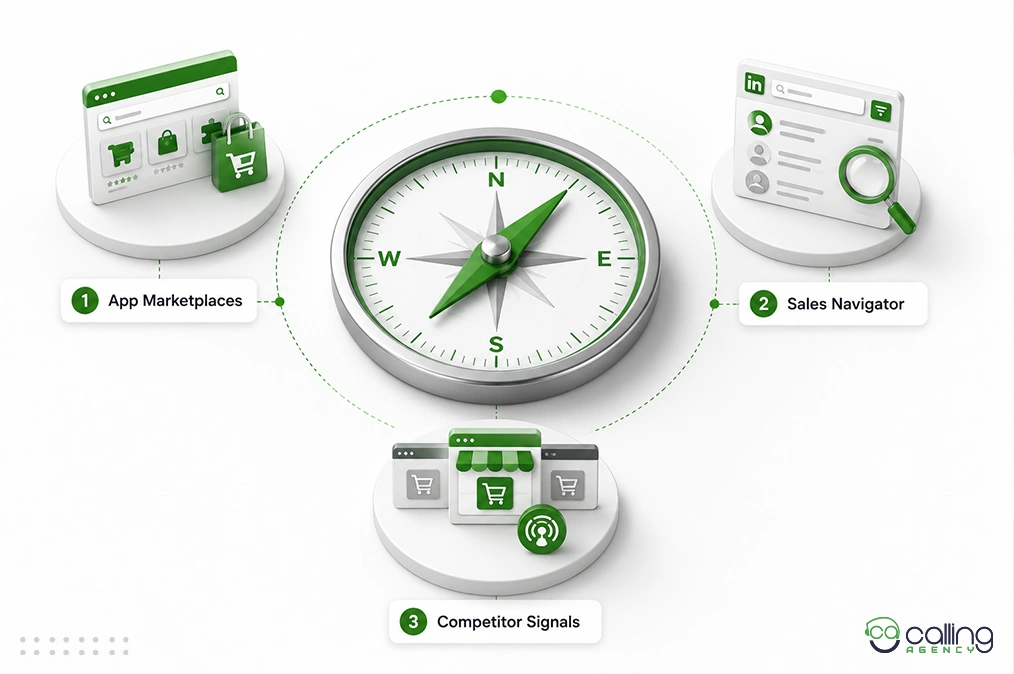
- App marketplaces: Find Shopify and BigCommerce stores using other payment terminals.
- Sales Navigator: Find decision-makers by job, industry expertise, company size and location.
- Competitor signals: Look for new funding, checkout issues or rising chargebacks.
A 5-month CallingAgency campaign for a payment processing and merchant services client generated 373 qualified appointments with a 35% conversion rate through calls, emails and LinkedIn InMails. Qualified leads grew 45% month over month.
Sales Navigator helps you find prospects. Calls and emails help turn them into meetings. Building lists yourself gives more control but takes time. Buying a pre-qualified list from an outsourced merchant services lead generation provider costs less rep time. But you need to check the lead quality and targeting first.
How to Use Shopify and BigCommerce App Directories to Find Leads
Use Shopify and BigCommerce app directories to find merchants using payment, checkout or fraud tools. Look for stores using competing or outdated plugins.
Prioritize stores that are:
- Growing their sales or traffic
- Adding international customers
- Starting subscription billing
- Adding a new payment processor
- Changing their checkout
- Outgrowing their current gateway
Check store size, platform and estimated traffic before adding a lead. Tools such as Similarweb and BuiltWith can help identify traffic and website technology. So, focus on higher-volume stores.
How to Build a Prospect List With LinkedIn Sales Navigator
Use Sales Navigator to build a prospect list and find the right decision-maker.
Target:
- Founder or Owner
- eCommerce Manager
- Head of Operations
- Controller or Finance Director
- CFO
Filter by industry, company size/headcount, location and job title. Save searches so you can refresh the list every week.
How to Reach Decision Makers at Ecommerce Companies
You have to find the person who makes payment decisions to reach decision-makers at eCommerce companies. Then book fintech sales meetings with the decision-makers and talk about what matters to them.
- Finance teams: Focus on fees, effective rates, chargebacks, reserves, cash flow and total costs.
- Founders: Focus on checkout conversion, international growth, customer experience and failed payments.
Use cold calls, email and LinkedIn together. Start with a specific problem and ask about their processor, gateway and payment issues. Then offer a solution.
Who is the Real Decision Maker for Payment Processing at an Online Store?
The real decision-maker for payment processing at an online shopping store is usually the founder at a small store. It can also be a finance, operations or payments leader at a larger company.
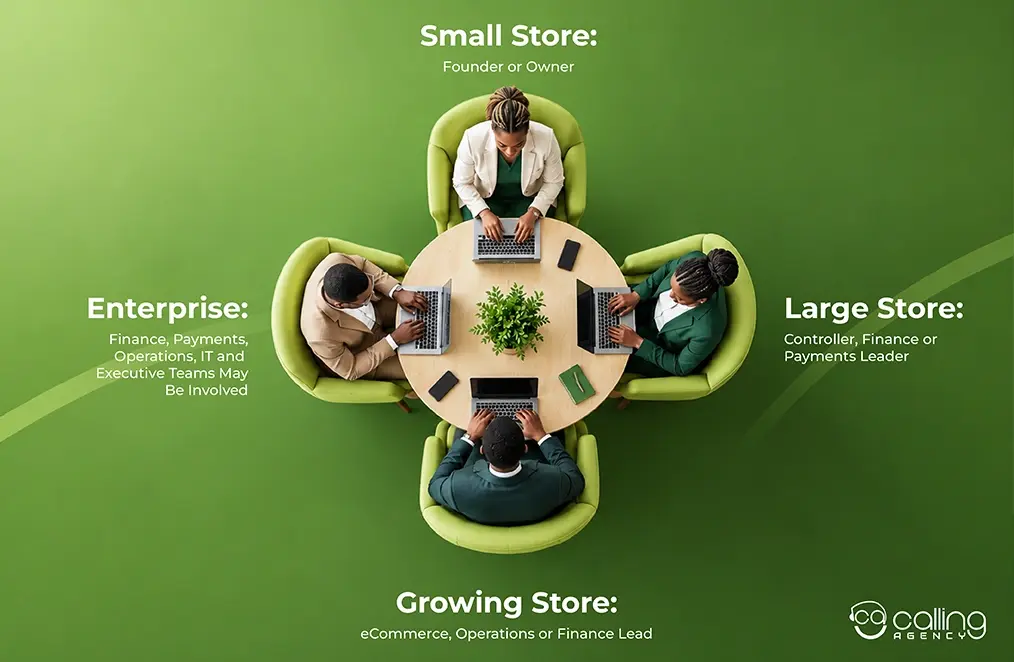
- Small store: Founder or owner
- Growing store: eCommerce, operations or finance lead
- Large store: Controller, finance or payments leader
- Enterprise: Finance, payments, operations, IT and executive teams may be involved
Find the person who can actually approve a new processor or gateway. Then match your pitch to their role.
What Should Your Outreach Message Say to Get a Response?
Your outreach message to get a response should start with something specific you can verify about the merchant. Then ask for a short discovery call.
Mention something you can verify, such as:
- Their platform
- A missing payment option
- A recent expansion
- A checkout problem
- Possible high processing costs
- A payment gateway
Show that you understand their setup. Connect it to a business owner’s problem. Then ask for a short conversation.
How to Run a Discovery Call With an Ecommerce Merchant
To run a discovery call with an eCommerce merchant, you have to use the discovery call to understand the merchant’s costs and checkout problem. Then recommend a solution.
Ask about:
- Current processor and gateway
- Platform and integrations
- Monthly volume and average transaction
- Pricing and fees
- Chargebacks and fraud
- Checkout abandonment and failed payments
- Payment terminal
- Account holds or reserves
- Gateway limitations
Ask for 3 recent processing statements if possible. Three months gives a better picture because eCommerce sales goals change with seasons, holidays and promotions. If needed, take help from the discovery call guide for merchant services reps.
What Questions Uncover the Merchant’s Real Pain Points?
Ask direct questions about costs, checkout, fraud detection and online retail. Such as:
- “Who processes your payments?”
- “Which gateway do you use?”
- “What is your monthly volume?”
- “How many chargebacks did you have in the last 3 months?”
- “Have you had any holds or reserves?”
- “How often do payments fail or need retries?”
- “Which payment methods do customers request?”
- “Are you happy with your gateway?”
- “What would make you switch?”
Look beyond price. High checkout abandonment may mean missing mail payments such as Apple Pay or BNPL. Frequent chargebacks may need better fraud tools. Holds or reserves can also be strong reasons to switch.
How to Build a Savings and Rate Comparison for CNP Merchants
To build a savings and rate comparison for CNP merchants, compare the merchant’s total processing cost, not just the advertised rate. Card-not-present transactions have different risk and pricing because the customer does not present a credit card or debit card.
Use at least three months of statements. This gives a better picture when eCommerce sales goals change during holidays, promotions or seasonal periods.
Interchange-plus vs. Tiered Pricing for CNP Merchants
| Pricing model | How it works | CNP fit |
| Interchange-plus | Interchange plus a fixed processor markup and transaction fee | Strong for merchants that want transparent pricing |
| Tiered | Transactions are placed into qualified, mid-qualified or non-qualified buckets. | Weaker because CNP transactions can fall into more expensive tiers |
| Flat-rate | One blended rate is charged for eligible transactions. | Simple, but may become expensive as volume grows |
Interchange rates are set by the debit and credit card networks. The main areas a processor can usually compete on are markup, gateway fees and other processor charges.
For CNP merchant services, interchange-plus makes these costs easier to see and compare.
How Do You Calculate Effective Rate for a Card-not-present Merchant?
To calculate the effective rate for a card-not-present merchant, you must use a simple formula.
Effective rate = Total processing fees ÷ Total processing volume × 100
For example:
$3,500 fees ÷ $100,000 volume × 100 = 3.5%
Use these four steps:
- Get total fees from the statement.
- Get total processing volume.
- Divide fees by volume.
- Multiply by 100.
Calculate it across three months. Then compare it with the merchant’s headline rate. Include processor fees, gateway fees, interchange fees, monthly fees, chargeback fees and other applicable costs.
This shows the merchant’s real processing cost.
How to Structure Your Proposal for Ecommerce Merchants
Structure your proposal for eCommerce by keeping it simple. Show the new setup, the cost and the savings.
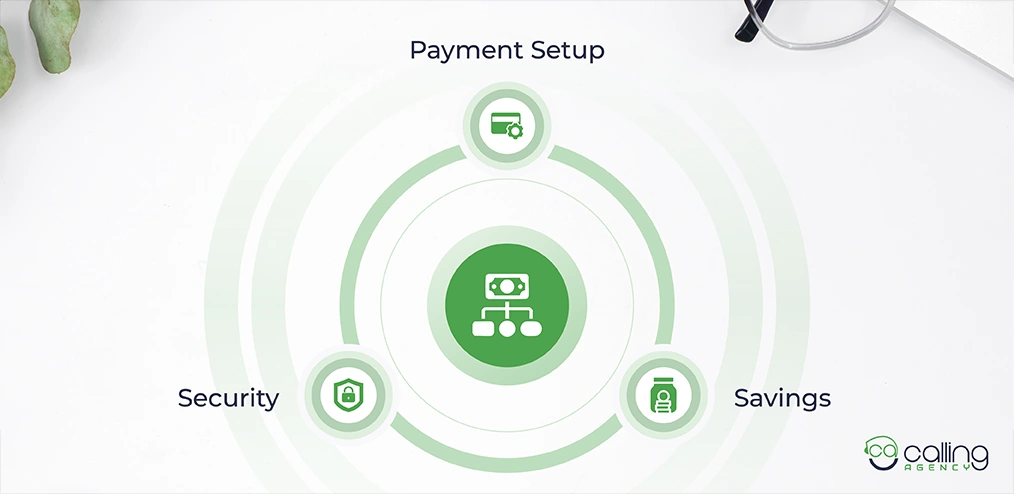
- Payment setup: Explain which processor and gateway you will use and how it will connect (hosted checkout, API or plugin).
- Security: Explain the fraud tools, chargeback protection and PCI DSS requirements.
- Savings: Show the merchant’s current cost, your proposed cost, effective rates and expected monthly savings.
What Should You Include in a CNP Merchant Proposal?
Include the price, gateway, integration, security and expected savings in a CNP merchant proposal. Show:
- Processing price, markup and transaction fees
- Gateway costs
- Current vs. proposed effective rate
- Estimated monthly savings
- Platform integration
- Fraud and chargeback tools
- PCI DSS responsibilities and applicable SAQ
- Implementation timeline
- Customer support process
Do not guess the SAQ level. A qualifying third-party hosted page may use SAQ A. Meanwhile, a merchant-controlled payment page may require SAQ A-EP.
Clearly state the gateway, integration method, encryption methods, SAQ and timeline so the merchant knows exactly what to expect.
Which Gateway Fits Which Platform and Integration Type?
Choose the gateway based on the merchant’s platform, country, payment methods and integration needs.
| Gateway | Common use | Common integration |
| Stripe | Fast-growing eCommerce businesses | Hosted checkout or embedded tools |
| Authorize.net | Merchants that need a widely supported gateway | Plugin, hosted page or API |
| NMI | ISO and reseller environments | Hosted page or API |
| PayPal/Braintree | Merchants wanting PayPal and card options | Hosted checkout or PayPal tools |
Match the Gateway to the Platform
- Shopify: Supports many payment providers, but options depend on the country and store setup.
- WooCommerce: Supports redirect, iframe and direct integrations. Direct integrations may require more PCI work.
- Magento: Stripe, Authorize.net and NMI can be added through suitable extensions.
Before recommending a gateway, check the platform, phone orders, country, payment methods, encryption methods and integration type.
Choose the Right Integration
Hosted checkout is usually the simplest option because the payment provider handles more of the payment page.
Do not promise a specific PCI DSS SAQ without checking the setup. SAQ A may apply when all payment-page elements come directly from a PCI compliance provider; if the merchant’s website supplies payment-page elements, SAQ A-EP may apply.
Before recommending a gateway, confirm the digital wallets, country, payment methods, virtual terminal and PCI requirements.
How Do You Expand and Get Referrals From Ecommerce Merchant Accounts?
To expand and get referrals from ecommerce merchant accounts, first, help the merchant with more payment needs. Then ask them for referrals.
For example, offer recurring billing, fraud protection, chargeback tools, BNPL, international payments or support for more stores.
Match the service to the problem. Failed subscription payments → billing recovery or rising fraud → fraud protection.
Once the merchant is happy with the results, ask for one introduction to someone in their business network. You can also check out how to shorten the merchant services sales cycle.
Frequently Asked Questions
How do you sell payment processing to ecommerce merchants?
To sell payment processing to eCommerce merchants, find the merchant’s main payment problem and show how your solution can fix it. Check their platform, processor and payment volume before discussing price. Look for problems with costs, fraud, chargebacks, checkout or integrations.
How do you find ecommerce payment processing leads?
Find eCommerce leads through Shopify, BigCommerce, LinkedIn Sales Navigator and targeted calls or emails. Focus on business owners that are growing, processing more payments or having payment problems.
What is a card-not-present transaction?
Card-not-present transactions are payments where the customer does not physically show the card. Common examples are online gaming, subscriptions and other remote payments.
Final Takeaway
The best eCommerce payment sales focus on the merchant’s real problem, not just a lower rate.
Ask, “What is costing you money or causing problems with your current payment setup?” Check their statements, chargebacks, checkout and technology to find the answer.
Then offer the right solution. High-volume merchant services may need lower costs. Subscription businesses may need better failed-payment recovery. High-risk merchant services may need stable processing and stronger fraud management. International sellers may need better currency and acquiring support.
When you solve the right problem, price becomes less important and the sale becomes easier to close.