

Selling merchant services to high-risk clients is about placement, not persistence. The reason why you got out of the low-risk retail sector is that Stripe and Square removed your price advantage. On the other hand, high-risk businesses are charged more but stay with you longer.
Additionally, they are more frequently declined by payment processors and those refusals rarely provide any information. Visa’s Excessive Merchant threshold is 150 basis points. In a nutshell, it means that your acquirer must remain within its limits after you channel the application to it.
This guide is intended for independent agents and sales leaders who run small independent sales organizations or ISOs. It assumes familiarity with interchange, residuals, processing rates and how qualified merchant services leads move through underwriting.
Which Acquirer Should You Send the Application To?
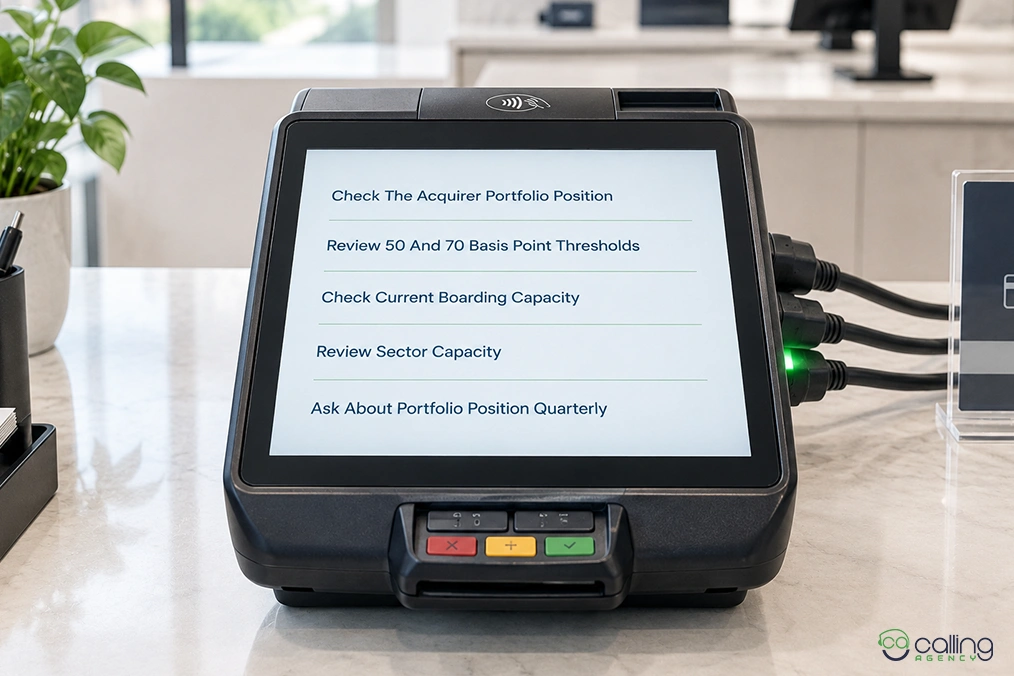
The core answer to this question is to send the application to an acquirer whose own portfolio sits below Visa’s monitoring lines. Visa’s Acquirer Monitoring Program suggests those lines at 50 and 70 basis points. It applies merchant-level thresholds only where the acquirer itself sits below both portfolio limits.
The information regarding the condition is frequently neglected. The trustworthy acquirer does not subject its merchants to excessive scrutiny. The one that has already overstretched itself does and it does not matter if two identical records are issued at the same time.
Choosing an acquirer is a controllable parameter that can be changed by an agent; however, most of the agents consider it to be immutable, which is where they lose their dealings.
| Level | Applies to | Threshold |
| Above Standard | Acquirer portfolio | 50 basis points |
| Excessive | Acquirer portfolio | 70 basis points |
| Excessive Merchant (Asia-Pacific, Canada, EU, US) | Individual merchant | 150 basis points from 1st April,2026 (previously 220) |
| Excessive Merchant (Latin America and Caribbean) | Individual merchant | 150 basis points |
| Excessive Merchant (Central Europe, Middle East, Africa) | Individual merchant | 220 basis points |
What to Ask an Acquiring Partner Before You Send the First Deal
Before sending the actual file, make sure that you are clear on the following points with the acquiring partner:
- What is their portfolio position in terms of 50 and 70 basis points?
- Do they track this number, or only react to it after a decline?
- What is the current boarding capacity in the sector you are interested in?
- Has their appetite tightened in the last quarter, even without an announcement?
Always remember to ask these questions quarterly. After all, the moves in portfolio positions must be followed by moves in risk-reducing measures too.
Example:
“Before I send you anything, could you tell me where your portfolio is in comparison to 50 and 70 basis points? Actually, I need to place this merchant in the right spot where he can actually be boarded.”
This kind of question should also be used early in a discovery call for merchant services reps, as it allows determining which acquirers remain in the shortlist for the rest of the conversation.
Which Businesses Count as High Risk Right Now
There are 10 merchant categories that require registration with Mastercard. For these merchants, it is not a matter of the underwriting process giving consent rather it’s a matter of whether the acquirer maintains the required registration.
Mastercard’s Security Rules and Procedures Merchant Edition of August 4, 2026 includes 10 registered categories.
- Adult industry non-face-to-face content and services
- Non-face-to-face online gambling
- Tobacco and pharmaceuticals
- Lotteries operated by government organizations
- Skill games
- High-risk cyber merchants
- Cannabis for recreational purposes, available only in Canada
- High-risk financial securities merchants
- Cryptocurrencies
- Merchants that sell physical goods through negative option marketing
In relation to these categories, the manual references previous Mastercard approvals, acquirer prerequisites and registration costs. Registration is an essential step that comes before onboarding to a payment gateway. An acquirer either has registration or does not have it.
Everything outside of the listed items does not help with the underwriting process, including such factors as chargeback history, status of the new business, poor creditworthiness and cross-border transactions.
Once again, regardless of an acquirer’s policy, none of the above factors will require registration.
The Chargeback Threshold That Gets a High-Risk Merchant Flagged
The registration process is used by Mastercard, while Visa adopts a different procedure. Instead of the flat rate of 1% quoted in many high-risk sales training sessions, Visa has developed a system known as Excessive Merchant that operates at 150 basis points as of April 1, 2026.
- This system looks at not only disputes but also all reports of fraud.
- The latest step in this process took place on April 1, 2025, when Visa canceled its Dispute and Fraud Monitoring Programs.
- Now only one measure exists, that being the Acquirer Monitoring Program.
- Visa dropped the amount from 220 down to 150 basis points or by almost 32%.
What the VAMP Ratio Actually Counts
VAMP stands for Visa Acquirer Monitoring Program. VAMP takes the total number of disputes and fraud reports and divides it by settled card-not-present (CNP) transaction volume. Besides this, sales that take place in a physical terminal are not included in the count, which puts a different perspective on qualifying specific types of merchants.
- If a merchant has mostly physical terminal transactions, those won’t make it to the VAMP stat.
- Two exclusions exist in the numerator. Dispute resolution through an alert network before chargeback execution and fraud reports qualifying under Compelling Evidence 3.0.
- Agents suggesting that the same chargeback ratio should be applied to different merchants will get corrected by those already knowing their numbers.
Why Small Merchants Cannot Trigger the Threshold on Ratio Alone
Visa enforces the merchant-level limit starting at 1,500 combined fraud and dispute events per month. This is a Visa VAMP threshold for Asia-Pacific, Canada, the EU, the U.S. and LAC, not a rule for all card networks. If a merchant stays below that level, they will not be monitored under VAMP regardless of the ratio.
A merchant processing a few hundred transactions a month will not hit 1,500 dispute events. The acquirer may implement stricter internal controls, but not the network-level limit described in many guides.
How Do You Qualify a High-Risk Merchant Before Submitting an Application?
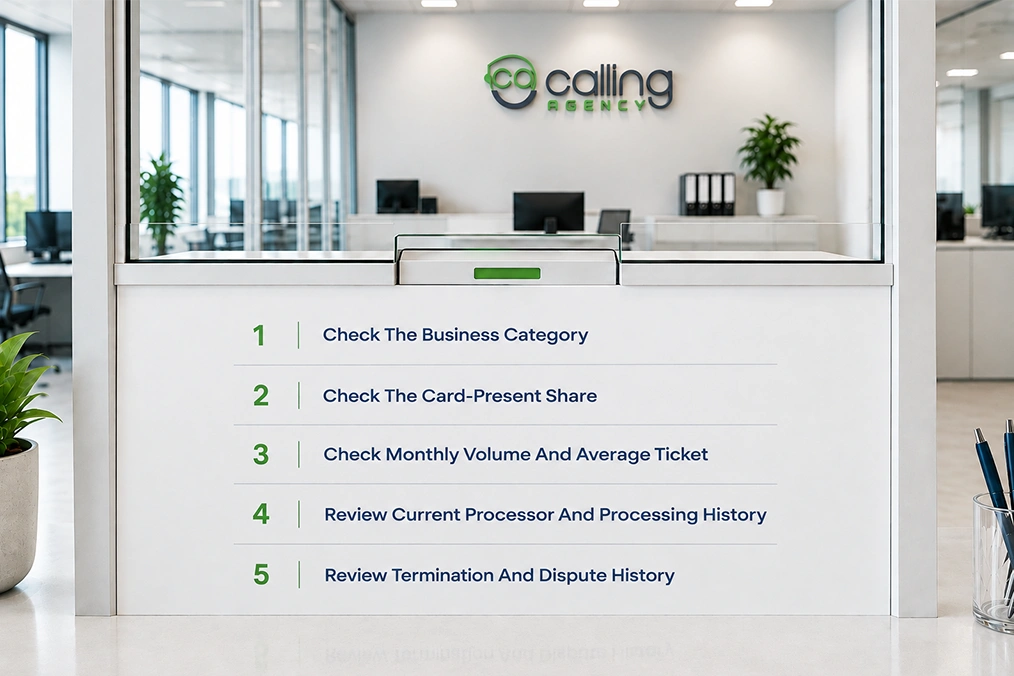
Perform five steps in a fixed sequence. First, check the category of the business, then the card-present share, after that the monthly transaction volume, then the processing history, and finally the disputes history. The position is important because the answer modifies the questions to be considered.
| Pass | Question | What the answer decides |
| 0 | Which category does the business fall under? | Whether a registration requirement applies |
| 1 | What share of sales runs card-present? | Whether the card-not-present ratio touches them |
| 2 | Monthly volume and average ticket? | Whether the 1,500 event floor is reachable |
| 3 | Current processor and how long with them? | Whether a decline was category or history |
| 4 | Prior termination and dispute history? | Which acquiring relationship receives the file |
Where to Find High-Risk Merchant Prospects Without Buying a Recycled List
High-risk acquirers outline the types of transactions and industry coverage they accept on their websites. By examining a couple of these articles, you can see what markets are accessible, even without paying for a comprehensive list. To do this:
- Start with acquirers with whom you have established connections and examine their websites for the information you need.
- Use one article from an acquirer with which you have no connection, as the amount of missing information can tell you whether or not establishing a connection would be worthwhile.
- Group ISO, Segpay and SecureGlobalPay frequently publish useful articles.
- CardPaymentOptions has its own high-risk register, but be mindful that both legal regulations and banking policies are prone to changes and have a rather short lifespan.
What Do You Say to a Merchant Who Has Already Been Declined?
Start by inquiring about which acquirer denied them and when. An eighteen-month-old denial tied to another portfolio position may be less relevant today, but it can still matter depending on the reason for the denial, the merchant’s history, MATCH status or current underwriting criteria.
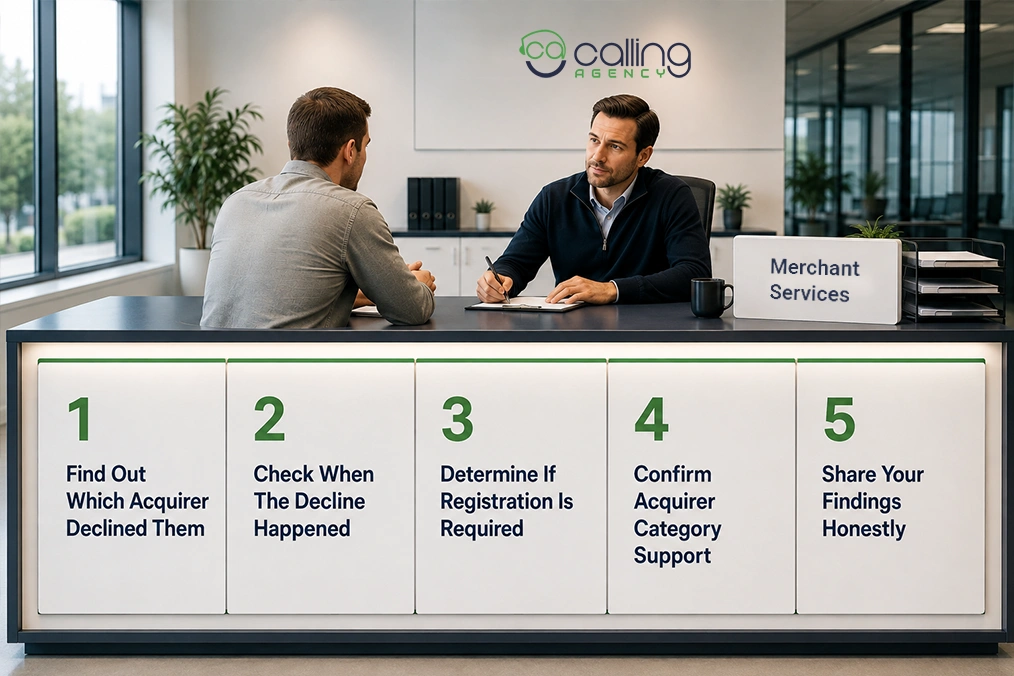
Many denied merchants have the sense that the problem is permanent and belongs to them. In most cases, the reality is the opposite. That is the essence of the reframe. Just remember not to start with processing rates. A merchant who has been rejected two times will not be focusing on it.
In this scenario, the second call is so much more important than the first. Usually, denied merchants have already received another promise of approval from somewhere already, so a bare confident proposal will sound boring to them. The secret is to come to them with some detailed information you managed to find out between the calls.
Before you make the second call, make sure that you do two things.
- Determine if their category has a registration requirement.
- Find out if your targeted acquirer can support the category and complete the required registration.
When you make the second call, just tell them your findings right away. My category requires registration and my acquirer has it is a formulation that no competitor would have used against them in our industry. It is either true or false, and that makes it effective. If your answer was no, say that too.
The merchant will not be getting a deal and the referral. The high-risk categories are narrow enough that everybody knows everyone. This same honesty pattern telling a merchant the truth even when it costs the deal is part of overcoming merchant services objections without resorting to a rate-first pitch.
When the Decline Was About the Acquirer, Not the Merchant
An acquirer that has reached its threshold may decline a merchant that it would have been able to board a quarter ago despite the fact that the merchant does not have any previous issues. This means that it is not a matter of the merchant but of the portfolio position.
In some cases, the reason for the decline has to do with industry type and prior problems rather than terminal performance. Even though the VAMP ratio considers non-present transactions only, that merchant’s in-person point-of-sale volume is hardly the reason for the decline.
When the Merchant Really Is Over the Line
Being at an actual level above the threshold indicates that the merchant needs to reduce its number of disputes prior to submittal. A different acquirer or pitch will not help in that case.
Say it even if it means losing a deal. Boarding a merchant who breaches the threshold leads to having remediation costs soon after boarding.
How Many Booked High-Risk Merchants Actually Clear Underwriting?
Over a 6-month campaign for CallingAgency services, 149 scheduled appointments resulted in 34 activated merchant accounts. This means an activation rate of 23%, since the company was recording around 5-7 appointments per month previously.
| Campaign length | Appointments booked | Prior baseline | Activated accounts | Activation rate |
| 6 months | 149 | 5 to 7 per month | 34 or more | At least 23% |
The campaign was aimed towards merchants in general and not merely high-risk businesses. Subsequently, it is unclear if the stated number constitutes the actual high-risk underwriting figure.
Instead, it is better to look at the connections between relevant appointments, submitted applications, approvals, accounts activated and residual revenue.
What It Costs to Acquire One Boarded High-Risk Merchant
There are no verified industry-wide statistics on this cost. Instead, what you get are approval conversion rates and cost ranges that are not verifiable. Agents should compare appointment costs with activation rates when planning their merchant services campaign budget.
- A commonly used “95% approval conversion rate” shows up across providers’ marketing materials with a lack of citation and use of hedging in language (“as much as”).
- This number is not useful for reliable planning.
Do your own calculations instead:
- Take meetings that you booked for a quarter.
- Use actual activation rate.
- Divide the cost of prospecting by the number of accounts boarded.
- Compare the number you get with the residual produced by these accounts over some time.
Running High-Risk Outbound In-House Versus Outsourcing It
The decision between running high-risk outbound in-house or outsourcing it depends mainly on the number of high-risk processing accounts or acquiring relationships that are in your targeted market.
| In-House | Outsourced |
| You can have only one acquiring partnership. | You can have three or more acquiring partnerships. |
| Very selective and precise; there’s no point in targeting merchants outside that one acquirer’s specialization. | Fit is no longer a restriction, so the search can be much more extensive. |
| Value comes from whether a prospect fits the single acquirer’s niche. | Value is determined by volume and amount of transactions. |
| Added capacity is beneficial only to some extent. Pitching more won’t help if the niche does not match. | Added capacity is beneficial as it means more leads become clients. |
Frequently Asked Questions
What chargeback rate makes a merchant high risk?
There is no single percentage. Visa uses the combined fraud and dispute percentage for card-not-present transactions. From 1 April 2026, Excessive Merchant puts a limit at 150 basis points. Acquirers have stricter internal limits and those are what you would start from when assessing a merchant’s business risk.
How do you qualify a high-risk merchant on a first call?
The five passes can be performed in this order. First, the category, then the card present percentage, volume, the current acquirer or aggregator and finally the past termination and dispute experience. Category is the first consideration since it determines if the registration is needed at all.
Can a merchant on the MATCH list still get an account?
MATCH is a term used to identify the Mastercard Alert to Control High-risk Merchants, while the latest Mastercard procedures use the term MATCH Pro. Acquirers who cover this area are not required to accept a merchant listed on MATCH Pro. They may onboard one after reviewing the risk, but acceptance remains the acquirer’s decision. The process of removal is conducted in accordance with Mastercard’s regulatory guidance, although we make no claims as to the specific details.
Does a high-risk merchant need a different sales pitch than a retail merchant?
No, there are not too many differences between the pitch aspect of selling and the placement aspect of pitching. The only thing that should be changed is the acquirer to whom the application is sent.
How long does high-risk merchant underwriting take?
It is difficult to be precise about the time frames. According to some information available, one could be approved within 24-72 hours of sending their application. However, according to another source, it takes 24 hours to 48 hours to review the application and at least 2-5 business days to complete the setup with the payment service provider.