

Lead follow-up is a very important part of sales generation for any business. Studies show that 80% of sales require more than 5 follow-ups to turn a lead into a customer, but 44% of sales professionals stop after doing the first follow-up.
This stat shows how you might be missing key opportunities to turn your merchant service leads to loyal customers if your sales team is not making a strong effort in follow-up.
This article explores the process of doing a proper follow-up, including identifying the intent behind the follow-up, creating the sequence, choosing effective channels to use, creating a follow-up script, and how to handle the common objection of a potential customer.
Understand Merchant Services Lead Intent Before You Follow Up
Merchant services lead generation experts target potential customers who are looking for a payment processing solution suitable to their business. These credit card processing leads usually want a solution that gives them the ability to handle transactions through credit cards, point-of-sale, and online payment systems securely.
Before following up on a merchant service lead, salespeople should know the type of customer who mostly belongs to a merchant service lead list and what they want:
- Businesses that need to handle a large volume of transactions securely and detect fraud or scams effectively
- Retail or e-commerce stores that want to handle payments with a system that works well with their tracking, inventory, and accounting software,
- Professionals such as doctors or lawyers who need to accept payment from their clients smoothly and in a fully compliant way.
- Software businesses or SaaS platforms that run a high-risk business and frequently need to refund their clients.
How to Build A Structured Follow-Up Timeline for Merchant Services Leads
It is essential to create a plan with a well-structured timeline for doing a follow-up on merchant service leads. The strategy or approach to reaching out to potential leads should be made depending on this timeline. This timeline will often determine whether or not you will be successful in closing the deal.
Here is a comprehensive guideline for effective follow-up:
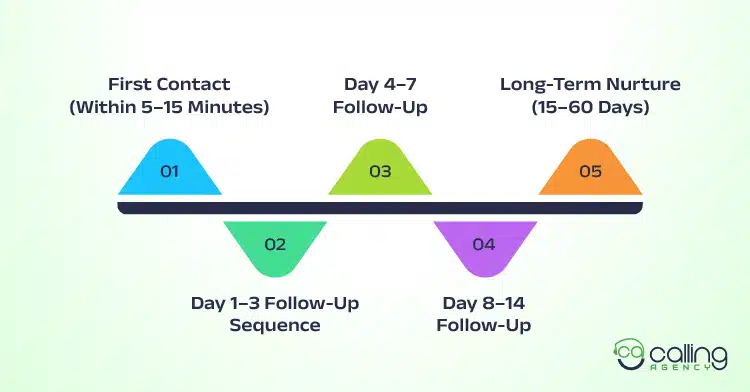
First Contact (Within 5–15 Minutes)
First contact with a follow-up within 5-15 minutes is very important for turning a lead into a customer. A stat shows that the businesses that contact a lead within 5 minutes are 21 times more likely to convert that lead than those who wait for the first 30 minutes.
If a prospect reaches out to you with a question, try to answer them within 5 minutes. It will increase the chance of converting that lead to a customer. In some cases you may not be able to respond that fast because you may need to gather information.
In that case, try to respond within 1 hour, and if it happens that a lead is reaching out to you outside the business hours, then it may take longer for you to respond. But make sure that you respond to that customer within 24 hours.
Remember, a prompt response is crucial, because if you take too long, a potential customer may go to a competitor for the same service.
Day 1–3 Follow-Up Sequence
After the first contact, you should let the lead process the information you have provided about your service. Then, try multiple channels such as LinkedIn, text, phone, and email to reach out to them. To keep your prospects engaged, you can share a cost-reduction stat or graph using the channel where they are most active. You can also engage them in a conversation that starts with an open-ended question, so they can explore their pain points.
Day 4–7 Follow-Up
At this stage, your potential customer is supposed to get the initial information of your service and have basic knowledge of what you offer. So you can try to break down some more exclusive information and benefits to them. Like, the packages that are well-suited for them.
Day 8-14 Follow-Up
After breaking down the packages and detailed information, you can share a real-life story of a similar business to highlight the impact of your solution. It will help the leads to reduce their hesitation and trust your solution. At the same time, offer a demo or trial service so that they can get real-life experience of using your service.
Long Term Nurture (15-60 Days)
Converting a lead into a customer may often take long-term effort. Research shows that, on average, it may take 6–8 attempts to convert a lead into a customer successfully. Other research shows that, in some cases, it can take even 7–14 attempts to convert a prospect.
So you need to be prepared for a long-term plan, and during this stage, you need to communicate with a prospect regularly with something interesting, such as the latest offer or a limited-time opportunity.
Follow-Up Channels: Which to Use and When
Potential customers of merchant service can be reached using multi-channel outreach strategy. However, it is essential to know their intent and persona before deciding which method you should use.
For example, for reaching out to someone in a business leadership position, you can use LinkedIn. On the other hand, someone who is running a retail store can be reached by a phone call.
Here is an overview of which channel you should use and when you should use them:
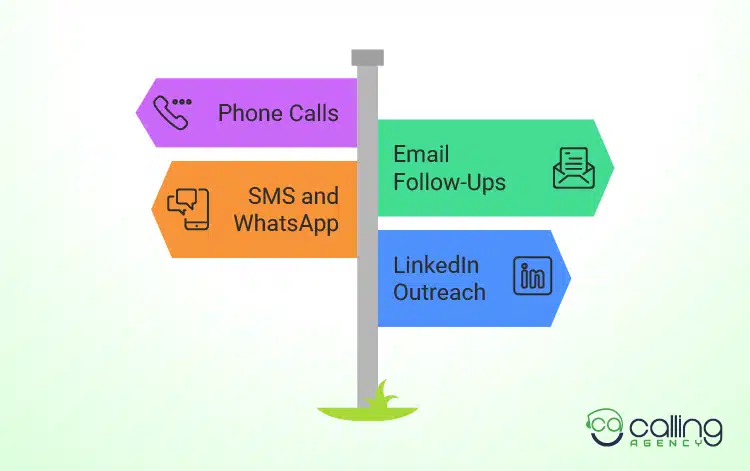
Cold Calling
Sales representatives sometimes use phone calls to reach out to the prospects. This practice is known as cold calling in sales. It can be very useful for explaining complex products or services to a potential customer.
Since a phone call gives you the ability to directly answer the common queries of a lead and address their objections in real-time.
However, phone calls may not always be the best channel for busy prospects. This is because there’s a risk that prospects may be annoyed by an unexpected call, and it may damage your business reputation.
Email Follow-ups
Email follow-ups are most effective for a decisive buyer who takes a long time to settle down. It is useful for sharing resources such as blogs, newsletters, and case studies.
SMS and WhatsApp
SMS and WhatsApp are best for leads who like to act on short promotional messages. The best time for sending SMS and WhatsApp messages is during lunch or afternoon hours when the potential customers are supposed to get some free time.
LinkedIn Outreach
LinkedIn outreach is useful for approaching the leads after sending them a connection request. While sending a follow-up on LinkedIn, you shouldn’t try to directly send a sales offer; instead, try to grab the interest of a lead. Then, send them an invite to a demo or meeting.
Use High-Converting Follow-Up Scripts
As a sales professional, it is essential for you to summarize a conversation before reaching out to the client no matter which channel you use. Having a follow-up script ensures that you can share your value proposition with the leads fluently and without missing any key points.
Here are some guidelines that you can use to prepare your follow-up script for different channels:
Initial Follow-Up Call Script
An initial follow-up call script refers to the speech you are supposed to give a merchant service lead during the first phone call follow-up. It should include these key parts:
Greetings or Introduction: Once a lead receives your call, greet them and say why you are calling them.
“Hello [Prospect’s Name], this is [Your Name] from [Your Company]. How are you today?”
“I’m following up regarding your interest in merchant services. I wanted to quickly connect to understand your current payment processing setup and see if we can help improve efficiency or reduce costs.”
Build Rapport: Tell the lead about the context or reason for calling.
“I am reaching out to you because I have noticed that you are running [talk about their business and challenges in the industry]. At our company, [create a strong value proposition for the lead in a single sentence].”
Qualifying Question: Ask a question to make sure that the lead is interested in continuing the conversation.
“Are there any challenges or issues you are experiencing with payment processing for your business?”
Call to Action: Keep the lead engaged so there is an opportunity to convert that lead into a customer.
“Would you like to schedule a quick demo or meeting so I can show how we can help you with payment handling?”
Follow-Up Email Template
Sending a follow-up email to the leads is an effective way of building connection with them. To generate sales from follow-up emails, a sales person usually needs to send multiple emails in a sequence. Each email in a sequence should have a specific structure or template to warm up the lead into taking action.
Here are some example templates you can use:
First Follow-Up Email (Within 5–15 Minutes)
Subject: Following up on your merchant service interest
Hi [Prospect’s Name],
Hope you are doing well? I am reaching out to you, as I have noticed from our previous conversation that you have shown interest in our merchant service.
At [Company Name], we specialize in helping businesses like yours improve efficiency and enhance customer experience with customized merchant solutions.
I’d love to learn more about the current payment setup and explore how we can reduce cost, speed up deposits, and simplify transactions for your business.
Would you be open to scheduling a quick call or meeting this week? I look forward to connecting with you.
Best regards,
[Your Name]
Second Follow-Up Email ( Send 2 Days after the first follow up)
Subject: Checking in on your merchant service needs
Hi [Prospect’s Name],
I just wanted to follow up to see if you’ve had a chance to review my previous message. At [Company Name], we help businesses like yours reduce transaction fees, speed up deposits, and simplify payment processing with customized merchant solutions.
I’d be happy to share a few solutions that could be a great fit for your business.
Let me know if you’re available for a quick 5‑minute call this week.
Best regards,
[Your Name]
Third Follow-Up Email (Send 4–7 Days after the second follow-up)
Subject: Helping streamline your payment process
Hi [Prospect’s Name],
I wanted to circle back to ensure you have all the information you need regarding our merchant services. Many businesses we work with have seen significant improvements in reducing transaction costs and accelerating deposits, which directly impacts cash flow and customer satisfaction.
If you’re still exploring options, I’d be happy to share a quick overview of how our solutions could fit your business. Even a short call could highlight opportunities to simplify your current setup.
Would you be open to a brief conversation this week?
Best regards,
[Your Name]
Fourth Follow-Up Email (Send 10–14 Days after the third follow-up)
Subject: Final check-in on merchant service solutions
Hi [Prospect’s Name],
I realize you may be busy, so I’ll keep this short. At [Company Name], our goal is to help businesses like yours save money and streamline payment operations. If now isn’t the right time, I completely understand.
That said, I’d love to connect whenever it’s convenient for you. Even a quick chat could uncover ways to reduce fees and make transactions smoother for your customers.
If you’d prefer, I can send over a brief summary of our solutions for you to review at your own pace. Just let me know what works best.
Best regards,
[Your Name]
The above email template gives you a brief idea about how you should structure your email. Based on the service of your merchant solution and follow-up campaign sequence, you can customize them.
For long-term lead nurturing (30-60 days), you should come up with your own research and plan how to keep the lead engaged. However, always A/B test your subject lines of the email and keep your message short while writing an email for a follow-up.
Voicemail Script
Salespeople often make some key mistakes in sending voicemail for follow-up. They sound too pushy and often forget to personalize their email to grab the attention of their prospect.
As a result, their leads often don’t feel the interest to listen to their whole message.
This is why creating a script is important, and here are some guidelines you should follow for writing the script:
- Keep the voicemail script short, within 15-30 seconds.
- Avoid direct sales talk; instead, focus on the interest of the leads.
- Personalize your voicemail based on your lead’s profile.
- Clearly state your contact information and when you are available.
Here is a template of a voicemail script that you can follow to create your own:
Voicemail Script Example
“Hi [Prospect’s Name],
This is [Your First and Last Name] with [Company Name].
We help businesses improve payment processing by reducing fees, speeding deposits, and simplifying transactions. I’d love to learn about your current setup and see if we can help.
I’ll try you again later this week, but if you’d like to reach me sooner, my number is [Your Phone Number].
Thanks, and I look forward to speaking with you.”
In this example script, the sales professional begins by explaining the company’s benefits and value proposition. Next, he or she expresses genuine interest in understanding the lead’s current payment processing setup.
This opens the door to identifying opportunities where the company can provide additional value to the client.
Overcoming Common Objections
As a salesperson, you’ll often encounter prospects who hesitate to continue the conversation for specific reasons. When following up with merchant service leads, it’s important to be prepared for common objections such as the following:
“I’m happy with my current processor.”
Many business owners express this because they are busy and prefer to stick with their existing setup unless a significant issue arises.
In these cases, you can respond effectively by:
- Acknowledging their satisfaction: “It’s great to hear that you’re happy with your current merchant solution.”
- Reassure that you aren’t beginning to push for sales: “It is hard to find a good payment service provider. I am not asking you to switch your existing provider, but may I ask about some areas where your current processor isn’t performing well, so that we can improve our service?”
- Offering additional insights: “Thank you so much for your time. Would you like me to share a PDF or video about our service just to learn how we are making transactions even faster and secure for small businesses.”
“I Don’t Have Time”
This is one of the most common objections sales people receive from their leads. When your prospect says that they don’t have time, you should respect their choice.
Here is how you should respond to them:
- Acknowledge their objection and propose a short time: “I know you are busy, so I won’t take long. May I ask for 2 minutes of your time.”
- Ask for a reschedule: “I understand. May I call you at some other time within this week?
- Offer to share a resource: “Since you are busy right now. Do you want me to send a video resource and PDF that explain how we simplify payment processing for business owners like you?”
Switching Is Complicated
There are prospects who might be too comfortable with their existing merchant service solutions and don’t want to switch because of that. They can have this objection: “Switching is complicated.”
Here is how you should respond to them:
- Offer assistance to simplify the switching: “I understand your concern. But we have a dedicated team to make it smooth and easy for you. Would you like me to schedule a meeting with them?
- Make them aware of the cost and benefits: “I understand the process may feel complicated. May I share a case study showing how we supported another client through the transition?”
- Use Social Proof: “I understand the process may feel complicated. May I share a case study showing how we supported another client through the transition?”
Conclusion
Following up with merchant service leads requires a strong and strategic effort for success. Salespeople need to be very thoughtful about the profile of their prospects and the channels they should use for follow-up. And they need a good script that clearly highlights the benefits of their merchant solution.
It is also very important to remember that converting a lead requires recurring effort. Additionally, how you handle common objections in a calm, logical, and professional manner makes a significant difference.