


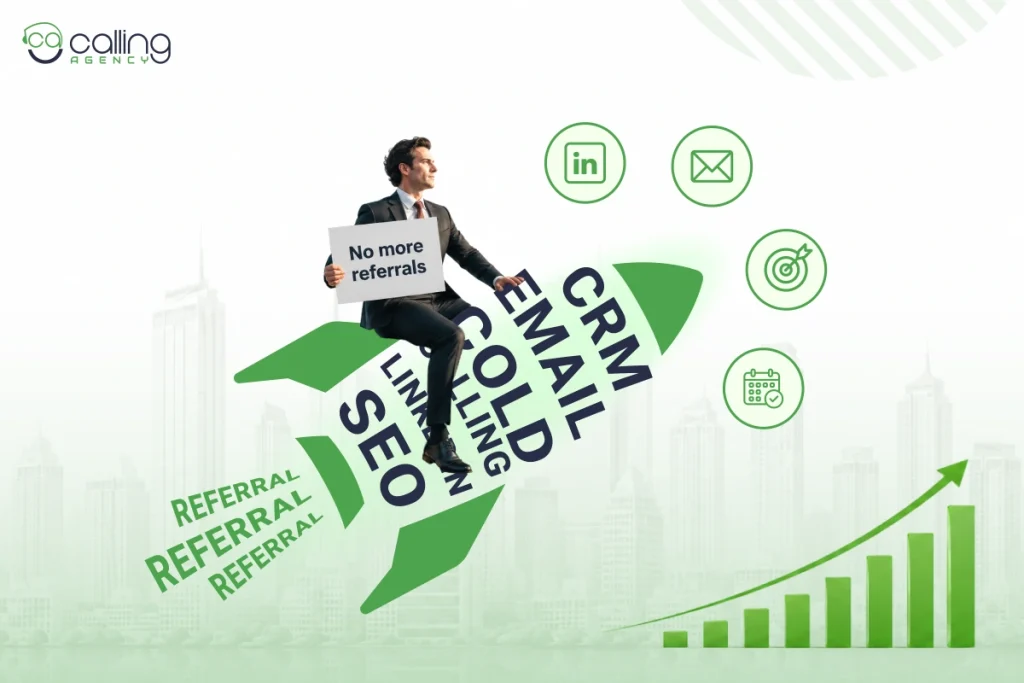
Referral dependency means an MSP only relies on referrals for new business. They do that because referrals get them high-quality leads at low cost. But they’re unpredictable and difficult to scale because you have to rely on others.
So how does an MSP escape referral dependency?
To grow smoothly, MSPs need a predictable pipeline by adding outbound prospecting. MSP lead generation can help create that predictable flow by focusing on a clear niche and building strategic partner relationships alongside referrals. You don’t need to replace referrals; you just need to give the right path to walk.
Here is what that looks like in practice.
| Who is this guide for?
This guide is for MSP owners and growth leads running roughly $750K to $10M in annual recurring revenue (ARR), with growth driven mostly by word of mouth. Now, at a point where referrals alone can’t hit the number. |
What Does Referral Dependency Mean?
Referral dependency means your MSP relies on referrals as its main source of new clients. You can’t control when they arrive, how many you’ll get, or whether they’ll come from the markets you want to grow in.
Referrals are valuable, but they have limits, for example:
| What Referrals Give You | What They Can’t Do |
| Pre-qualified, trusted leads | Generate leads on demand |
| Faster sales cycles | Target specific industries or markets |
| Low customer acquisition cost | Create a predictable pipeline |
| High close rates | Scale beyond your network |
Many MSPs become referral-dependent without realizing it. Growth comes naturally, so there’s little reason to build a sales process. You can understand it by looking at some things, such as:
- You never had to build a sales function, so you never did.
- Growth felt organic, and the pipeline never felt urgent.
- A referral source retires, or a major client moves IT in-house.
- Introductions slow to a drip, with no system to replace them.
If you’re not so sure about it, then a simple way to test your business is to ask: “If referrals stopped today, where would my next client come from?”
If there’s no clear answer, you’re relying more on referrals than on a repeatable sales system.
Why Referrals Alone Can’t Scale an MSP Service
Referrals are word of mouth. That is why they cannot scale an MSP. They are unpredictable, you cannot control them, and there is no repeatable system behind them.
A referral needs someone to know the right business, at the right moment, and make the introduction. Break any link in that chain, and the opportunity never appears.
Run the numbers on a typical book. These are illustrative inputs, not survey data.
| Step | Calculation | Result |
| Active clients | Starting client base | 40 |
| Clients who refer (25%) | 40 × 25% | 10 referrals |
| Qualified opportunities (50%) | 10 × 50% | 5 qualified opportunities |
| New clients closed (80%) | 5 × 80% | 4 new clients |
4 clients a year works for a small MSP that wants to stay small. It does not work if you plan to double.
Swap in your own client-base figures if you have them, and label them first-party.
There’s another challenge: referrals usually stay within the same network.
So, if most of your clients are manufacturers, you’ll probably get more manufacturing referrals. If you mainly serve local law firms, your introductions will likely come from other law firms nearby. Over time, your market becomes limited to the businesses your clients already know.
How to Escape Referral Dependency as an MSP?
Escaping referral dependency means adding channels you start yourself. Six approaches, ordered from positioning to execution.
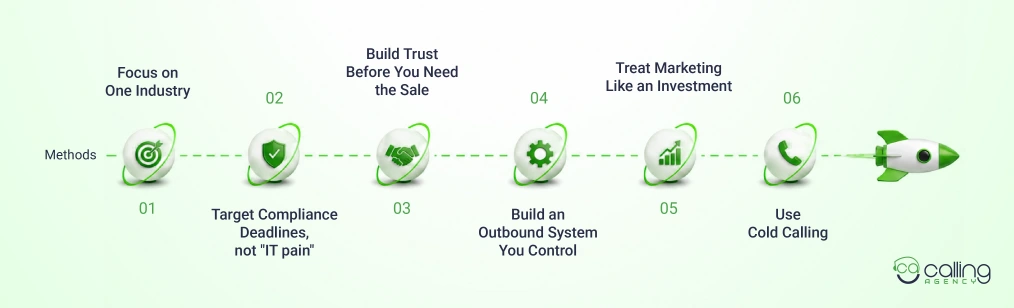
Method 1: Focus on One Industry
It’s better to focus on 1 industry than all over the industry. For example, if you work with healthcare practices, learn their compliance requirements, common cybersecurity risks, and the software they use every day.
Cause if you know their business, then you can easily speak their language and position yourself as an expert.
Specialization is still uncommon. In MSP Success’s December 2025 reader survey, 33% of responding MSPs named vertical specialization as a way they differentiate from competitors, behind longevity in business at 53% and cybersecurity expertise at 51%. A narrow vertical claim is easier to defend than a broad one.
You can also create content, case studies, and outreach built for that industry with that info. Prospects will trust you more if they know you understand their niche.
Method 2: Target compliance deadlines, not “IT pain”
Don’t ask “Do you need IT support?” cause the answer is usually “No, we’re happy with our current provider.”
So you need to look for events that force a business to make an IT decision.
For example, a company preparing for a HIPAA or PCI audit, renewing its cyber insurance, opening a new office, or undergoing a merger suddenly faces new technology challenges.
These events are your pinpoint. They create urgency, making businesses much more willing to review their current IT provider.
That’s why many successful MSPs lead with cybersecurity and compliance. You’re solving a problem the business already knows it has, instead of trying to convince them they have one.
Method 3: Build Trust Before You Need the Sale
Generic security advice builds nothing. “Protect your data” and “use strong passwords” read like every other MSP post. Write about incidents you actually handled. Also make the Method 3 bullets parallel. Currently, one is “What happened when,” one is “How a,” one is “Why was a.” Pick one form:
– The 15-person accounting firm locked out by a phishing email.
– The misconfigured Microsoft 365 tenant that exposed shared files.
– The cyber insurance claim denied because MFA was never enabled.
For example,
- What happened when a 15-person accounting firm got locked out by a phishing email?
- How did a misconfigured Microsoft 365 tenant expose shared files?
- Why was a client’s cyber insurance claim denied due to missing MFA?
The main point is to keep it simple yet real. When you describe real scenarios, even without naming the client, prospects in the same industry immediately recognize themselves in the story.
Method 4: Build an Outbound System You Control
Referrals happen when someone else decides to introduce you. Outbound happens when you decide it’s time to create new opportunities.
So, start with a clear ICP, build a list of qualified companies, find the right decision-makers, and reach out consistently through email, LinkedIn, or cold calling. Keep your contact data clean and follow up regularly.
The point is to build a repeatable process that brings qualified conversations into your pipeline every month. That’s something referrals alone can never guarantee.
Method 5: Treat Marketing Like an Investment
Many MSPs say they want more clients but spend very little on marketing. When referrals slow down, growth slows down too.
Put money into channels you control, such as SEO, content marketing, outbound sales, LinkedIn, paid ads, or strategic partnerships. Then track which channels produce real opportunities and shift budget toward the ones that do.
That way, you will have a better chance of getting leads. But yes, referrals should always be part of your strategy because they convert well. But they shouldn’t be the only reason your pipeline grows.
Method 6: Use Cold Calling
Cold calling is another way to get leads. If referrals have slowed down, cold calling is one of the fastest ways to put new opportunities into your pipeline. Here you decide who to contact, when to contact them, and how many businesses you can reach each week.
Build an ICP & buyer persona, then start with companies that match your MSP. That way, you’re speaking to businesses that are far more likely to need your services.
Also, cold calling works even better when you pair it with cold email like-
- Cold calling starts conversations and can book meetings on the first touch.
- Cold email keeps your name in front of prospects who didn’t answer or weren’t ready to talk.
So, if you’re using both channels together, it creates multiple touchpoints. That makes it much more likely that a prospect will remember you when the timing is right.
The biggest advantage is predictability. Referrals happen when someone decides to introduce you. Cold calling lets you decide how many conversations to start each week. It gives your MSP a pipeline you can actually control.
What Does Predictable Pipeline Mean for an MSP?
Predictable pipeline means controllable inputs produce forecastable outputs. You decide how many prospects to contact, so you can estimate how many conversations, meetings, and clients follow. Every MSP sales pipeline follows the same basic process:
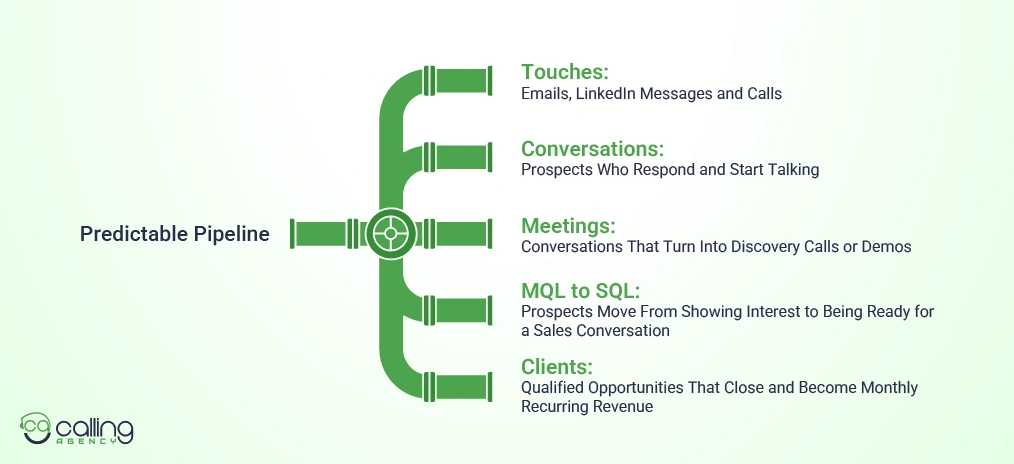
- Touches: The emails, LinkedIn messages, and calls you send.
- Conversations: The prospects who respond and start talking.
- Meetings: Conversations that turn into discovery calls or demos.
- MQL to SQL: Prospects move from showing interest (Marketing Qualified Leads) to being ready for a sales conversation (Sales Qualified Leads).
- Clients: Qualified opportunities that close and become monthly recurring revenue (MRR).
You can easily track each stage in your CRM. Once you know your conversion rates, you can predict how many activities you need to reach your revenue goals. Here is how referrals & predictable pipeline help you:
| Dimension | Referrals | Predictable pipeline |
| Control over volume | None; set by others | You set the input volume |
| Speed to start | Instant but unpredictable | Ramps over weeks, then steady |
| Forecastability | Can’t build a forecast | Forecastable once rates are known |
| Scales on demand | No | Yes; turn the dial up |
| Message control | Others describe you | You control positioning |
| Cost per client | Very low | Higher but predictable |
| Enters new verticals/geos | No | Yes; you choose the targets |
A predictable pipeline doesn’t replace referrals. It complements them. Referrals will always be valuable, but they can’t guarantee a steady flow of new business.
A repeatable sales process controls how many opportunities you generate, which is what makes growth forecastable. Keep the referrals. Add a channel that runs whether or not anyone makes an introduction, which is the whole job of lead generation.
Why MSP Founders Specifically Get Stuck (The Technical-Founder Trap)
MSP founders get stuck because they built the business on a skill that doesn’t transfer. Many MSP founders win clients through referrals because people already know and trust them. The problem starts when the business grows. When a salesperson can’t find clients, they figure out some big issues like:
- Your reputation doesn’t transfer.
- Sales feels uncomfortable.
- The pipeline depends on you.
So, the mindset should be like: don’t think of sales as pitching. It is like diagnosing a business problem. So, keep,
- A pitch tries to sell a service the prospect didn’t ask for.
- A diagnosis asks questions, uncovers problems, and recommends the right solution.
It’s easy for you because, as an MSP, you already diagnose technology issues every day. Selling works the same way. So, build a repeatable process that anyone on your team can follow.
That’s how you create a pipeline that keeps generating opportunities, whether the conversation is led by you, a salesperson, or a vCIO.
Which Channels Replace Referral Dependency for MSPs?
Not every lead generation channel delivers results at the same speed. If you need meetings quickly, direct outreach works best. Cold calling, appointment setting, and cold email can start generating conversations within weeks because you’re reaching out to decision-makers directly.
Here are a few channels we normally use-
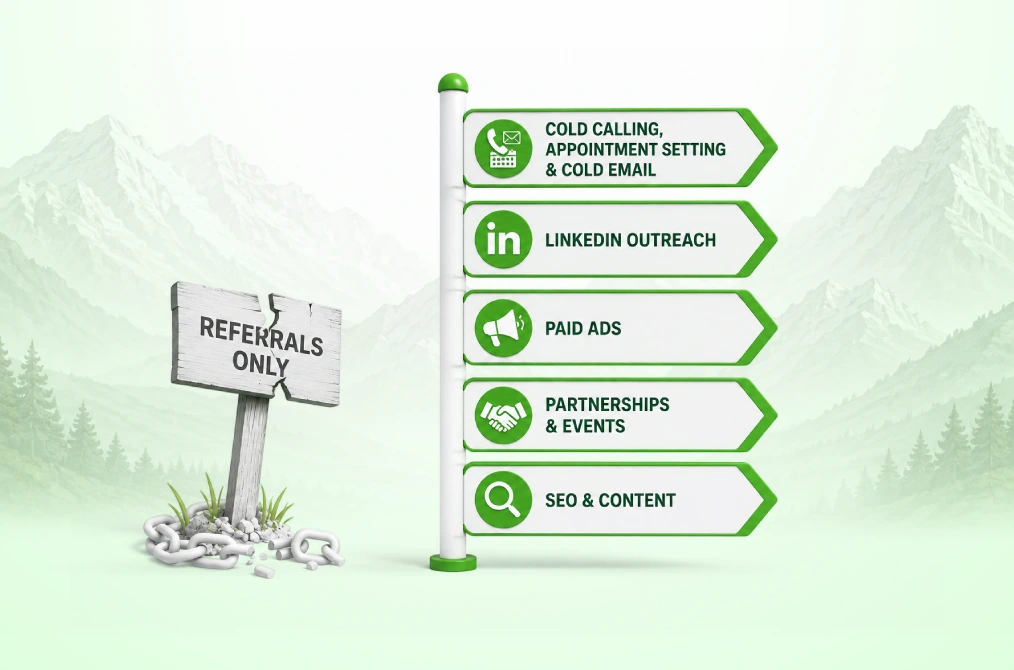
| Rank | Channel | Speed to meeting | Cost profile | Control | Best for |
| 1 | Cold calling, appointment setting & cold email | Fastest (weeks) | Moderate, predictable | High | Filling pipeline now |
| 2 | LinkedIn outreach | Moderate | Low–moderate | High | Warmer, role-targeted outreach |
| 3 | Paid ads (Google/LinkedIn) | Fast traffic | High, variable | Moderate | Capturing active searchers |
| 4 | Partnerships & events | Slow, warm | Moderate | Low–moderate | Trust-based introductions |
| 5 | SEO & content | Slowest (months) | Front-loaded, compounds | Moderate | Long-term inbound demand |
Should You Build an In-House SDR Team or Outsource Appointment Setting?
It depends on your growth stage, but for most small and growing MSPs, outsourcing appointment setting services is the faster way to build a predictable pipeline.
If you want to book qualified meetings quickly and reduce reliance on referrals, outsourcing usually delivers results sooner. If you’re ready to invest in a long-term sales function, building an in-house SDR team offers greater control.
But the decision shouldn’t be based on salary alone. Compare customer acquisition cost (CAC) with customer lifetime value (LTV).
- CAC is how much you spend to acquire one client.
- LTV is the total revenue that client generates over the entire relationship.
Referrals have a very low CAC, but you can’t control when they happen. Outbound prospecting costs more, but it gives you a pipeline you can scale and forecast. Because MSPs earn recurring monthly revenue and often retain clients for years, a higher CAC is usually justified if it consistently brings in qualified long-term customers.
So, mainly, choose outsourcing if you need meetings now. Build an in-house SDR team when you’re ready to invest in a scalable internal sales engine.
The Real Cost of an In-House SDR & Outsourced
| Factor | In-house SDR | Outsourced appointment setting |
| Time to launch | 6–10 weeks to hire and onboard | 2–3 weeks to first calls |
| Ramp to productivity | 3–6 months | Weeks |
| Monthly cost | Loaded cost well above base salary | Disclosed competitor ranges: $3,000–$8,500/mo |
| Management load | High: you manage, coach, script | Low: vendor manages the team |
| Turnover/decay risk | High: churn resets ramp | Absorbed by the vendor |
| Flexibility | Fixed cost, hard to scale down | Scale volume up or down |
Which Option Fits Your MSP?
The right choice often depends on your current size and growth goals.
- For ARR under $3M, outsourcing is usually the better option.
- If you are above ~$5M ARR, then building an in-house SDR team or using a hybrid approach.
As your business grows, you can shift more outbound activities in-house. Until then, outsourcing helps you generate consistent opportunities without slowing down your growth.