
Selling commercial insurance policies is a complex task to accomplish. Policy acquisition/ purchase is a calculated process which relies on rigorous research, market comparison and risk evaluation.
Due to this complexity, outbound lead generation is very crucial for insurance. It allows brokers and agents to take proactive measures and deliver an influential message.
This later helps to acquire new customers and keep the business going.
This blog will explain how outbound lead generation significantly impacts commercial insurance businesses.
What Outbound Lead Generation Means In Commercial Insurance?
Outbound commercial insurance lead generation is the process that helps insurance providers penetrate new markets with their offerings. It is a proactive marketing strategy that assists in capturing untouched markets.
Generating outbound leads for commercial insurance is different from other industries. It involves reaching out to prospects during or before they actively look for insurance solutions.
Unlike inbound marketing, outbound does not wait for search intent. Insurance agents or brokers can initiate direct contact with decision-makers at their policy renewal window. The objective and strategy here is to start a conversation, not to close a sale immediately.
Targeting High-Value Prospects
In the commercial insurance context, outbound focuses on targeted business accounts. These businesses often have complex risks and multiple policies. Thus, it makes them high-value potential customers.
These high-value businesses purchase insurance on a predictable renewal cycle.
Outbound outreach typically includes:
- Identifying high-value businesses
- Directly contacting decision-makers
- Introducing convenient coverage discussions
Building Relations on Trust
Outbound leads assist agents and brokers in developing a meaningful conversation. It helps to identify the pain points a potential customer is facing.
Then it lets them make offers that align with their pain points. When offers are aligned, the conversion rate automatically increases.
Gaining Edge in a Competitive Market
Among various commercial insurance marketing ideas, outbound lead generation remains vital for securing a competitive edge. This advantage is cultivated through several strategic channels.
First, it plays a critical role in B2B insurance sales. Insurance decision makers are sensitive and convincing them requires giving them a detailed explanation on how the whole process will work. A successful conversion lies in making the pitch on
- Coverage gaps of the current policy
- Required time to renew the policy
- And to insurance decision-making managers
Eventually, outbound leads help improve pipeline flow and lead handoff rate. But a core competitive advantage of outbound lead generation is real-time lead qualification capability.
The process usually moves through:
- Prospecting and initial outreach
- Discovery calls to assess whether the business is fit or not
- Identification of sales-qualified leads (SQLs)
Who Outbound Lead Generation Targets In Commercial Insurance?
Outbound lead generation in commercial insurance targets specific B2B prospects with clear buying intentions.
It is not designed for mass outreach or individual policy buyers.
The primary focus is on companies that match a defined Ideal Customer Profile (ICP). These are businesses with recurring insurance needs and complex risk exposure.
Helps Define Your Commercial Insurance Target Profile (ICP)
A strong outbound strategy begins by defining the commercial insurance ICP.
This profile outlines which businesses are worth pursuing.
Key ICP attributes often include:
- Company size and employee count
- Annual revenue range
- Industry risk level
- Geographic market and regulatory environment
- Existing policy complexity
This helps to generate high-intent commercial insurance leads and improve conversion rates.
Identifying Specific Verticals and Markets for Insurance
Outbound insurance marketing provides better results when focused on specific industry verticals. Because different industries face different issues, liability and operation-related risks.
Common verticals targeted include:
- Construction and contracting
- Transportation and logistics
- Manufacturing and warehouse management
- Healthcare and medical facilities
- Professional service firms
Market selection also plays an influential role. State regulations and local risk factors often shape insurance buying decisions too.
Targeting the right verticals makes outreach more relevant and timely.
3 Core Outbound Lead Generation Channels for Commercial Insurance
Outbound lead generation for commercial insurance relies on a coordinated multi-channel approach. Instead of relying on a single method, outreach uses diverse communication channels to nourish prospects.
The goal is simple.
Reach decision-makers at the right time with relevant messages.
These channels are designed to generate high-intent commercial insurance leads, not volume.
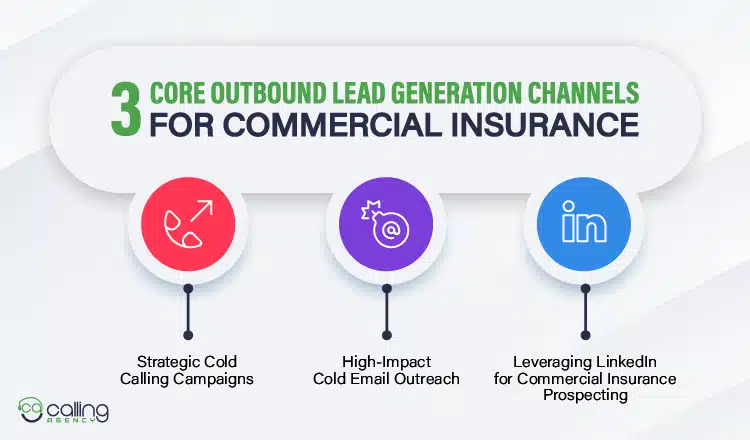
1. Strategic Cold Calling Campaigns
Cold calling means reaching out to potential customers via phone calls who have no prior idea about a business.
Cold calling is one of the oldest lead generation methods, which still works well, especially in commercial insurance scenario. The reason is simple, it has the capacity to make direct communication with proper management.
A successful cold calling generates leads for insurance business relies on:
- Calling during renewal windows
- Respecting the Telephone Consumer Protection Act (TCPA) and Do Not Call (DNC) regulations
- Keeping conversations consultative rather than only focusing on sales
To operate this successful campaign, prior strategy development is needed. This strategy should focus on:
- Basic research on the prospects about their policy renewal window and decision-making management, it helps faster qualification of leads
- Constantly monitoring the leads and calls to comply TCPA and DNC
- Track records of any prior conversation so that the consultative nature of the calls can be carried out
2. High-Impact Cold Email Outreach
A cold email is a message that you send to a person or an organization who has no prior idea about your operation.
The goal is simple, start a meaningful conversation with potential buyers.
It allows insurance agents and brokers to introduce value without immediate pressure.
Effective cold email campaigns for insurance should focus on:
- Industry-specific messages
- Clear relevance to the targeted business
- Use concise, direct copy which matches a single, clear call to action (CTA) to respect prospects’ time.
Is cold Email legal?
Yes, cold emails are legal, but there are some guidelines that you have to follow.
In the USA, businesses have to comply with the CAN-SPAM Act to send cold emails. This allows to maintain better data privacy and reduces the possibility of fraud.
Are Cold Email and Email Marketing the Same?
No, cold emails are sent to prospects who have no idea about the business.
On the other hand, Email marketing targets individuals who already have an idea and sometimes an interest in the business.
3. Leveraging LinkedIn for Commercial Insurance Prospecting (Social Selling)
LinkedIn is a powerful platform for generating B2B insurance leads. From top to the most junior management, LinkedIn is a go-to professional site for everyone.
Thus, it is a perfect platform to do both research and engagement.
Benefits of LinkedIn for generating outbound leads:
- Can precisely identify decision-makers
- Understand company size, industry, potential risks and other insights like engagements with other businesses
- Can give a better idea about the potential policy renewal window
LinkedIn outreach works best when combined with other methods, especially cold calling.
Establishing the first contact here gives a competitive advantage and helps to build up a professional yet trustworthy relationship.
5 Steps for Commercial Outbound Lead Generation
Generating outbound leads for commercial insurance works well if it follows a structured process. Especially the lead generation process in B2B’s perspective needs this structure to give a business a rich prospect pipeline.
Each step in the process is important to qualify leads. Later, this helps to find out the timing when possibility to get an action increases.
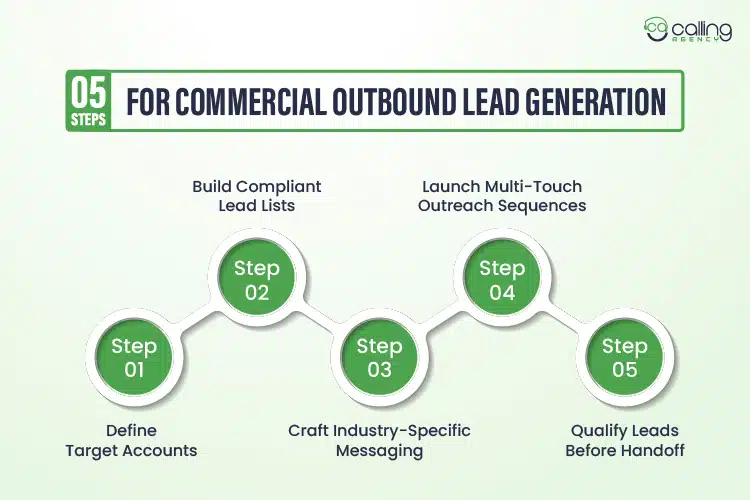
1st Step: Define Target Accounts
The first step in generating leads is identifying target accounts that match your ICP.
These are businesses with active insurance policies or at renewal stage and are facing higher risk exposure. This step narrows down the working area and increases conversion rate of the leads.
This step involves:
- Identify industries that have the possibility of facing coverage issues or are exposed to higher risks
- Research company size and revenue stream to construct an impactful pitch
- Market demography and regulation assessment
- Policy complexity and renewal cycles evaluation
This clear targeting ensures that outbound efforts are focused on high-intent commercial insurance leads.
2nd Step: Build Compliant Lead Lists
Once accounts are clearly identified, the next step is building compliant lead lists.
Accuracy and compliance are critical in the insurance industry because of high competition and its complex nature.
- Use industry and revenue data to create a list that matches with your best-performing niches
- Identify decision makers before you reach out
- Double-check your lists against DNC and TCPA registries to ensure every call and email is 100% legal
Clean data protects the reputation of your business and improves response rates.
3rd Step: Craft Industry-Specific Messaging
Generic outreach strategies rarely work well in developing quality B2B insurance leads.
Messages must reflect industry risks and environment to draw attention from the prospect.
Effective outreach highlights these to qualify leads:
- Coverage gaps of the current policy
- Premium-related issues
- Compliance and risk exposure
- Policy alignment with current operations
Industry-specific messages position agents as advisors, not sellers.
4th Step: Launch Multi-Touch Outreach Sequences
For commercial insurance leads, a multichannel approach proves better results if done accurately. As converting a prospect into a paying customer takes time and nurturing, using a single communication channel can cause irritation.
That’s why sometimes calls work well or sometimes email obtains better results.
Typical sequences combine:
- Cold emails
- Cold calls and voicemails
- LinkedIn and professional network touches
But a consistency across channels is required to increase engagement.
5th Step: Qualify Leads Before Handoff
The whole process of lead generation’s main focus is to provide the sales team with a pipeline of contacts that are sales-qualified leads.
The qualification process focuses on:
- Determine policy renewal window
- Find out who makes insurance decisions
- Identify coverage gaps and pain points
Conclusion
For commercial insurance, timing and accuracy are critical. Outbound lead generation allows you to stay ahead of the renewal cycle, reaching decision-makers before they make a purchase.
A balanced omnichannel approach helps qualify leads and create a strong and trustworthy relationship. This later assists in making conversions and a steady growth of the business.
But generating outbound leads for commercial insurance needs monitoring, consistency and patience. The key here is to utilize the timing with precision.