

Manufacturing lead generation typically costs $250 to $900 per qualified lead or $3,000 to $15,000 per month for an agency retainer. A qualified lead pays for a single outcome. Whereas a retainer pays for an ongoing lead-generation program. That is why two vendors can quote very different prices for the same work. If we say, how much does manufacturing lead generation cost, the answer varies.
The actual cost depends on the lead definition, channel, target market, and level of qualification. This guide explains lead costs by channel, hidden costs and how to set a budget based on your own economics.
Manufacturing Lead Generation Cost at a Glance
Buyers use the word “cost” in different stages of lead generation. Each funnel stage can cost different amounts to manufacturers in the United States and Canada.
| What you are buying | Typical range | What it actually means |
| Raw lead | $30 to $150 | A contact who has shown some interest but hasn’t been fully qualified. |
| Sales qualified lead | $250 to $900 | A prospect who matches your target customer, has a relevant need, and may be ready to buy soon. |
| Booked meeting | $150 to $750 | A scheduled meeting with someone in plant operations, procurement, or engineering. Check if no-shows are included. |
| Quote-ready RFQ | $600 to $2,500 | A request with enough details, such as specifications, volume, or materials to prepare a quote. |
| Monthly retainer | $3,000 to $15,000 | An ongoing fee for lead-generation services. It doesn’t automatically guarantee a specific number of leads or sales. |
These prices are not fixed market rates. They reflect different service levels. A $50 raw lead and a $900 sales-qualified lead are not the same product.
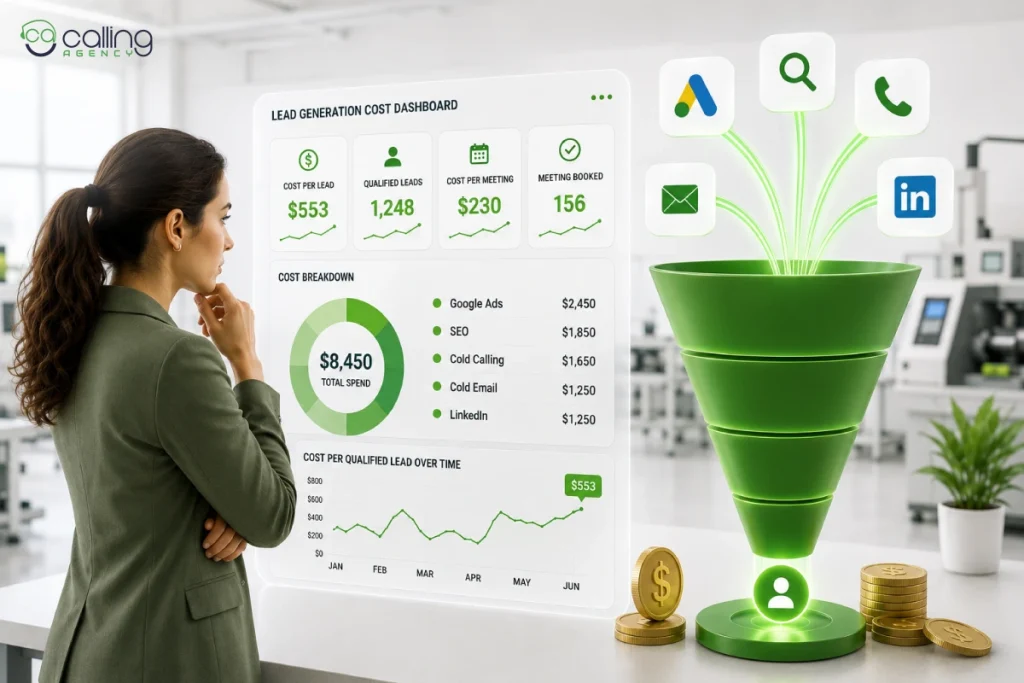
HubSpot’s benchmark puts the average B2B CPL at about $84, while its 2026 data shows manufacturing at about $553. This shows that lead costs vary by industry, channel and lead quality.
Why Published Cost Per Lead Figures Contradict Each Other
Published cost-per-lead figures differ because they measure different types of leads, industries and stages of the sales process. That is why you may see manufacturing lead costs quoted at $84, $136, $553 and even more than $3,000.
These numbers may all be correct. The important question is what each figure counts as a “lead” and where it sits in the sales pipeline. Let’s be clear with the table below:
| Published figure | Source | What it is measuring |
| About $84 per lead | HubSpot | Average B2B lead cost across different channels |
| About $136 per lead | Environmental XPRT | Average lead cost for manufacturing companies |
| $142 to $811 per lead | CEIR | Different costs for trade show leads and sales |
| About $553 per lead | Scube Marketing | Paid-search lead cost for manufacturing |
| $420 to $3,080 | Belkins | B2B lead costs across different industries and company sizes |
| $230 to $350 | CallingAgency | Cost for meetings with qualified plant or production leads |
These figures are benchmarks, not fixed prices. HubSpot reports manufacturing CPLs of about $415 for organic leads, $691 for paid leads and $553 overall. Belkin’s 2026 research reports $700 to $1,260, depending on company size. The difference shows that lead costs vary based on how leads are defined and measured.
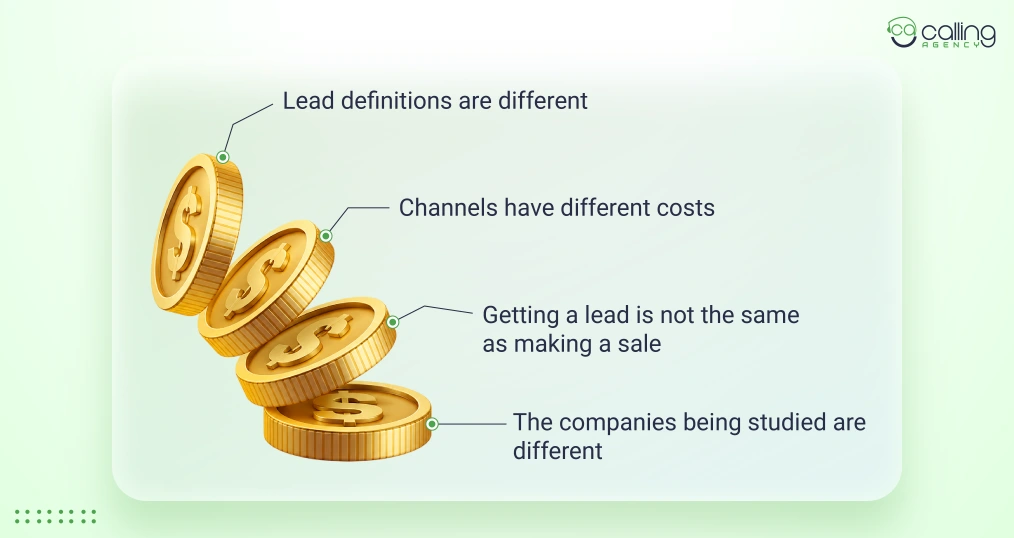
Four reasons these numbers are different:
- Lead definitions are different: A sales process has different stages like form submission, qualified lead and quote-ready RFQ. All of them are not the same thing.
- Channels have different costs: A low-cost channel can make the average cost look lower than it really is for other organic channels.
- Getting a lead is not the same as making a sale: CEIR research, for example, separates the cost of generating exhibition leads from the cost of turning those leads into sales.
- The companies being studied are different: A benchmark that large manufacturing buyers have may not apply to a small 40-person machine shop.
Cost by Channel for Manufacturers
Channel choice can have a major effect on lead-generation cost. We can show you that through a table:
| Channel | Typical cost | Best for | Where it breaks down |
| Trade shows and expos | $140 to $810 per lead | Meeting engineers and buyer personas face-to-face. | Costs vary by event. A badge scan is not always a qualified lead. |
| SEO and capability pages | $2,000 to $8,000 per month | Reaching buyers searching for specific processes or materials. | It can take months to build organic traffic. |
| Google Ads | $80 to $400 per lead | Testing demand for specific products, parts, or processes. | Specialized keywords may have very low search volume. |
| Outbound cold calling | $150 to $600 per booked meeting | Reaching plants that may not search for your services online. | Results depend on data quality and the caller’s skills. |
| Cold email | $25 to $75 per lead at top of funnel | Reaching many targeted contacts. | Poor data and weak targeting can give bad delivery. |
| $150 to $250 and up per lead | Reaching engineering, procurement and management roles | Highly targeted campaigns can be expensive. |
Trade show costs vary by the event, booth size and how a lead is defined. CEIR provides trade show benchmarks, while HubSpot provides broader B2B cost benchmarks.
Content marketing also takes time to produce results. The Content Marketing Institute found that only 20% of manufacturing marketers rated their content strategy as very effective, while 67% rated it moderately effective. This does not mean SEO does not work. It means publishing content alone does not guarantee results.
How Agencies Price Manufacturing Lead Generation
Manufacturing lead generation agencies usually have five pricing plans. They show who takes the risk if the leads are poor quality.
| Model | Typical range | Who carries risk | What to watch for |
| Monthly retainer | $3,000 to $15,000 per month | You | Make sure the agreement clearly defines lead quality. |
| Pay per lead | $50 to $250 per lead | Vendor | Make sure the vendor clearly defines what counts as a lead. |
| Pay per appointment | $150 to $750 per meeting | Vendor | Check whether the meeting should happen to be charged. |
| Hybrid base plus fee | $2,000 to $5,000 base plus per meeting | Shared | Check what the base fee covers and how meeting fees are calculated. |
| Hourly or project | $25 to $75 per hour | You | Track the time you spent researching, building lists and doing outreach. |
These are typical market ranges, not fixed prices. Callbox charges about $6,000 to $15,000 per month, while Leadium lists programs at $3,500 to $5,000. CallingAgency lists services from $1,699 to $9,500, depending on the program.
Pricing also affects who takes the risk. Before comparing prices, ask what counts as a qualified meeting. And for B2B appointment setting, see who qualifies it.
In-House SDR vs Outsourced Cost
Hiring an in-house SDR usually costs more upfront because you pay for salary, benefits, tools and training. Let’s figure out the comparison with a table.
| Factor | In-house rep | Outsourced program |
| Year one cost | $90,000 to $100,000, including salary and other costs | $36,000 to $120,000, depending on the service level |
| Time to first meeting | 60 to 90 days | Two to four weeks |
| Ramp period | Three to six months while the rep learns the role | Training and ramp-up are included in the program |
| Cost behavior | Fixed cost, even during slow periods | Variable cost, depending on the contract |
| Data and domains | You own them | Confirm ownership before signing |
| Best fit | Steady sales volume and a long-term plan | Fast results, testing and avoiding new hires |
The U.S. Bureau of Labor Statistics reports a $66,780 median annual wage for wholesale and manufacturing sales representatives based on May 2024 data. Adding payroll costs and sales tools makes the total cost much higher.
For technical sales, BLS reports mean wages of $130,410 for sales engineers. And $114,520 for technical and scientific sales representatives.
So, compare outsourcing with the full cost of hiring, not salary alone. In-house teams offer more control, while outsourcing provides faster setup and more flexibility.
Hidden Costs That Do Not Show Up in the Quote
Six costs can appear after the initial lead-generation quote. They are:
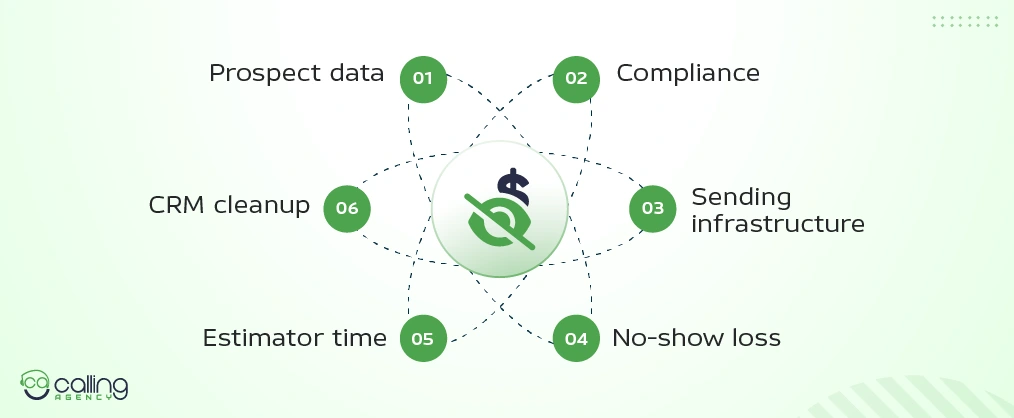
- Prospect data: A verified NAICS- or SIC-filtered list can cost about $0.30 to $2.00 per contact through list-building services. Building it yourself costs employee time.
- Compliance: Calling and email campaigns need proper compliance, opt-out handling and record-keeping.
- Sending infrastructure: Domains, mailboxes and campaign setup can cost hundreds of dollars per month.
- No-show loss: With a 60% show rate, a $400 booked meeting costs about $667 per held meeting. Check the show rate, not just the booking rate.
- Estimator time: Poorly qualified RFQs can waste valuable engineering and estimating time.
- CRM cleanup: Wrong or duplicate records create extra work and can make sales reports less accurate.
How to Calculate Your Own Cost Per Lead Ceiling
Your maximum cost per lead is the amount you can afford to spend on each lead. Its formula is:
Maximum cost per lead = Account value × Close rate ÷ Target acquisition ratio
Worked example, a contract manufacturer:
| Input | Value |
| First-year account value | $40,000 |
| Lead-to-customer close rate | 12% |
| Target value-to-acquisition ratio | 3 to 1 |
| Revenue per lead | $40,000 × 0.12 = $4,800 |
| Maximum cost per lead | $4,800 ÷ 3 = $1,600 |
Use your own close rate to set a realistic lead-cost limit. If you lack enough data, Ruler Analytics conversion benchmark can provide a starting point. Its 2026 research shows that conversion rates vary by industry, traffic source and buyer journey.
For example, a customer worth $95,000 over three years with a 12% close rate generates $11,400 per lead. At a 3:1 target ratio, your maximum CPL is $3,800.
The short-term calculation protects cash flow. But the longer-term view accounts for repeat business.
When a Low Price Is a Warning Sign
A very low price can mean that important parts of the service are missing. It can occur when there are:
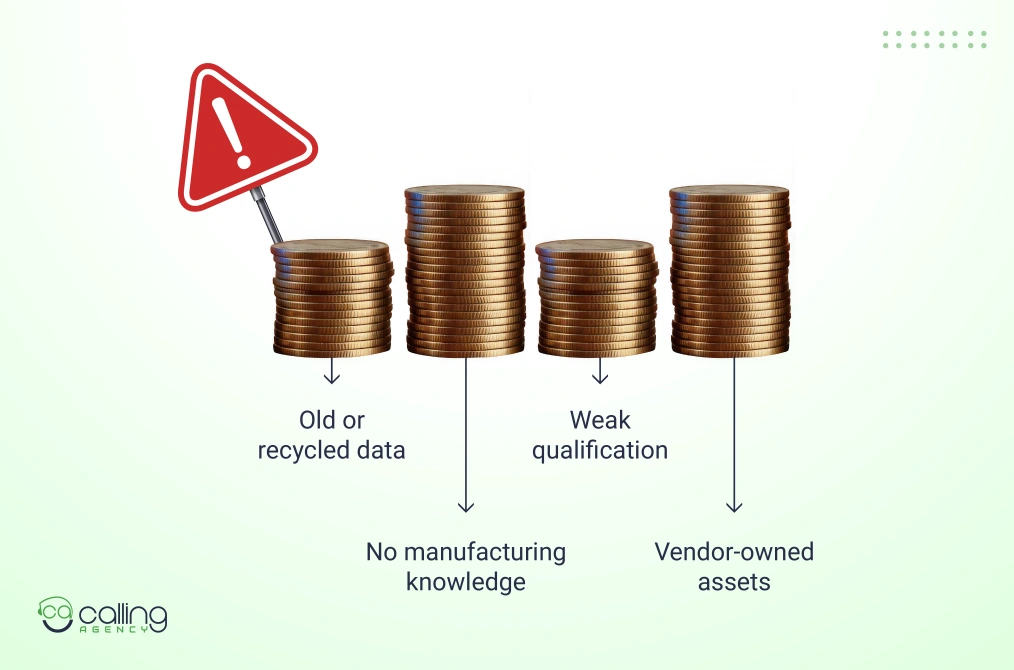
- Old or recycled data: The same contacts may have been sold to other companies.
- No manufacturing knowledge: Callers may struggle to speak with plant or engineering teams.
- Weak qualification: Every answered call may be counted as a lead.
- Vendor-owned assets: You may lose access to domains, data or campaign assets when the contract ends.
That’s why ask the provider how they handle contact verification and follow-up before choosing one.
The Cost Number That Actually Matters
Cost per lead alone is not enough to judge a manufacturing lead-generation program. You have to compare the cost per qualified opportunity and the cost per closed purchase order with the value of the account.
CallingAgency runs outsourced manufacturing lead-generation programs focused on meetings with plant and engineering contacts. So, bring your average close rate and target acquisition ratio to the first discussion. Then you can set a budget based on your actual sales economics.
Conclusion
The right manufacturing lead-generation cost is not always the lowest price. It is the price that produces targeted leads your team can actually convert.
So, start with your average account value, close rate and target acquisition ratio. Then set your maximum CPL. Next, compare agency pricing, in-house costs and hidden costs. Such as data, tools, follow-up and sales time.
Don’t think a cheap lead is always a good lead. Sometimes, a smaller number of qualified prospects can be more valuable than a large number of unqualified prospects.
Frequently Asked Questions
What is a good cost per lead for manufacturers?
A good CPL is one that stays below your acquisition ceiling. Calculate it as average account value × close rate ÷ target acquisition ratio. As a broad benchmark, HubSpot reports a blended manufacturing CPL of about $553. Qualified leads may cost more.
How much do agencies charge for manufacturing campaigns?
Manufacturing lead-generation retainers typically cost $3,000 to $15,000 per month, while pay-per-appointment programs cost about $150 to $750 per meeting. Check what the price includes, such as list building and CRM work.
How long before a manufacturing outbound campaign pays for itself?
A manufacturing outbound campaign can take six to nine months to pay for itself. The actual timeline depends on your close rate and sales cycle. Samples, tooling and multiple approvals can delay the first purchase order.
Why is manufacturing cost per lead higher than other B2B sectors?
Manufacturing leads can cost more because purchases often involve multiple decision-makers and technical qualifications. A verified prospect and the right decision-maker is more valuable than a basic contact.