
Account-based marketing and lead-based marketing are both effective for lead generation, but the choice of taking one strategy between them depends on your needs, pain points, interests, ability, adaptability, etc. Lead-based marketing is a broad strategy where account-based marketing is more specific.
Both have some pros and cons, but some marketers keep one strategy ahead of another. We are going to break down every aspect with detailed analysis in this session, so let’s get started without further delay.
What is Account-based Marketing (ABM)?
Account-based marketing is a B2B strategy focused on targeting specific or individual accounts that have the potential to generate higher revenue. The key characteristic of account-based marketing is that it brings the sales and marketing teams together.
More specifically, it’s the alignment of the sales and marketing teams, often supported by a strong B2B lead generation service to identify and validate target accounts. They both work together, targeting a specific decision maker to drive through the sales funnel to the closing deal stage.
Let’s pick an example: ABM is like using a fishing rod to catch a big fish instead of casting a wide net.
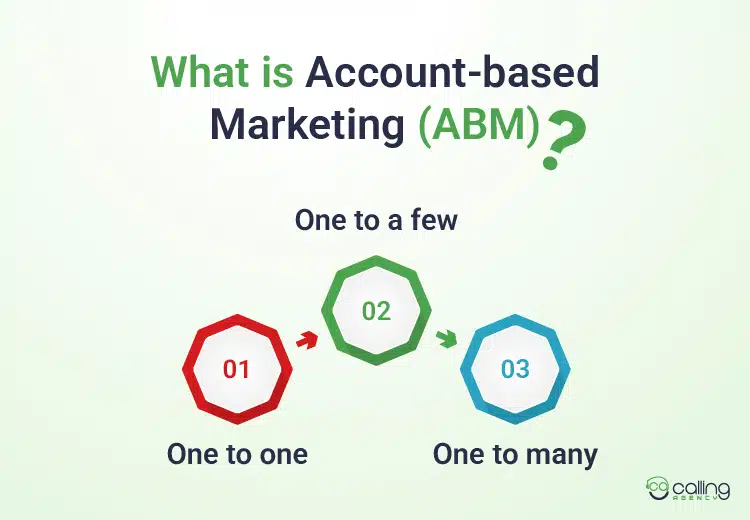
ABM has three types of approaches:
- One to one( 1:1, Strategic ABM):
- One to few( 1: Few, ABM lite):
- One to many(1: Many, Programmatic ABM):
Account-based marketing strategy is typically run with those three types of approach, but the one-to-one has the most popularity, where the other two have individual requirements as well.
What is Lead-based Marketing?
Lead-based marketing is a broader term. It is a process of attracting leads, then capturing them, nurturing them, and converting them into paid customers. Initially, there are four stages of lead-based marketing.
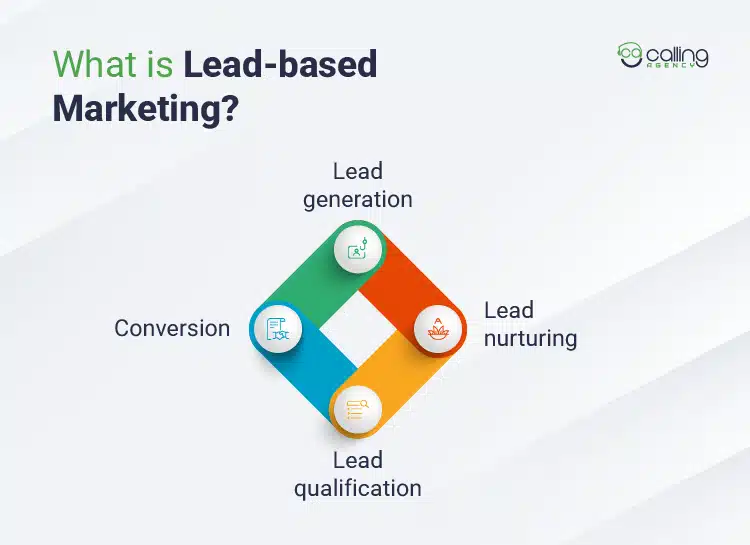
- Lead generation: You can generate leads in-house, or you can take a B2B lead generation service from different agencies as well. If you plan to generate in-house, then you need to attract prospects through blogs, ads, webinars, social media posts, cold calling, email marketing, etc.
- Lead nurturing: Lead nurturing is a process that keeps a prospect warm, reminds them of your brand name, offers, products, or services.
- Lead qualification: You can not just approach every lead you have on your list. If you do so, it will kill your valuable time and bring frustration due to rejection. So apply lead qualification frameworks or apply lead scoring to filter out bad leads and reach the potential customers.
- Conversion: In this final stage, you pitch your sales and close them or break up with them if your offer doesn’t fit with the prospect.
This is how lead-based marketing works, and this process is called lead-based marketing.
ABM vs Lead-based Marketing: Key Differences
| Aspect | ABM (Account-Based Marketing) | Lead-Based Marketing |
| Targeting | Specific accounts/companies | Individual leads/prospects |
| Personalization | Highly personalized campaigns | Moderate personalization |
| Scale | Low-to-medium (focused accounts) | High (broad audience) |
| Sales Alignment | Mandatory (closely aligned with sales) | Optional |
| Ideal Deal Size | High ACV (Enterprise deals) | Low-to-mid ACV |
When to Use Account-based Marketing?
According to the requirements of your business, you can plan to apply account-based marketing. Let’s break down all the details of when to use account-based marketing in your business and measuring ABM success based on real business outcomes.
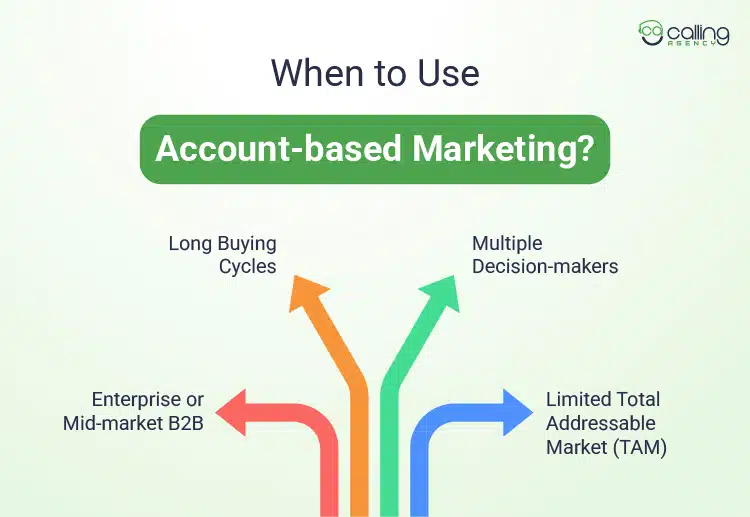
1. Enterprise or Mid-market B2B
Enterprise and business-to-business mid-market companies can use ABM because the core characteristic of enterprise-level or mid-market B2B fits the account-based marketing strategy. When targeting a big fish or enterprise-level customer, ABM stands out with its personalized outreach, follow-up nurturing, and targeting.
2. Long Buying Cycles
Suppose your product takes a long time to close a deal, like 6 to 12 months, then it’s better to use ABM. Typically, a normal customer forgets about the company or brand name after purchasing a product or service.
Here, account-based marketing targets specific accounts and keeps reminding them about your company, so they get triggered every time to make a purchase. So you can say that, or with a long sales cycle, ABM is one of the best solutions.
3. Multiple Decision-makers
Big companies normally have multiple decision makers, like the CFO, CEO, and Managing Directors, etc. Account-based marketing is a perfect strategy to reach them separately and inform them about your offer, which creates a strong brand awareness and leads to a positive result.
4. Limited Total Addressable Market(TAM)
When your TAM is small, you can not waste a single lead. In this situation, account-based marketing is the best solution. For a limited total addressable market, you are recommended to reach out to them individually, and that’s what ABM is.
ABM creates long-term relationships and focuses on analyzing more about the lead and personalizing every outreach, which ensures your quality lead nurturing and constant follow-ups.
When to Use Lead-based Marketing?
If your business requires lead-based marketing and you still stick to ABM to target accounts or that strategy, then you are wasting your time and money. Your business requirement is the most important when choosing the strategy.
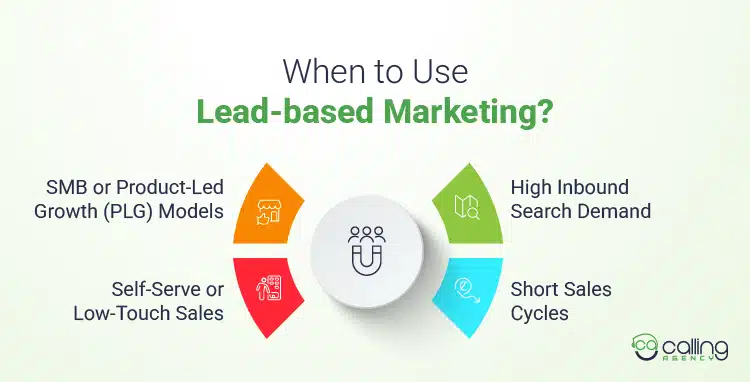
1. SMB or Product-Led Growth (PLG) Models
If your business targets Small to Medium Businesses (SMBs) or relies on a bottom-up adoption model, lead-based marketing is your engine.
- The Volume Game: SMB markets are massive. You need thousands of leads to hit your revenue targets because individual deal sizes are smaller.
- The PLG Flywheel: In Product-Led Growth (like Slack or Zoom), the goal is to get as many individual users into the product as possible. You market to the user, not the executive board.
- Lower CAC: Lead-gen tactics (like SEO and social media) are generally more cost-effective for reaching thousands of people than the high-touch personalization required for ABM.
2. High Inbound Search Demand
If people are already actively searching for a solution to their problem, you don’t need to target them; you just need to be there when they look.
- Capture Existing Intent: Use SEO and PPC to capture users who are typing “best CRM for startups” or “how to automate payroll.”
- The “Hand-Raiser” Advantage: Lead-based marketing excels at identifying people who are already in a “buying state” and ready to engage immediately.
3. Short Sales Cycles
If your product can be bought in a matter of days or weeks, the heavy lifting of ABM is a waste of resources.
- Speed to Lead: Lead-based marketing is designed for quick conversion. A prospect sees an ad, downloads a guide, gets a few automated emails, and buys.
- Minimal Nurturing: Unlike ABM, which requires months of “warming up” an account, lead-gen thrives on “strike while the iron is hot” tactics.
4. Self-Serve or Low-Touch Sales
When a customer can sign up for your product without ever talking to a salesperson, you are in the realm of lead-based marketing.
- Automation-First: You rely on email workflows, “Aha! moments” in the product, and automated onboarding to convert leads into customers.
- Scalability: Lead-based marketing is infinitely more scalable than ABM. You can double your leads by increasing your ad spend or content output, whereas ABM requires more human hours for every new account added.
Can ABM and Lead-based Marketing Work Together?
Yes, ABM and lead-based marketing can work together to make a powerful strategy without conflicts with each other. ABM is like fishing with a rod, and lead-based marketing is casting a wide net, but what if you do both, then your lead generation and sales closing become stronger.
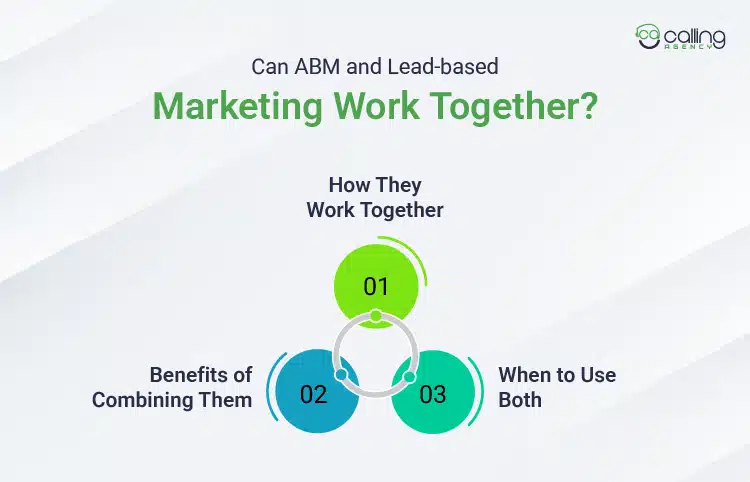
How They Work Together?
Lead generation and data feeding: While lead-based marketing brings you a lot of prospects, some of them are high-quality, some are not. You get a lot of data, which can be fed to CRM to identify an ideal customer profile.
Outreach and nurture: Once you filter and identify the ideal customer profile, you can apply account-based marketing to reach out to them with personalized content.
Hybrid model: A hybrid model of ABM and lead-based marketing, together aligning sales and marketing teams with wide lead generation marketing, can really be a powerful tool.
Benefits of Combining Them
- Full Funnel Coverage: Lead generation fills the top of the funnel, while ABM handles the high-value, bottom-of-funnel precision.
- Deeper Relationships: Account-based marketing builds trust with key decision-makers in target accounts.
- Better ROI: Combining broad reach with focused personalization maximizes marketing impact.
- Data-Driven Decisions: Shared data between sales and marketing improves performance for both.
When to Use Both?
- Small Target Market: When you have high-value customers, ABM helps filter out noise, while lead gen can find those specific accounts.
- Growth & Precision: You need steady pipeline volume (Lead Gen) AND high-impact, personalized engagement (ABM).
Metrics That Matter in ABM vs Lead-based Marketing
ABM strategy and lead-based marketing do not work the same way. So, we should not measure them the same way either. Lead-based marketing looks at people. ABM looks at accounts. That is the main difference.
In lead-based marketing, these metrics matter most:
- How many people visit your website
- How many people become leads
- Cost per lead
- Number of MQLs
- How many leads turn into customers
- How fast leads move through the funnel
These numbers show how well you bring in many leads and move them forward.
In ABM, these metrics matter more:
- How many target accounts do you reach
- How engaged each account is
- How many people inside one account interact with you
- Pipeline value from target accounts
- Win rate of accounts
- Deal size and account growth
These numbers show how well you build strong relationships with the right accounts.
The key thing to remember:
- Lead-based marketing is about more leads
- ABM is about better accounts
Using lead numbers to judge ABM can give the wrong picture. ABM may bring fewer leads, but it often brings bigger and better deals.
Conclusion
A prerequisite of applying a marketing strategy for lead generation is good decision-making ability. If you miss it, then it’s going to be a mess. We have covered everything, such as key differences, when to use them, and metrics, so nothing to worry about.
Whether you run lead-based marketing, account-based marketing, or both in a hybrid way, what is important is implementing them with accuracy. Those time-consuming strategies can’t give you results in an hour, so keep patient, don’t get frustrated, just follow the process.