

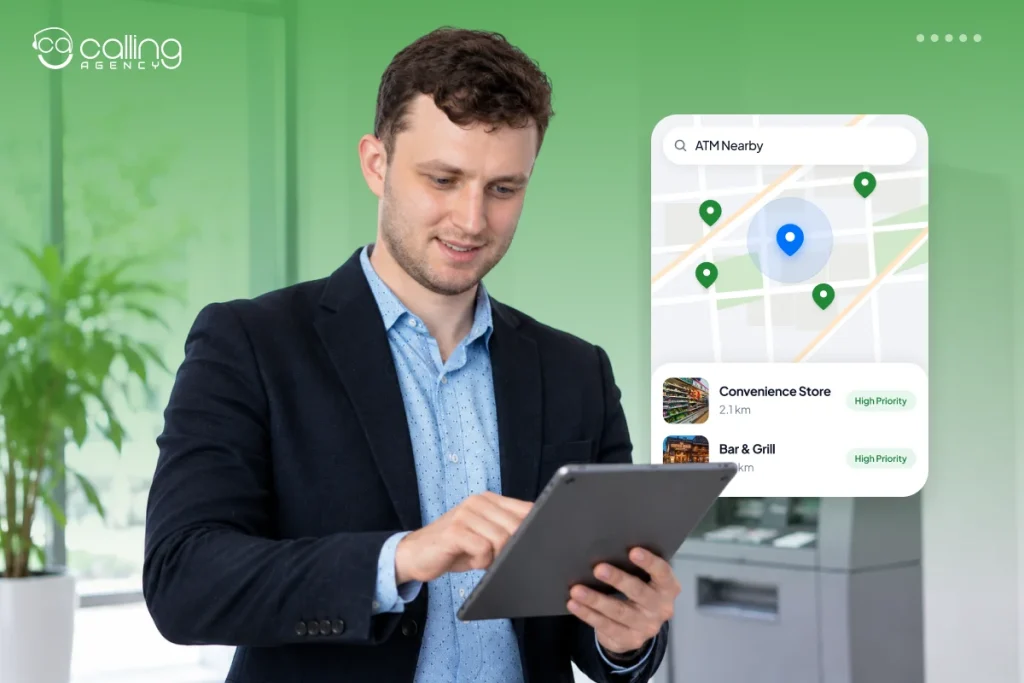
You can find locations that need heavy cash flow from liquor license records, map searches, census data. Evaluate every location with how much traffic it draws, cash needs, exiting ATMs, cash scarcity even with current ATMs.
Finding the suitable location, venue or shop is the very first step of an ATM installation process. Independent ATM deployers (IADs), ISOs and route owners have to deal with this on a regular basis so that the outreach team contacts the right decision-maker. Finding the suitable locations eventually helps to get ATM placement leads.
What Makes a Location Worth Installing an ATM
A suitable ATM location is a place where people need cash on the spot and has good foot traffic to cover the surcharge and bills. A location with no competitive ATM is more ideal. But often, places like malls still need more cash options even though there are existing ATMs installed at that location.
Around 15 percent of all payments still happen in cash in the USA, but evaluating the cash demand for a location is mandatory.
Evaluate potential ATM placement locations with these 6 factors:
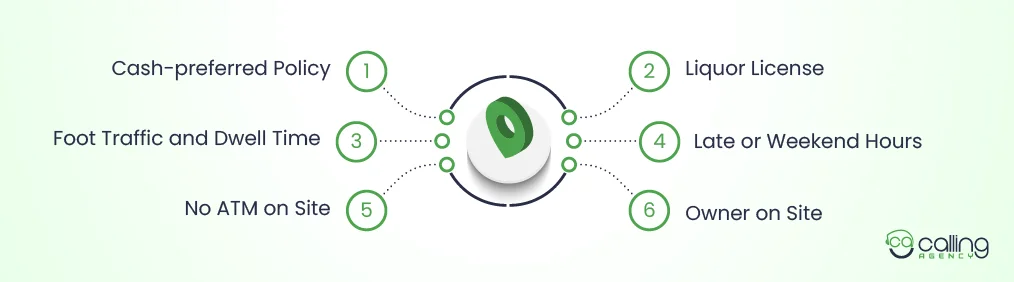
- Cash-preferred policy: Malls, shops, stores where “Cash only” signs are common.
- Liquor license: Bars often accept cash payments and tips.
- Foot traffic and dwell time: Fair venues, stadiums, nightclubs or other locations where people usually stay for a long time.
- Late or weekend hours: Customers may need cash when nearby bank branches are closed.
- No ATM on site: Locations where there is good foot traffic but no ATMs.
- Owner on site: Privately owned businesses or independent businesses may offer easier access to the person who signs the agreement.
Another key thing to do after evaluation is building an ideal customer profile. This is because on average, consumers aged 55 or older make 10 cash payments per month.
But younger customers between 18 and 24 make fewer than 5 cash payments a month. That’s why finding out the cash demand is necessary.
Best Locations for ATMs
As discussed earlier, the best locations for ATMs are independent shops or businesses with heavy cash requirements, like bars, liquor stores, convenience stores, laundromats, malls and more.
Highest Cash Demand Potential
- Bars, nightclubs and lounges: cover charges, tabs and tips.
- Liquor and package stores.
- Independent convenience stores and gas stations.
- Cannabis dispensaries.
Steady Regular Demand
- Laundromats.
- Barbershops, nail salons and beauty salons.
- Smoke and vape shops.
- Independent restaurants with a bar.
- Hotels and motels without a lobby ATM.
Seasonal and Event Demands
- Festivals, fairs, flea markets, concerts.
- Sports complexes, bowling alleys.
Portable ATMs are suitable for events, festivals and concerts. Casinos, chain stores and franchises require complex approvals. Especially casinos have far more complicated paperwork to do. But if the demand is high, they can be more profitable.
Where to Find ATM Location Prospects?
Public liquor license records, census business data and public searches on maps help you find potential locations. Other ATMs are also a potential way to find locations. You need to find out the gaps and demand in those locations.
| Method | Description |
| State Liquor License Records | Every state keeps a liquor license database, and it’s a quick way to get a list of bars, restaurants and liquor stores. Filter by license type and county, and you’re left with only the businesses in your target area. |
| Census Business Data | County Business Patterns shows how many businesses of a given type operate in a ZIP code. It gives counts only, not names, so it’s better for sizing up an area than for building a call list. |
| Map Searches | Type “bar,” “laundromat” or “smoke shop” into Google Maps along with your target ZIP code. Reviews often reveal the gaps, since customers tend to mention when a place is cash-only or has no ATM. |
| ATM Locators | Bank and ATM network locators show where machines already exist. The best prospects are areas full of cash-heavy businesses but with few machines nearby. |
| Route Walk-Ins | Stop by businesses close to your current ATMs or cash-loading stops. Shorter distances mean lower travel and servicing costs, which adds up over time. |
| Merchant Referrals | Existing location owners often know other business owners nearby. Ask whether anyone they know has been complaining about customers who can’t pay cash. |
| Purchased Lists | Business contact lists can save time, but treat them as a starting point. Before you reach out, confirm the owner’s details, check that the business is still open, and make sure it doesn’t already have an ATM. |
For Census research, check these NAICS codes in County Business Patterns:
- 722410: Bars
- 445320: Liquor stores
- 457110: Gas stations with convenience stores
- 445131: Convenience stores
- 812310: Laundromats
- 812111: Barbershops
- 812113: Nail salons
- 459991: Smoke shops
Census data gives you the numbers. Then use Google Maps to find the names.
How to Build Your ATM Location List?
A good ATM location list gives you information about who to contact, where the business is, if it already has an ATM and whether the venue suits a new placement.
Every row should carry these fields:
- Business name, venue type, NAICS code, and independent or chain
- Address, ZIP code and route zone
- Main phone number, plus the owner or manager’s name
- Operating hours and liquor license type, if it applies
- Payment policy: cash only, card minimum or card surcharge
- Existing ATM: the provider, the contract end date if you know it, and the nearest alternative machine
- Contact status: not contacted, contacted, site visit booked, signed or lost
Then build the list in five steps:
- Collect raw records from public licenses, map searches and referrals.
- Remove duplicates. Set chains aside, since they need corporate approval.
- Find owner names in state business filings and on business websites.
- Check phone numbers, hours and other details.
- Score every location and sort the list by priority.
Collecting addresses is the easy part. Verifying them takes the real work, and custom list building can help you organize business and contact data before outreach.
How to Score and Prioritize Locations
After building your potential ATM locations or prospect list, you need to make a priority list for outreach. You will not be able to contact everyone at once. The priority list will give you an idea of whom to contact first.
Score every location on a 10-point scale. A higher score refers to the most important ones.
| Scoring Criteria | Points |
| Cash-preferred policy | 3 |
| Liquor license | 2 |
| No ATM on site | 2 |
| Owner usually on site | 1 |
| Open past 10 p.m. or on weekends | 1 |
| Inside your current route zone | 1 |
| Total | 10 |
Locations that score between 8 and 10 will be on your top-priority list. Contact them first, verify who signs ATM placement agreements and identify demand and potential.
5-8 will be your mid-priority list. Outreach to them after the first group. Under 5 will be your lower-priority list, contact them last.
But remember, don’t treat these scores as a prediction. Use this just as a screening tool. Because under-5 locations may also be profitable. Then you also need to evaluate the location’s transportation cost, cash loading and frequent maintenance visits. Any site that has difficulty with these must have a lower score.
Again, an existing ATM does not necessarily decrease the score. Some locations may have a contract ending date soon. This contract renewal window is an opportunity for you. Besides, even with existing ATMs, often bad service or excess traffic can still create room for new installations.
How to Turn the List Into Placement Meetings
Cold calls are still highly suitable for setting appointments but your call timing must be chosen strategically. Call the owner or decision-maker when they are less busy and can talk with you. Do not directly ask for placement or agreement rather ask to visit the site first.
- Timing: Bars are best in the early afternoon. Convenience stores are normally less crowded mid-morning and laundromats are less crowded on weekday mornings.
- Who to ask for: For independent and private owned establishments, ask if they have ownership of the property or its on lease. You also need to ask if there are any business partners as well.
- The pitch: Keep the conversation on what they will get from the deal. For example, sharing revenue, easy cash access for customers and more.
- Placement model: Offer them full placement or merchant-owned anything that matches with their arrangement.
- Follow-up: It often takes 8-10 touchpoints to convince one prospect just to set a meeting. That’s why you need to follow up regularly.
- Compliance: Follow telemarketing, consent and Do Not Call rules, especially with automated calls or texts.
Frequently Asked Questions
How do I find locations for my ATM?
You can find the locations from state liquor license records and map searches by category and ZIP code in your route. Evaluate all the sites if they have the cash demand, traffic or an existing ATM. Then find who can sign an ATM placement agreement.
Where are the best places to put an ATM?
Malls, convenience shops, restaurants and businesses that handle a lot of cash are the best places to start. Bars, liquor stores, convenience stores, laundromats, salons and smoke shops are also potential locations for ATM placements. Venues that host festivals, concerts, fairs or events also have ATM demand where portable ATMs can be placed.
Can I buy an ATM location list?
Yes. You can buy an ATM location list. But the list will have only the business name, address or phone number. You still need to verify the owner, demand for cash, and cash scarcity even if there are ATMs already. You also need to verify if the owner owns the place or if it’s on lease.
How do I know if a location already has an ATM?
Use an ATM locator, Google Maps or recent reviews. Then you can also ask the owner of a shop or manager directly if they have an ATM in their location. Ask politely if they can share when the current contract will end.
How do I approach a business owner about an ATM?
The best way to approach an owner is to make a cold call. Then ask if you are talking to the person who can sign or approve an ATM placement agreement. Mention all the benefits the ATM will offer and what problems it will solve. Also tell them about the revenue share they will get. Lastly, ask them to visit the site and don’t push for signing on the first call.