


If you already inspect kitchen fire systems at restaurants, you can offer the same service to restaurant groups. So, stop working with one restaurant from now on. Try to work with a company that owns 10, 30, or more restaurants.
Especially to sell kitchen hood suppression inspections to multi-unit restaurant groups, find the person who hires kitchen fire protection companies for the group. Then, explain how you will inspect the restaurants, send reports, and handle all repairs.
Under NFPA 17A, kitchen hood fire-suppression systems usually must be inspected every six months. That means a group with 30 restaurants needs 60 inspections a year.
This guide shows you how to find restaurant groups, contact the right people and win contracts from multiple service providers. If needed, take CallingAgency’s fire protection lead generation service. It will help you reach property and operations managers easily.
Who Signs Suppression Contracts at a Restaurant Group?
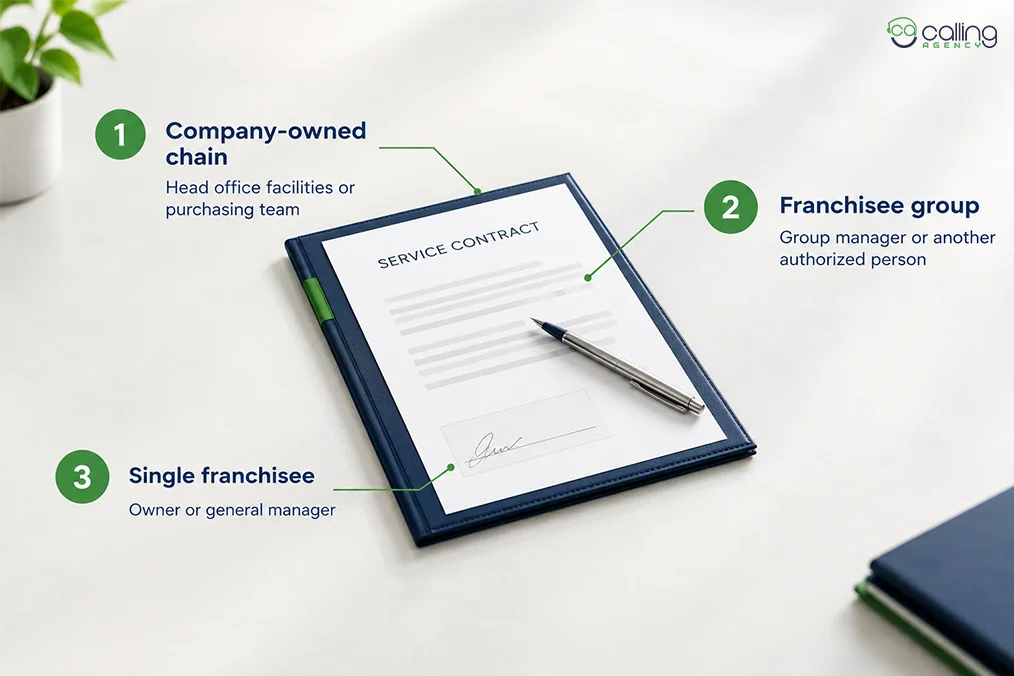
It depends on who owns the restaurant and who chooses the contractor to sign suppression contracts at a restaurant. Let’s say you want to inspect fire suppression systems at 30 restaurants that are owned by one group. In that case, you have to contact the group first, not each restaurant. Before that, know how to build a fire protection prospect list, then contact them.
| Ownership | Who signs? | First call |
| Company-owned chain | Head office facilities or purchasing team | Facilities manager |
| Franchisee group | Group manager or another authorized person | Facilities or operations director |
| Single franchisee | Owner or general manager | Restaurant owner or manager |
The restaurant brand may set safety rules, but the franchisee or restaurant owner has to pay for inspections and that person will choose the contractor. For example, El Pollo Loco’s 2004 franchise agreement says franchise owners must maintain their equipment and follow the law. However, it does not clearly say who shall choose the fire suppression contractor. This agreement is quite old. So, check the brand’s current rules.
Before giving a price to the owner, ask, “Who pays for inspections and repairs?” “Who approves the price and signs the contract?” and “Does one office manage all restaurant locations?”
Also, check the franchise agreement and the Franchise Disclosure Document (FDD). FDD Item 8 explains whether the owner must buy from certain suppliers or has to follow specific purchasing rules. If needed, check the FTC’s franchise guide to learn about it in detail.
Keep in mind that rules about buying equipment may not apply to fire suppression services. Some brands also require contractors to get approval before working at their restaurants.
That’s why I ask how to become an approved vendor. If the brand allows it, you may be able to work directly with a franchise owner.
How Restaurant Chains Hire Fire Vendors
Restaurant chains hire fire protection companies through online platforms, national contractors, or direct agreements with franchise owners.
Many chains use ServiceChannel to manage contractors and repair jobs. Some of its restaurant customers are Panda Express, Shake Shack, and Raising Cane’s. Panda Express manages more than 2,000 facilities through the platform. ServiceChannel also tracks costs, work quality, and contractor performance. More than 500 brands use it.
Other chains use different platforms. Let’s say Five Guys uses Fexa to manage contractors, jobs, and insurance documents. So, before registering, ask the chain which platform it uses.
Chains also check whether contractors arrive on time and do the work properly. If they find their performance is bad, they may not offer the job.
There are two ways you can get restaurant chain work. One is working with a national contractor and working directly with a franchise owner. Companies like AIE serve restaurants across the country. They may hire local technicians to do the work in your area. Whereas a franchise owner with 20 restaurants may hire one local company to service all 20 locations.
For a small company, working with a national contractor can be easier. So, contact these companies too. Ask them if they need technicians in your area. Also, be certain about the payment and who is responsible for each task.
Getting Onto a Facilities Platform
To join a facilities platform, register your company and provide the required licences and technician details. The ServiceChannel’s registration guide can help you on how to register. But registration alone is not enough. A chain must invite and approve your company too.
Here are the three steps that you must follow:
- Register your company: Here, you need to add your services, contact details, and service areas.
- Add your technicians: You have to set them up on the provider mobile app to manage jobs and send updates.
- Get approved by the chain: Accept its invitation and provide the required insurance papers, licenses, and certificates.
ServiceChannel says its platform covers more than 500,000 locations. But each chain decides which contractors it will accept.
When you get a job, arrive on time, complete the fire suppression hood inspection and submit the required documents. Make sure the records of inspections and repairs are clear enough to understand.
Register and contact chains at the same time. That’s why they ask which platform they use and whether they need fire suppression contractors.
Where to Find Multi-Unit Restaurant Groups
To find multi-unit restaurant groups, start with restaurant groups that own several restaurants near your service area. Remember, one contract could bring regular fire suppression hood inspection work from many locations.
In Franchise Times’ Restaurant 200 list, you can see the largest U.S. restaurant franchisee groups. Its July 2026 list covers 200 groups that operate 33,635 restaurants and earn more than $57 billion in combined sales. Let’s look at it in detail.
| Restaurant 200 figures | Value |
| Groups | 200 |
| Total restaurants | 33,635 |
| Average restaurants per group | About 168 |
| Yearly inspections per average group (2 per restaurant) | About 336 |
These are averages. Some groups own more restaurants than others. Even a group with 42 restaurants could need about 84 inspection visits a year.
Some groups own restaurants under different brands. Franchise Times reports that 43 groups on its 2026 list operate Taco Bell locations alongside other brands. One contact may help you reach several brands. But each brand may have its own contractor rules.
You can find more groups through brand franchise directories and Franchise Disclosure Documents (FDDs). You can check restaurant websites for franchisee lists. And in the FDD, check item 20 especially. It provides information about franchisees and restaurant locations.
Find Groups That Operate More Than One Brand
Some companies own several restaurant brands. Like one company may own many restaurants under different names. So, know who to contact. Then choose the company that manages them all.
First, find out which restaurant brands the company owns and how many locations it has near you. Then, find its head office and the person who manages its restaurants. Also, check whether the company has any special rules for hiring fire protection contractors.
This information can be available on company websites and franchise disclosure documents (FDDs).
Turn the List into a Call Plan
Once you have a list of restaurant groups, choose which ones to contact first. Start with groups that have several restaurants near your current service area. These locations will be easier to reach. If the groups have a few distant restaurants, they can still be worth contacting.
Next, find the person who manages the group’s restaurants. Check the company’s website or LinkedIn. There, you can find their facilities manager, maintenance manager, or operations director. If it’s a smaller group, the owner may handle this work.
Then, call the group’s main office and ask who hires fire suppression contractors. If that person is not available, ask who manages inspections and chooses contractors.
What Does a Multi-Location Suppression Contract Need?
Your multi-location suppression contract should list every restaurant you will service. It must include the fire suppression hood inspection dates and the prices for kitchen hood inspections. Besides, who will do the work must also be included.
Make sure you follow the NFPA 17A standard for kitchen fire suppression systems. It covers inspections every six months, along with monthly checks and hydrostatic testing of tanks every 12 years.
NFPA 96 covers kitchen ventilation and fire safety. And since hood cleaning is a separate service, state that in your contract, whether you offer it or not.
| Contract term | What to include |
| Locations | Each restaurant’s address and system brand |
| Inspections | Two visits per year, where required |
| Technicians | Training for each system brand |
| Reports | One report per restaurant |
| Repair prices | Agreed prices before work starts |
| Extra coverage | Partner companies for distant locations |
| Emergency service | Response times and extra fees |
| Billing | When and how the group pays |
Show the restaurant group how you will manage all its locations. For example, 30 restaurants need two visits. So, you have to make 60 inspection visits. You have to show the customer how you will plan these visits smoothly.
Before you give a price, find out which fire suppression systems each restaurant uses. It can include brands like ANSUL, Pyro-Chem, and Kidde. Also, you can use the ANSUL distributor search. It will help you to find authorized distributors.
When you make fire suppression inspections, you may find problems that need repairs. So, agree on repair prices with the customer before the work begins. Also, decide who can approve repairs.
Just make sure you make these four things clear in your contract. These are which restaurants you will service, when you will visit, what repairs will cost, and how you will report problems.
How Do You Win a Group That Already Has a Vendor?
To win a group that already has a contract, you have to show that your company can do the job even better. You can start with a few restaurants and make these attempts:
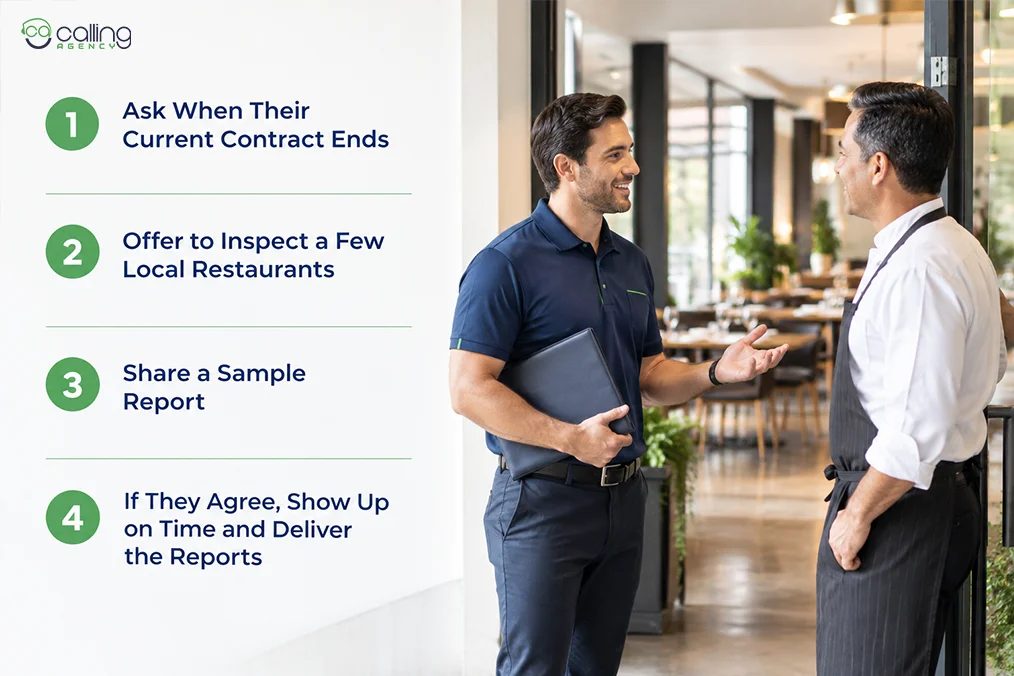
- First, ask when their current contract ends.
- Then, offer to inspect a few restaurants in one area.
- Show the customer a sample inspection report.
- If they accept your offer, arrive on time, complete the inspections and send the reports.
Let’s say the group’s current company misses visits or sends reports late. In that case, you have to tell them how your company won’t make such mistakes. But if the group is already happy with its current company, ask when you can contact them again. Try to convince them by giving a better offer.
Make sure you can ask these questions on your call:
- Who manages your restaurant fire suppression inspections?
- When does your current contract end?
- Which suppression system brands do you use?
Outreach Results From a Fire Protection Campaign
Calling the right people can help you find new customers and win more restaurant contracts. We can see that CallingAgency’s Henrichsen’s campaign booked 213 appointments in 12 months. The campaign promoted fire protection services to restaurants, offices, factories, shops, and property managers.
CallingAgency also reports that CallingAgency reported an estimated sales pipeline of $1.9 million or more. These are the company’s reported results, not a guarantee for every company.
You can use the same approach to find restaurant groups that need fire protection services. First, make a list of groups with restaurants in your service area. Then, call the person who manages fire safety for those restaurants. Explain which systems you can service and how you will plan the inspections. Lastly, ask when their current contract ends.
Conclusion
To win a restaurant group’s business, show that you can do the job well at every location. For that, you have to offer fair prices, arrive on time, and send clear inspection reports.
Start with a few restaurants. If the customer is happy with your work, ask to service more locations. In this way, you can win a larger contract. It even helps in building a lasting business relationship.
Frequently Asked Questions
How often do restaurant hood suppression systems need an inspection?
Restaurant hood suppression systems need an inspection every 6 months. This means you have to make 2 visits per year. Restaurant owners must also check the system monthly. Also, the wet chemical tanks need a hydrostatic test every 12 years.
Who pays for suppression inspections at a franchise restaurant?
The franchisee usually pays for suppression inspections at a franchise restaurant. We can see in the El Pollo Loco franchise agreement that it requires franchisees to pay for equipment maintenance. Other brands may have different rules. So, it’s better that you check the franchise agreement and FDD Item 8 and quote a price.
Do I need to be on ServiceChannel to work for restaurant chains?
You will need to be on ServiceChannel to work for restaurant chains only if the chain requires it. However, some franchisee groups hire contractors directly. That’s why ask the buyer which platform they use.
Can one fire company cover every location in a restaurant group?
Yes, one fire company can cover every location in a restaurant group if it can service every location on time. For distant restaurants, you may need to hire qualified local contractors. So, name these partners in your contract. Make sure they follow the same schedule and use the same report format as you do, just like AIE.
How do I get multi-unit franchise groups if I only service single restaurants?
If you service single restaurants, then also you can get multi-unit franchise groups by reaching groups that have several restaurants near you. If needed, use Franchise Times’ Restaurant 200 to find large groups. Call their office and ask for the facilities or operations manager. Then offer to service a few restaurants first.