


Most janitorial sales time gets wasted on people who cannot actually approve the contract. The receptionist may take your card and the night supervisor may like your crew, but neither one controls the budget.
Most commercial cleaning contracts are signed by a property manager, facility manager, operations leader or procurement decision-maker. But of course, it depends on the type of facility and the company’s structure.
Like, a property manager may manage a multi-tenant office, a practice administrator may manage a medical facility and a school district may require a purchasing recommendation and board approval.
So before you start calling, map who signs, who influences the decision and who can block the deal. Then you can easily make things work better and do quality assurance.
TL;DR
- Buildings under roughly 20,000 square feet usually have one signer: an office manager, a practice administrator or the owner.
- Larger buildings split the job. A facility manager evaluates. A finance or procurement approver signs.
- Portfolios and chains push the signature up to a regional title and gate it behind an approved vendor list.
- Public sector buildings replace the signer with a process: a formal solicitation and a contracting officer.
- In every one of these, the person who walks the building with you decides whether your proposal moves forward. Win that person first.
The Decision Maker Map by Facility Type
The right buyer for commercial cleaning services depends on the facility, ownership structure and company size. Titles can vary, but the buying path usually follows a clear pattern. Some contacts manage the building, others recommend vendors and someone else may control the final budget.
Use the facility type to identify the most likely decision maker first, then map the people who influence or approve the contract. This is also an important part of commercial cleaning lead generation, because reaching the right buyer early can shorten the sales process.
For example:
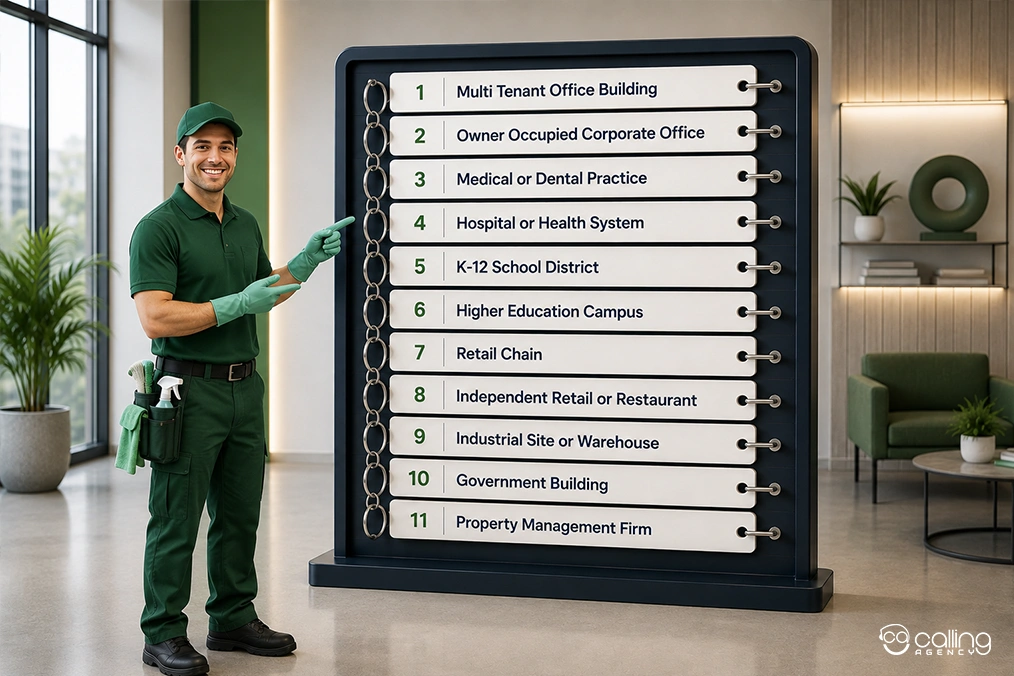
| Facility Type | Who Signs | Who Also Weighs In | Usual Deal Killer | Where to Start |
| Multi-tenant office building | Property manager. Regional property manager above the spend threshold | Asset manager, anchor tenants | Tenant complaint history and insurance limits | Property manager, one building at a time |
| Owner-occupied corporate office | Facility manager or director of facilities. Office manager under about 20,000 sq ft. | Office manager, HR, controller | A quiet auto-renewal with the incumbent | Facility manager |
| Medical or dental practice | Practice administrator or practice manager | Physician owner, lead nurse | Missing infection control documentation | Practice administrator instead of physician |
| Hospital or health system | EVS director, routed through supply chain | Infection prevention, materials management, GPO | Group purchasing agreements and credentialing | EVS director, on a long runway |
| K-12 school district | Board vote on a recommendation from the director of operations | Custodial supervisor, business manager | Fiscal year timing and formal bid rules | Director of operations, before the bid drops |
| Higher education campus | Director of facilities or custodial services with purchasing | Residence life, athletics, EHS | Semester calendar and union coverage rules | Facilities director, plus the purchasing office |
| Retail chain | Regional or national facilities manager | Store manager, loss prevention | An existing national program contract | Regional facilities manager |
| Independent retail or restaurant | Owner or general manager | Shift lead | Cash flow and month-to-month thinking | Owner directly |
| Industrial site or warehouse | Plant manager or maintenance manager. Procurement above-threshold-based industry certifications | EHS manager, shift supervisors | Safety onboarding and restricted site access | Plant or maintenance manager |
| Government building | Contracting officer or procurement officer | Facilities director as the requester | Formal solicitation rules and registration | Procurement portal first, facilities director second |
| Property management firm | Regional PM or director of property management | Local property managers | Approved vendor list cycle | One building, then the portfolio |
How Does Contract Value Change the Cleaning Buying Process?
As the contract value increases, commercial cleaning purchases usually become more formal and involve more people.
It may look like a simple price comparison. But it can turn into a structured procurement process with Service Level Agreements (SLAs), compliance checks, detailed proposals and multiple stakeholders reviewing the vendor.
Because a facility manager may approve a $900 monthly service directly but needs a controller or owner to approve an $8,000 monthly agreement. Because the authority depends on recurring revenue.
Ask about the approval process early. A simple question like, “What is the approval threshold for a recurring service agreement here?” tells you who else needs to be involved and helps you plan the close.
Because the number of people involved can also increase with the facility’s size and complexity.
So, Gartner reports that complex B2B purchases typically involve six to ten decision makers. Janitorial contracts can follow the same pattern when large buildings, multiple departments or compliance requirements are involved.
Contract timelines generally get longer as the account gets larger:
- Small buildings: around 2–4 weeks
- Mid-size commercial: around 4–12 weeks
- Institutional and public sector: around 6–18 months
For example, one janitorial outbound campaign generated 70 appointments over 10 months by consistently targeting the mid-size commercial market.
So, don’t treat every cleaning prospect like a one-person sale. Find the approval threshold, identify everyone involved and match your follow-up to the account’s buying timeline.
3 Places the Map Gets Complicated
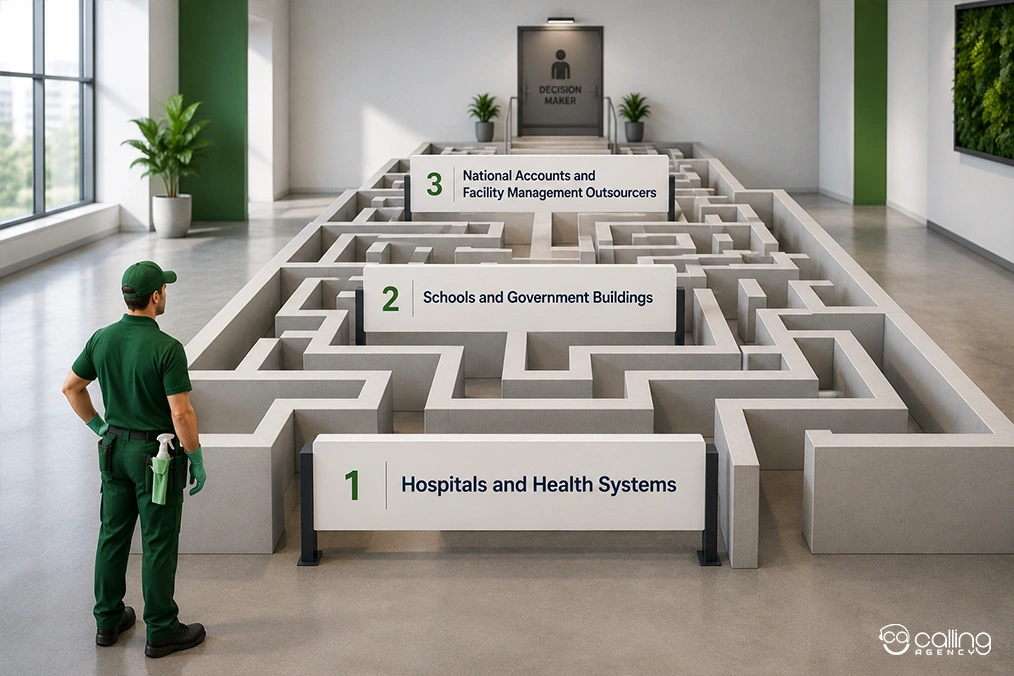
Hospitals and Health Systems
Hospital cleaning involves more than price. The EVS Director usually oversees cleaning, but Supply Chain and Infection Prevention can also influence or block the deal.
GPO agreements, vendor credentialing, background checks and training requirements can significantly lengthen the sales cycle. So, treat hospitals as long-term opportunities rather than quick wins.
Schools and Government Buildings
Public sector cleaning follows procurement schedules rather than immediate cleaning needs. A school district may want your service but still have to wait for its bid or RFP window, often around the July–June fiscal year.
For federal work, contractors need an active System for Award Management (SAM) registration. In addition, contracting officers verify if the specific registration is active when you submit an offer and receive an award.
The smart move is to get on the bidders list early and build a relationship with the facilities director, who often helps shape the cleaning specifications. This specification can determine which vendors are realistically positioned to win.
National Accounts and Facility Management Outsourcers
Retail chains, bank branch networks and large corporate campuses often don’t hire the cleaning company directly. Instead, they outsource facility management to firms such as ABM, Aramark, Sodexo or C&W Services, which then subcontract the janitorial work.
That changes who you need to sell to.
The site manager may check your team’s work, but the actual buyer is usually a vendor manager, sourcing lead or procurement contact at the FM company.
This channel can offer more locations and more predictable volume, but you usually give up some margin in return. So before spending months chasing a national account, decide if the volume and stability are worth the lower margin.
Who Is Not the Decision Maker in Signs the Cleaning Contract?
Not everyone needs your attention. Some people are automatically not in the decision-maker role, such as:
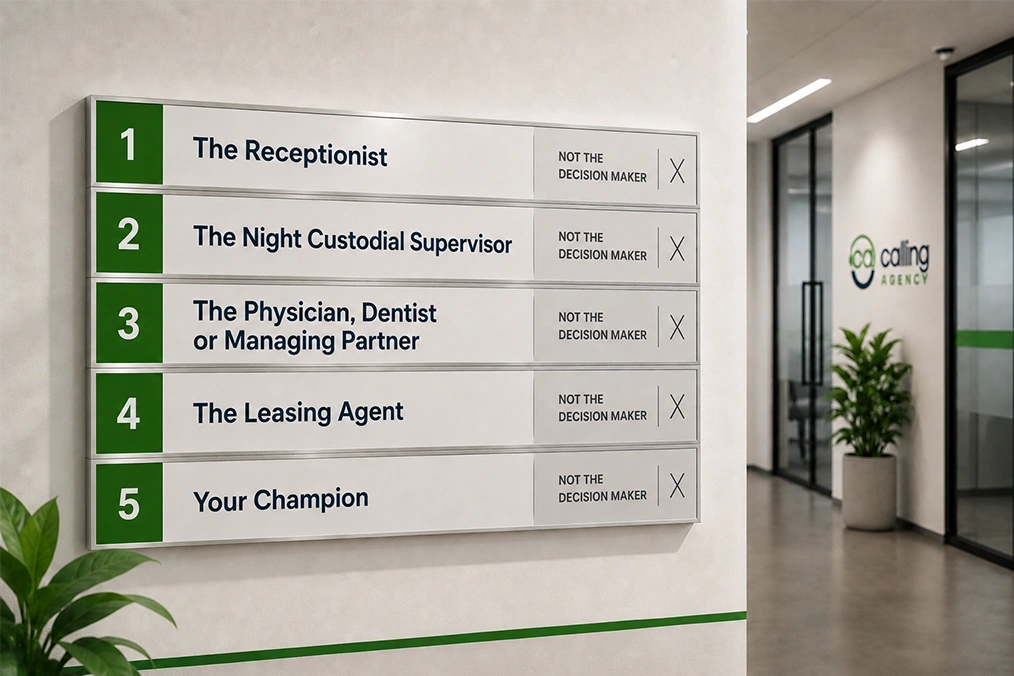
- The receptionist: Useful for getting the right contact name and spelling. Usually not the person who can schedule a buying conversation.
- The night custodial supervisor: Often works for the current cleaning company, so they are rarely the person deciding who replaces it.
- The physician, dentist or managing partner: They may own the practice, but cleaning decisions are often handed to the practice administrator or office manager.
- The leasing agent: Leasing agents deal with tenants and leases. They usually don’t control building service vendors.
- Your champion: A contact is not necessarily a buyer just because they like your service. If they say, “I’ll pass this along,” they are a messenger. If they say, “We would need to review the scope,” you are talking to someone closer to the buying decision.
Five Questions To Expose Real Authority on the First Call
- Who else signs off on a recurring service agreement at this location?
- When does the current cleaning agreement expire and does it renew automatically?
- Is there an approved vendor list and what does a new vendor need to get on it?
- What insurance limits and documents do you require before a walkthrough?
- If the proposal looked right, what happens next inside the building?
Question five does more work than the other four combined. A real signer can explain how the decision gets made. A messenger can only tell you who to send the information to.
So, ask the right questions on the first call, qualify the contact before scheduling a walkthrough and you will spend less time measuring buildings for people who were never in a position to hire you.
How to Reach Commercial Cleaning Decision Makers by Job Title?
The best outreach channel depends on the title you are trying to reach, such as:
On-site decision makers usually answer the phone.
Facility managers, practice administrators, plant managers and independent owners are often available during business hours. A direct call can work well because they are dealing with the building, staff and service issues themselves.
Regional and corporate titles are harder to reach by phone.
Regional property managers, national facilities managers and FM sourcing leads often screen unknown calls. For these contacts, LinkedIn outreach combined with a short, building-specific commercial cleaning leads email template can get more attention.
Public sector buyers follow a different process.
They are not waiting for a cold call. You need to be registered, listed as an eligible vendor and ready to respond when the solicitation opens.
The problem is not the pitch. It is reaching enough of the right titles every week for most cleaning companies. At this point, commercial cleaning lead generation and janitorial appointment setting come in. Build the list by job title and facility type. After this, consistently get those people into conversations.
What Should Be in a Commercial Cleaning Contract?
A commercial cleaning contract should define the scope, service frequency, price, contract term, start date and responsibilities of both sides. Those details also tell you how qualified the opportunity is before you spend time on a walkthrough and proposal.
Ask about the current contract early.
Find out what is being cleaned, how often, what the client pays, when the agreement expires and who has the authority to replace the provider.
The most useful details for sales are:
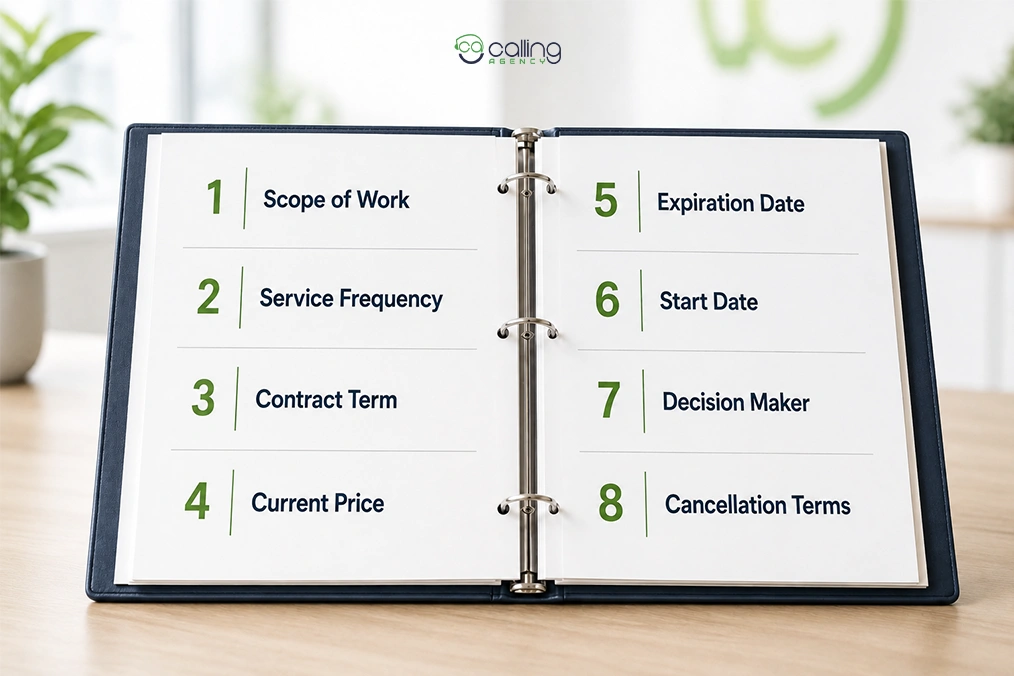
- Scope of work: What areas and services are included?
- Service frequency: How often does the facility need cleaning?
- Contract term: Is the agreement month-to-month, annual or longer?
- Current price: What is the client paying now, if they are willing to share it?
- Expiration date: When can they actually switch providers?
- Start date: When would a new cleaning company need to begin?
- Decision maker: Who reviews the proposal and signs the agreement?
- Cancellation terms: Can the client leave the current provider now or is there a notice period?
This information helps you separate a real cleaning opportunity from a quote request. A facility with an expiring contract, defined scope and decision-maker is far more valuable than one with only requests pricing.
So don’t wait until the walkthrough to ask about the contract. The contract tells you when the opportunity is real, who controls it and how much work it will take to win.
Conclusion
Cleaning is one service sold through many different buying structures. Before your next outreach block, sort your prospect list by facility type. Add the most likely signing title. Note the lease renewal, contract expiration, fiscal year or other event to create an opportunity.
The pitch matters, but getting to the right person matters more. We have seen the same pattern in outbound campaigns for office cleaning companies. Including accounts able to move forward are usually the ones where the first real conversation happens with someone who can actually say yes.
So build the list around who buys, when they can switch and what event creates the opportunity. Then make your outreach.