


To win warehouse and industrial cleaning contracts, prepare your documents. Then find the right logistics facilities, understand the work and submit a profitable bid. Industrial buyers often check insurance, safety records and prequalification.
Follow these six steps to win industrial cleaning contracts:
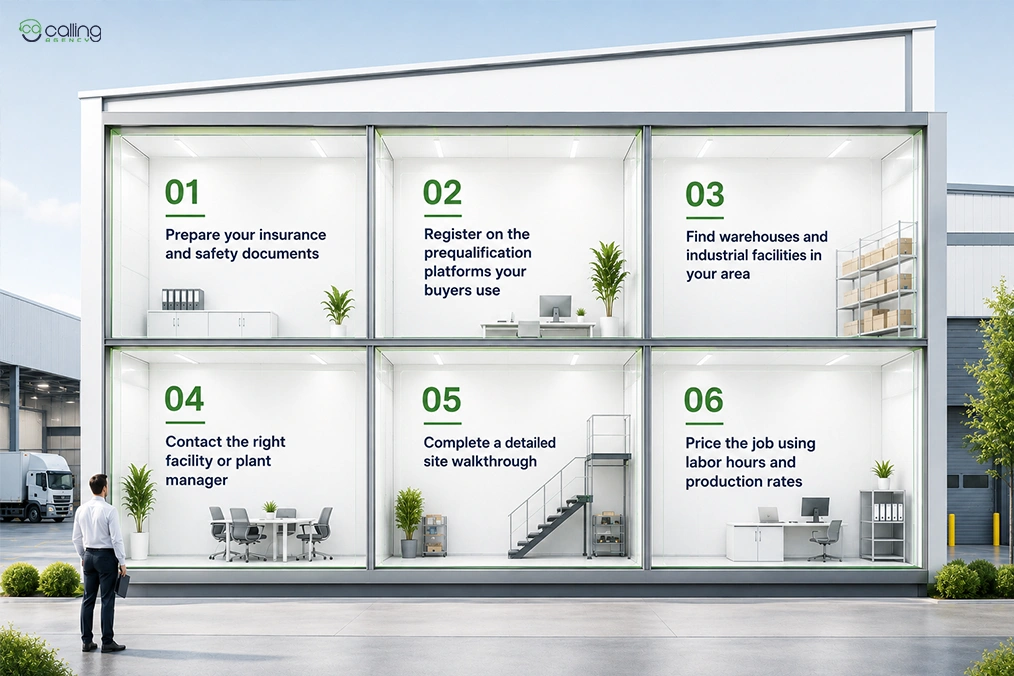
- Prepare your insurance and safety documents
- Register on the prequalification platforms your buyers use
- Find warehouses and industrial facilities in your area
- Contact the right facility or plant manager
- Complete a detailed site walkthrough
- Price the job using labor hours and production rates
Staffing rules also matter. The federal worker-retention rule was rescinded on December 22, 2025. California may still require 60 days of worker retention, while New York City and Philadelphia may require 90 days. This depends on the specific rules and exemptions.
What Do Industrial Facilities Require Before You Can Bid?
Most industrial facilities require insurance, safety documents and a COI before they consider your cleaning bid. Having these requirements ready can helps commercial cleaning lead opportunities move through the sales process more smoothly.
You will usually need general liability, workers’ compensation, commercial auto insurance and a janitorial bond. Many cleaning clients also want a certificate of insurance (COI) as an additional insured. They may also ask for safety training records in the sales process.
The exact business insurance limits are usually set by the facility based on its risks. Do not assume your office-account coverage will be enough.
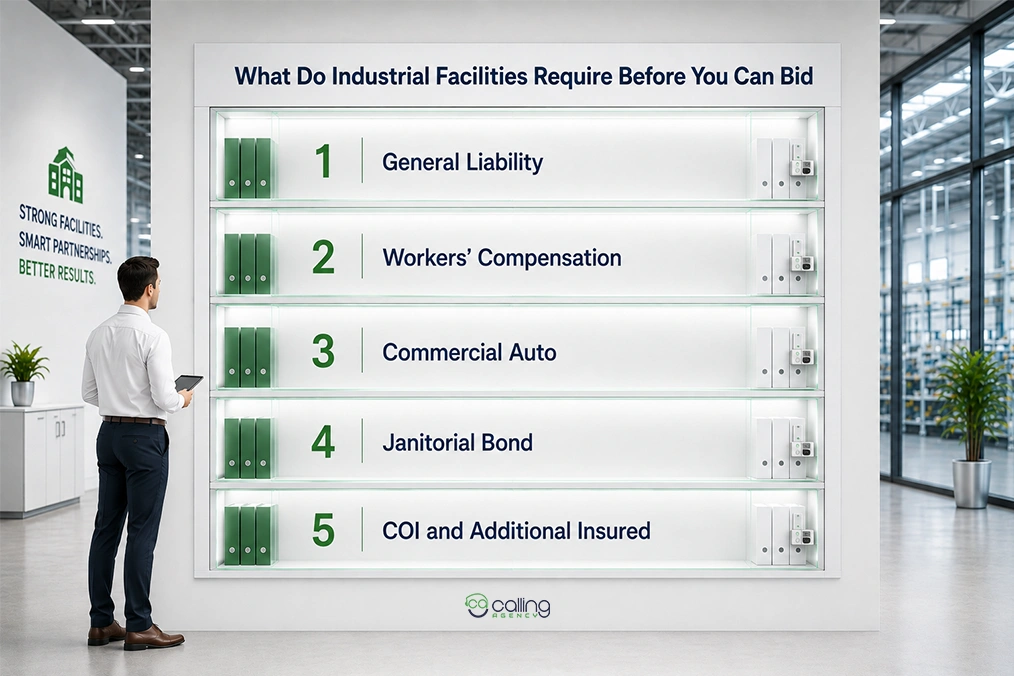
| Coverage | What It Covers | Who Sets The Requirement |
| General liability | Injury or property damage | Facility |
| Workers’ compensation | Employee injuries | State law |
| Commercial auto | Vehicles used for the job | Facility |
| Janitorial bond | Certain employee theft risks | Facility |
| COI and additional insured | Proof of required coverage | Facility |
Workers’ compensation is different because most states require it by law once you have employees.
Before you price the job, ask for the insurance requirements and scope of work. If you need extra coverage, include that cost in your bid.
Safety Documentation That Gates The Bid List
Safety paperwork can decide whether an industrial facility allows your company to bid at all.
Industrial buyers may check your safety program and safety performance before they even look at your price.
They may ask for:
- Written safety program:
- Training records
- EMR (Experience Modification Rate)
- TRIR (Total Recordable Incident Rate)
- Hazard communication
- Machine safety
- Confined-space awareness
- OSHA inspections or training records
Remember, the exact requirements depend on the facility and the work you will do.
Do not collect certificates without a written safety program. Build the program first, then organize the training records that support it.
Where To Find Warehouse And Industrial Cleaning Leads
The best industrial cleaning leads come from public bids, contract renewals, LinkedIn and many more. But the main channels are:
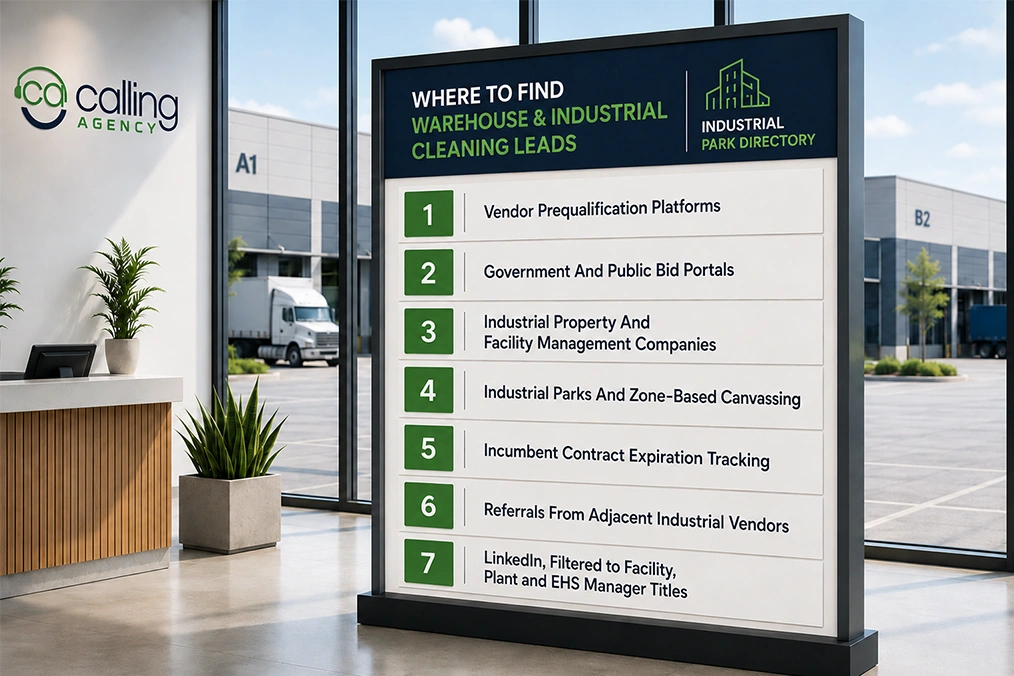
- Vendor prequalification platforms
- Government and public bid portals
- Industrial property and facility management companies
- Industrial parks and zone-based canvassing
- Incumbent contract expiration tracking
- Referrals from adjacent industrial vendors
- LinkedIn, filtered to facility, plant and EHS manager titles
The two most useful sources are prequalification platforms and contract-expiration tracking. It’s because they can show opportunities before regular cold outreach does.
Vendor Prequalification Platforms
ISNetworld, Avetta and Veriforce help industrial buyers find approved cleaning vendors.
Ask your target facility which platform it uses before paying. The buyer chooses the platform, not you.
You may need to provide:
- Insurance
- Safety program
- Employee training records
- Incident history
- Company information
- Compliance records
ISNetworld charges an annual fee plus a one-time account setup fee. The cost depends partly on your average employee count over the past three years. These fees are not refunded if you cancel or fail the review.
The process is pay, submit documents, complete the review and become visible to buyers.
There is no fixed published review time, so ask the facility about its deadline first.
Government And Public Bid Portals
You can find government warehouse and industrial cleaning contracts through SAM.gov and state or local bid portals.
- gov: It shows federal warehouse and depot contracts.
- State and local portals: These show distribution centers, maintenance facilities and fleet depots.
These opportunities are usually RFPs (requests for proposals) with a fixed deadline. They include the scope of work, required forms, insurance requirements, evaluation criteria and contract terms.
Always read the entire RFP before pricing your bid. If you miss a required document, it can disqualify your company.
Industrial Property And Facility Management Companies
One facility management relationship can lead to several cleaning contracts.
These companies may manage multiple warehouses, distribution centers or industrial properties. One facility management relationship can lead to several cleaning contracts. These companies may manage multiple warehouses, distribution centers or industrial properties. Finding the right cleaning client saves time.
Industrial Parks And Zone-Based Canvassing
Visit several businesses in the same industrial park instead of targeting them one by one. Plan your route, check which tenants are in each building and ask who handles cleaning decisions. Where required, follow badge-in and visitor rules. This lets you reach multiple potential clients in one visit.
Incumbent Contract Expiration Tracking
When you track a facility’s current cleaning contract that is up for renewal, it gives you an opportunity to contact them.
Ask about the renewal date and notice deadline. The notice deadline matters more than the contract end date. Because many contracts automatically renew unless the customer gives notice. You can say, “When does your current cleaning agreement renew?”
Referrals From Adjacent Industrial Vendors
Industrial vendors can refer you to facility and plant managers because they already work with your potential customers.
Build relationships with:
- Pallet suppliers
- Equipment service companies
- Waste haulers
- General contractors
- Maintenance companies
- Industrial suppliers
They already know facility and plant managers. You can bring steadier leads than cold calling if you keep these relationships.
If you cannot manage all seven lead sources, you can outsource the outreach to book industrial walkthroughs.
Who Decides Which Cleaning Company A Warehouse Hires?
The facility, plant, operations or EHS manager usually controls the cleaning decision, while procurement may join for larger contracts.
Titles That Control The Cleaning Decision At An Industrial Site
The right person depends on the facility:
- Single-site facility: Facility or plant manager
- Large company: Regional facilities manager
- Small facility: Operations or maintenance manager
- Large contracts: Procurement may also approve
- Industrial sites: EHS can reject a vendor for safety reasons
EHS may not sign the contract, but they can veto a vendor. So, ask early, “Who handles the commercial cleaning contract and who else needs to approve the vendor?” This can save you from wasting time.
The Outreach Sequence That Books A Site Walkthrough
To book a walkthrough, lead with your safety record, not your price.
Then point out one real problem at the facility. Such as loading docks, soil load or dust buildup. Also, use phone, email and an in-person visit. Industrial managers often work on the floor, so a drop-in can work better than repeated calls.
Can You Bring Your Own Crew When You Take Over An Incumbent’s Contract?
You cannot always bring your own crew when you take over an incumbent’s contract. In some areas, you must keep the existing cleaning crew for 60 or 90 days before bringing in your own staff.
| Jurisdiction | Instrument | Transition Period | Who is excluded |
| Federal service contracts | Rescinded December 22, 2025 | No current federal requirement | Not applicable |
| California | Displaced Janitor Opportunity Act | 60 days | Contractors with under 25 employees, workers with under 4 months at the site, under 15 hours per week and managers or supervisors |
| New York City | Displaced Building Service Workers Protection Act | 90 days | Workers may be excluded based on pay, hours, job status, or time at the site |
| Philadelphia | Protection of Displaced Contract Workers | 90 days | Exclusions are set by the local ordinance |
California’s rule applies to successor contractors with 25 or more employees. New York City’s $47.93/hour pay limit changes every January, so check the current amount.
These rules can depend on the location, property type and employees. Other cities may have similar laws. These are building-service laws with specific coverage requirements. So check whether they apply to the particular warehouse or industrial facility before making staffing promises.
Lastly, check local rules before promising a client that you can immediately replace the existing crew.
What To Capture During An Industrial Site Walkthrough
During an industrial walkthrough, measure the actual cleaning work, not just the building’s square footage.
| What To Capture | Why It Matters |
| Surface mix by area | Concrete, epoxy and carpet need different cleaning rates |
| Rack height | High areas may need lift equipment |
| Dock count and traffic | Busy docks need frequent cleaning |
| Shift schedule | Shows when your crew can work |
| Restroom and break room count | Changes labor needs |
To understand the account, ask these questions:
- What is the current cleaner missing?
- What inspections or audits does this facility have?
- Who else must approve the cleaning company?
Do not price the whole building as one large floor. In the cleaning industry, different areas need different labor, equipment and cleaning frequency.
How To Price And Bid An Industrial Cleaning Contract
Use production rate to price industrial cleaning. Do not use one price per square foot for the whole building because different areas take different amounts of time to clean. Always check your rates against local labor costs and your own costs.
Square Footage, Production Rate, Or Fixed Monthly
| Method | How It Calculates | Best Use | Where it fails on industrial |
| Per square foot | One rate for the total area | Open, consistent spaces | Mixed surfaces make it inaccurate |
| Production rate | Area cleaned per hour or labor hours | Most industrial work | Needs accurate task rates |
| Fixed monthly | One price for the full scope tier | Stable bundled contracts | Scope changes can reduce your margin |
Production rate is usually the best method for industrial work. Measure how much area each task can cover in one hour. Then calculate the total labor hours and build your price from those hours.
Cost Components Industrial Bids Miss
Include all your costs before deciding the final price. Industrial bids often miss these five:
- Night/weekend pay: extra cost for off-hour work
- Labor burden: payroll taxes and insurance
- Equipment costs: including scrubbers, sweepers and depreciation
- Supervision: especially for multiple shifts
- Travel: for sites outside your normal service area
Also include supplies, insurance, equipment maintenance and your profit margin. Clearly write your exclusions too following the janitorial service proposal structure. This protects your profit if the client asks for work outside the agreed scope.
How Do You Win A Government Warehouse Cleaning Contract?
To win a government warehouse cleaning contract, register on SAM.gov. Then get a UEI, use the correct NAICS code and meet the solicitation’s small-business requirements.
SAM.gov Registration And NAICS Setup
Register in SAM.gov and get a Unique Entity ID (UEI). For warehouse and plant interior cleaning, use NAICS 561720.
Other industrial services may use different codes:
- 561790: certain exterior building cleaning
- 238990: exterior sandblasting
- Duct cleaning: not covered by 561720
The SBA’s NAICS 561720 size standard is $22 million in average annual receipts. This determines whether you qualify as a small business as per the SBA size standards table.
Also, check the solicitation’s NAICS code, your business size, SAM.gov registration, UEI and certifications before bidding. Any wrong code can make you ineligible.
Set-Aside Certifications That Improve Your Odds
Federal set-aside programs can reduce the number of companies competing for a cleaning contract. Its four common categories are:
- Small business
- SDVOSB (Service-disabled veteran-owned small business)
- WOSB (Women-owned small business)
- HUBZone
For NAICS 561720, businesses with average annual receipts of $22 million or less can qualify as small businesses under the stated SBA size standard. Most independent commercial cleaning companies are below this limit.
For federal janitorial contracts, the old employee right of first refusal rule no longer applies. The Department of Labor rescinded it on December 22, 2025
Frequently Asked Questions
What insurance do I need for industrial cleaning contracts?
You usually need general liability, workers’ compensation, commercial auto and a janitorial bond for industrial cleaning contracts. You may also need a COI naming the facility as an additional insured. The facility decides the coverage limits, which may be higher than for office cleaning.
Do you need certification to clean industrial facilities?
No, there is no single certification required for every facility. Buyers mainly check your safety program, training, insurance and safety record. Some facilities may require extra training for specific hazards.
How do I compete against a large national cleaning contractor?
Compete against a large national cleaning contractor by being more responsive and flexible. Offer reliable janitorial services, flexible shifts and local knowledge. For government contracts, also check if you qualify for a small-business set-aside.
Can a new cleaning company win a warehouse contract?
Yes, a new cleaning company can win a warehouse contract. You do not always need years of experience. You need the right insurance and prequalification to meet the buyer’s requirements.
Conclusion
Winning industrial cleaning contracts starts with preparation. Have your insurance, safety documents, training records and prequalification ready. Then find the right decision-maker and check the current vendor and renewal date.
During the walkthrough, understand the surfaces, shifts and deep-cleaning needs. Price the job based on the actual labor required, not just square footage.
Finally, check local worker-retention laws before taking over an existing contract. This helps you submit a bid that covers your real costs.