


To reach IT decision-makers, you need to time outreach with trigger events and thread multiple stakeholders at once. A single cold email to one contact rarely moves a technical deal today. Strategic IT lead generation depends on timing and multi-channel outreach, not volume. Buying committees for enterprise technology purchases typically include six to ten people, per Gartner’s research on B2B buying groups. They pull from security, engineering, finance and procurement. These groups filter generic pitches out in seconds. Buyers now research quietly and avoid mass emails and demo forms until late in the process.
In practice, this means tracking breaches, executive turnover, compliance deadlines and infrastructure or tooling changes, then targeting the right person with a message built for their role. This guide shows how to find those triggers, get past technical gatekeepers and multi-thread a buying committee before competitors arrive.
Who Are IT Decision-Makers?
IT decision-makers are individuals within a company who approve, budget or deny technology acquisitions: CIOs, CTOs, IT Directors, IT Managers and in some cases CFOs for larger expenses. These are the people you need in the room if you sell software, hardware or IT services.
The Core Roles
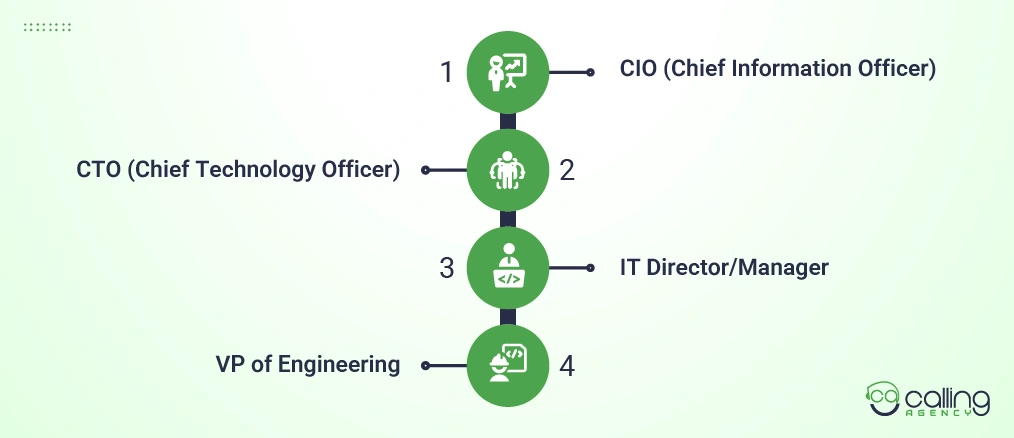
- CIO (Chief Information Officer): responsible for IT strategy and tech budget ownership.
- CTO (Chief Technology Officer): responsible for product and infrastructure decisions.
- IT Director/Manager: Operational and vendor management.
- VP of Engineering: makes decisions related to dev tools and technical stack.
Why B2B Sales People Should Care?
IT purchases normally include 6 to 10 stakeholders, not a single individual. Cost almost always is signed off on by the director or CIO level, and managers simply want a tool. Skip either one, and the deal gets stuck.
The Real Challenge
Naming the right person is the easy half. Getting a reply is the hard one. The titles change, the budgets shift, and most cold outreach is filtered out before it ever reaches a decision-maker.
Working a list of verified titles is one thing. Confirming which of those names actually holds budget authority before a rep spends three weeks on the wrong contact is where most teams stall. That starts with our B2B list building services, where every title is checked by hand before it reaches a rep. That’s the specific problem targeted IT lead generation is built to solve: pinpointing decision-makers by role, budget authority and buying intent, so outreach lands with people who can actually say yes.
How Does the Buying Committee Change by Deal Size?
However, larger deals get a bigger IT buying committee. Deals with smaller quantities are usually routed to a single approver. Five to eight stakeholders from IT, finance and leadership is a typical approval level in enterprise deals. Aligning your outreach with the deal size prevents you from reaching out to a CIO for a $6,000 purchase, or a single IT manager for a six-figure enterprise deployment.
Quick Breakdown by Deal Size
| Deal Size | Typical Committee | Key Decision-Maker |
| SMB (under $10K) | 1 to 2 people | IT Manager or Owner |
| Mid-Market ($10K to $100K) | 3 to 4 people | IT Director + Finance |
| Enterprise ($100K+) | 5 to 8 people | CIO, CTO, CFO, Procurement |
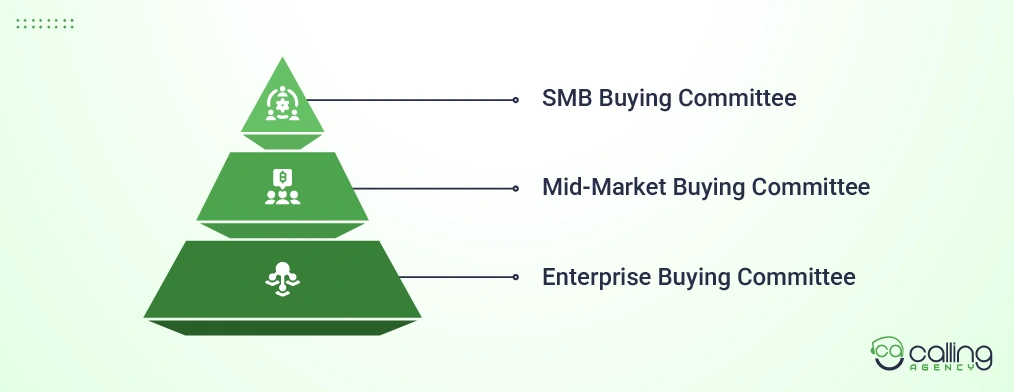
SMB buying committee
- One person usually makes the call, often the owner or IT Manager
- Budget approval moves fast because there is less bureaucracy
- Price and ease of use matter more than brand reputation
Mid-market buying committee
- An IT Director requests the solution, but Finance approves the spend.
- Vendor comparison becomes common at this stage.
- Sales cycles stretch to 30 to 60 days.
Enterprise buying committee
- The CIO owns strategy
- The CTO checks technical fit and the CFO controls the budget
- Procurement and Legal review contracts before signing
- Security and compliance teams often join the review
- Sales cycles can run 90 days or longer.
Why Committee Size Changes Your Strategy
Selling to one SMB owner differs from convincing eight enterprise stakeholders. This gap matters most for MSPs, where technical trust and long-term reliability count at every level. A managed service provider lead generation partner helps identify who sits on each committee, so outreach targets real buying power instead of job titles.
What Do IT Buyers Screen For in the First 10 Seconds?
IT buyers scan a vendor site rather than read it. In less than 10 seconds, they inside-average if the vendor helps to back up their claims and whether or non trust in any way on behind-the-scenes work of a site. A buyer should be able to summarize what a company does, who it is selling to and why it will win within the first 10 seconds of arriving.
A Clear Message First
Your hero section has to state what the company does and who it sells to. One clear promise beats five clever lines. A buyer who’s still confused at 10 seconds lands on a competitor’s site instead.
Trust Signals Buyers Look For
Security buyers read a website as proof of how a company runs internally. A slow site or a hidden compliance page signals weak internal standards.
- Certifications and compliance badges need to sit in plain view, not buried in a footer.
- Named companies with specific, measurable results build trust.
- Generic logos and vague quotes do not move buyers at all.
Site Speed Is a Buying Signal
Google’s 2016 mobile speed research found that 53% of mobile site visits get abandoned when a page takes longer than three seconds to load. A slow site reads as a preview of an unreliable product. Aim for a page load time under 2.5 seconds for Largest Contentful Paint.
Mobile Experience
Buyers research on their phones between meetings. Mobile pages need full functionality, not a stripped-down version of the desktop site.
A vendor’s site gets judged the same way its product will be judged later. A confusing or slow site reads as untrustworthy before a single sales call happens.
Which Channels Reach IT Buyers, and in What Order?
IT buyers move through five channels in sequence. AI search and analyst content come first, followed by peer review sites, LinkedIn and communities, the vendor website and finally direct sales contact. B2B buyers now complete roughly 60-70 percent of their research on their own before talking to a seller.
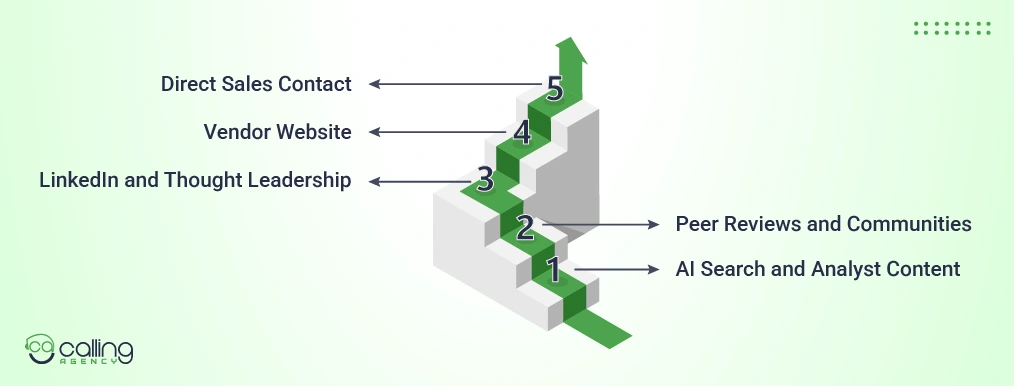
Stage 1: AI Search and Analyst Content
Buyers now start research with AI tools instead of search engines. The assets that matter most are the ones buyers find on their own, without vendor input. That includes analyst coverage, peer reviews, search results and AI-generated answers. Formal analyst reports are fading fast from enterprise buying. According to TrustRadius’s January 2026 survey of 1,862 technology buyers, only 13% used analyst reports to make a purchase decision, a 63% decrease since 2022.
Stage 2: Peer Reviews and Communities
Peer opinion carries more weight than vendor marketing at this stage. Buyers pass useful peer reviews to other members of the selection committee. Much of that discussion happens in private channels a vendor never sees.
Stage 3: LinkedIn and Thought Leadership
Top-of-funnel channels here include LinkedIn posts, peer validation, email nurture sequences, webinars and syndication on respected third-party sites.
Stage 4: Vendor Website
By the time a buyer reaches the vendor site, they are confirming fit and checking proof, not discovering the company for the first time.
Stage 5: Direct Sales Contact
Sales contact happens last, not first. Buyers reward vendors who show up with relevant context tied to a real trigger, not a generic pitch fired off on a rep’s schedule.
| Order | Channel | Buyer Behavior |
| 1 | AI search and LLMs | Summarizes vendors, drafts RFPs |
| 2 | Peer reviews | Validates claims, shares with committee |
| 3 | LinkedIn and communities | Builds trust through peer opinion |
| 4 | Vendor website | Confirms fit, checks proof |
| 5 | Sales contact | Final validation, not discovery |
What Trigger Events Open the Door?
Trigger events are business or technical changes such as a breach, a leadership hire or a compliance deadline that signal a company is ready to buy new technology. Spotting these signals before your competitors do is what turns cold outreach into a warm conversation.
The IT Trigger List
Trigger patterns show up across IT purchasing generally, not just security. Common signals include:
- No, company itself or a very tight (related) industry peer being hit by a data breach or ransomware attack
- Hiring a new CISO, CTO or IT security hire; new leaders generally re-audit vendors within their first 90 days
- SOC 2 audit windows, PCI-DSS annual revalidation and composition and delivery of HIPAA or GDPR enforcement actions
- M&As or funding rounds, through which new capital typically releases fresh budget across IT
- Cloud migration or a new server rollout, which only increases the attack surface along with the tooling footprint
- A new VP of Engineering or CTO hire, since incoming technical leaders commonly re-evaluate the dev tool stack in their first quarter
- Lapsed or sharply rising cyber insurance premiums
- Failed audit or penetration test results
- Rapid headcount growth, meaning more endpoints, more engineers and more risk
How to Catch Triggers Early?
Speed matters more than volume here. Most buyers engage the first vendor that reaches out within a week of the trigger happening.
- Set up intent data platforms such as Bombora or G2 to track surges in relevant topic research
- Monitor job postings for new IT and security-hire signals
- Track SEC filings and press releases for funding and M&A news
- Use breach-disclosure alerts and dedicated industry news feeds
- Watch LinkedIn job changes to spot new decision-makers early
Watching five signal sources by hand costs a rep several hours a week, which is why most teams quietly stop doing it after the first month or two. A dedicated monitoring setup is the difference between reaching a prospect the week of the trigger and reaching them a month late. It’s the core of how structured, trigger-based lead generation programs are run.
How Do You Get Past a Technical Gatekeeper?
The fastest path past a technical evaluator is to speak their language, not a sales script. IT managers and security analysts filter out generic pitches instantly. A message that names their actual stack reaches the leader who signs.
Why Generic Pitches Fail
Technical evaluators screen out vague value propositions on sight. If your opener sounds like every other vendor email, it gets deleted before it reaches the decision-maker.
Tactics That Work
- Reference their specific tech stack, SIEM, cloud provider or endpoint tool in the first line.
- Lead with a technical insight, such as a known vulnerability in a tool they use
- Ask a narrow, specific question rather than pitch, since evaluators respect precision.
- Name frameworks the way practitioners do: MITRE ATT&CK or the NIST Cybersecurity Framework (NIST CSF), not just “NIST,” which is the agency, not the framework
- Time outreach around a trigger event, since evaluators escalate faster when urgency is clear
Build Credibility Fast
Share a short technical resource, like a vulnerability breakdown or a benchmark report, instead of a brochure. Gatekeepers escalate contacts who prove they understand the problem, not those who just want a meeting.
How Do You Multi-Thread the IT Buying Committee?
Multi-threading means engaging several stakeholders at once instead of chasing a single champion. IT purchases usually involve people across technical, financial and security roles. A deal that relies on one contact stalls the moment that person changes jobs.
How to Thread by Role?
Each stakeholder cares about a different risk, so the message has to shift with the role.
- CISO or Security Lead. Focus on risk reduction and compliance.
- IT Director. Focus on integration and operational load.
- CFO or Finance. Focus on cost, ROI and total spend.
- End Users or Engineers. Focus on ease of use and daily friction.
- Focus on contract terms and vendor reliability.
Engineering the Internal Referral
Most momentum comes from inside the account, not from outside it. Asking a technical champion to introduce you to the budget holder works best. Internal referrals convert at a much higher rate than cold outreach to a new stakeholder. Create a short, role-specific piece for the champion to forward, not a full deck, so it is easy to pass along.
Multi-threading also protects a deal when one contact goes quiet. For teams reaching IT buyers across a committee, structured outreach to each role at once can shorten sales cycles noticeably.
Why Does Self-Serve Outreach Stall for IT Buyers?
Self-serve funnels stall with IT buyers because very few sign up for a demo before finishing their own research. Technical buyers read documentation, check forums and compare tools without logging into a form, so inbound tracking misses most real buying activity.
What Works Instead
- Outbound calling and triggered email sequences, not random cold lists
- Booking meetings with the specific stakeholders who matter, not whoever fills a form
- Pairing intent data with direct outreach, so timing matches genuine interest
- Short technical hooks in outreach instead of demo requests, since buyers respond to insight
- Tracking the meeting-to-opportunity rate, not just the number of meetings booked
Scaling Without Losing Fit
The real challenge is growing meeting volume without losing targeting quality. Accounts already showing trigger signals convert into meetings at a far higher rate than a cold, unqualified list.
This approach has worked well in practice. B2B appointment scheduling data from an engagement with a cybersecurity firm showed a pipeline reset after shifting from self-serve to targeted outbound.
A case study in cybersecurity B2B lead generation found that pairing intent signals with direct outreach produced more qualified meetings than inbound-only partnerships.
Final Thoughts
Your website matters less in 2026 than where IT buyers already are: AI search, peer review sites and LinkedIn. By the time they reach your site, they’re checking proof, not discovering you, and you have about 10 seconds to give it to them. Sales contact is the last step in that sequence, not the first.
The real edge comes from catching trigger events like executive hires, funding rounds, renewal windows and moving within days while the signal is still fresh.
FAQs
How do you reach a CISO?
Never pitch a CISO once, through trigger events, peer referrals, and a specific technical insight. CISOs answer the risk-framed message that is currently framed by something real in their world, a SOC 2 audit coming up, a breach at a peer in their industry, a vulnerability in a tool they run.
How many people are in a B2B tech buying committee?
A B2B tech buying committee averages six to ten stakeholders spanning technical, financial, security and end-user roles, per Gartner’s research on B2B buying groups. Committee size tracks deal size: an SMB purchase may involve one approver, while an enterprise deal pulls in five to eight.
When is the best time to reach IT decision-makers?
Reach out within a week of the trigger event, a breach, a new security hire or a compliance deadline. The window closes fast, because the first credible vendor to arrive with relevant context often sets the evaluation criteria for everyone who follows.