



Buying signals make it easier to identify the target businesses for getting IT services rather than cold outreach. Most businesses have very visible signs that they are ready to invest in managed IT, cybersecurity, cloud migration or consulting services. The trick is identifying the signals that precede them by starting to search for a provider.
This guide covers nine buying signals that reveal when a company has an active IT need. By identifying these signals, you can strengthen your IT lead generation efforts, reach prospects at the right time, improve response rates and shorten the sales cycle.
The Nine IT-Services-Native Buying Signals
- Breach filings and public incident disclosures
- Software end-of-life dates
- Compliance deadlines
- Cyber insurance renewals
- IT leadership changes
- MSA renewal windows
- Funding, hiring and headcount growth
- Public RFP postings
- Technographic shifts
Each of these signals has a different source, a different urgency tier and a different decay window, meaning the outreach timing and messaging has to match the signal type exactly.
Who This Guide Is For
- MSPs (managed service providers)
- MSSPs (managed security service providers)
- VARs (value-added resellers)
- Cybersecurity firms
- Cloud services firms
- IT consulting firms building a signal-based prospecting motion
Below, we break down where to find each signal, how long it stays actionable and how to reach the account without sounding like every other vendor chasing the same trigger.
What Are the Buying Signals for IT Services?
Buying signals for IT services are dated, public events at a target account that open an active procurement window. Unlike generic B2B intent data, they anchor on regulatory, lifecycle and incident triggers specific to IT services purchasing, not on vague research behavior scraped from anonymized browsing.
What Separates a Real Signal from Noise
There are two filters that determine if something is counted as such. To begin, the event must be dateable and publicly verifiable rather than being inferred from anonymized intent data. Second, it needs to compel an operational or budget decision by a specific date.
Signals That Count
- SEC 8-K breach filing
- Windows 10 end-of-support date passed
- Cyber insurance renewal 90 days out
- New CIO appointment
- Request for proposal (RFP) released for managed IT services
All these are direct ties to a budget cycle, compliance needs or leadership request. These are precisely the triggers which drive IT decision-makers towards vendor evaluation.
Signals That Don’t Count
- You have accessed a cybersecurity blog anonymously
- Content download on cloud migration
- Paid intent platform interest score
- A mid-level engineer switching jobs
- Competitor comparison search
These reflect curiosity, not commitment. What you end up with is not the out-of-date, public quality that distinguishes a true trigger from background research effort.
Why Signal-Based Prospecting Wins for MSPs?
Signal-based prospecting works better for MSPs than high-volume outreach because SDRs focus on accounts already showing a genuine business need. When outreach aligns with events such as a security breach, an EOS announcement or a CIO change, prospects are more likely to respond.
For MSPs building a pipeline in 2026, effective MSP lead generation means shifting SDR time away from broad cold lists and toward accounts currently within an active buying window.
Why Generic B2b Buying Signal Frameworks Miss It Services Triggers
Most B2B intent platforms are built for horizontal use cases like SaaS or marketing tools. They track keyword searches, content downloads and website visits across broad topic categories. This model breaks down for IT services because IT procurement doesn’t follow a research curve. It follows compliance deadlines, lifecycle events and incident response windows.
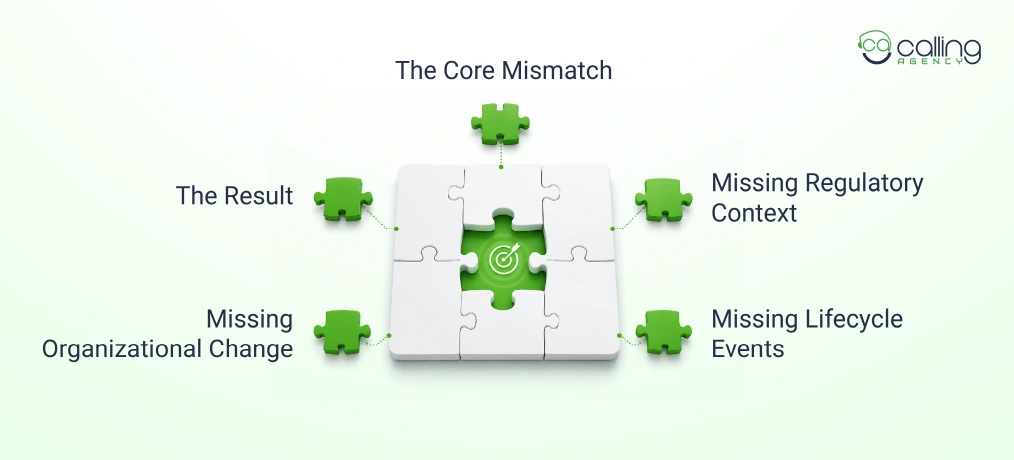
The Core Mismatch
Generic frameworks treat all research activity as equally predictive. But someone reading a firewall comparison article could be a student, a competitor or an IT director with no active budget. Without a dated trigger tied to that activity, the signal carries no urgency. IT services buying decisions are event-driven, not curiosity-driven, and generic intent scoring cannot tell the difference.
Missing Regulatory Context
Horizontal platforms rarely track filings or mandates that create hard compliance deadlines, such as:
- SEC 8-K breach disclosures
- HIPAA violations or audits
- PCI DSS non-compliance notices
These filings often force companies into vendor evaluation, whether they were “researching” beforehand or not. A generic intent tool has no mechanism to flag this.
Missing Lifecycle Events
Software and hardware end-of-support dates create predictable, dated windows where organizations must act. Examples include:
- Windows 10 end-of-support
- Server OS end-of-life dates
- Expiring cyber insurance policies
These aren’t inferred behaviors. They are calendar facts. Generic frameworks built around anonymized browsing data simply don’t ingest this kind of structured, public information.
Missing Organizational Change
A new CIO or IT director typically re-evaluates vendor relationships within their first 100 days. Generic platforms track job changes broadly but don’t weight leadership-level IT hires as procurement triggers, since that requires industry-specific context most horizontal tools don’t have.
The Result
Sales teams using generic frameworks end up chasing warm-sounding but unqualified activity. MSPs and IT service providers that build around dated, industry-specific triggers instead of anonymized intent see materially better conversion, because they’re reaching accounts already inside a real buying window.
The 9 It-Services-Native Buying Signal Categories
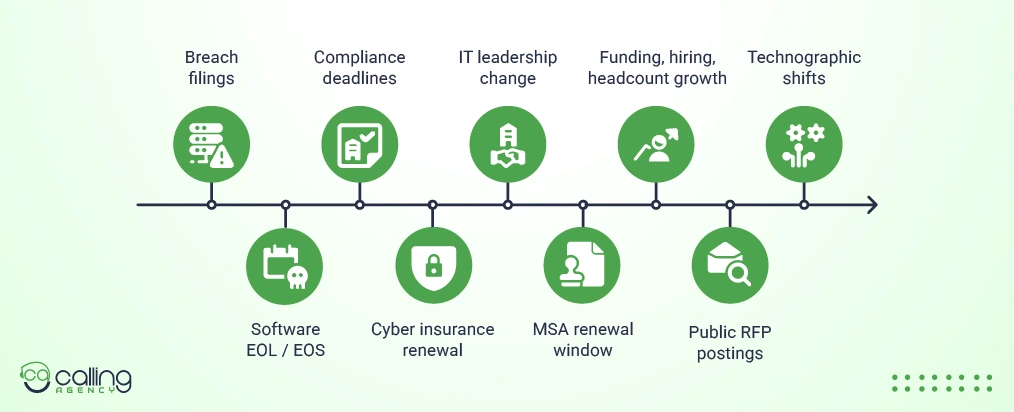
IT services buying decisions rarely start with curiosity. They start with a dated event that forces a company to act, whether that’s a regulatory deadline, an expiring contract or a leadership change. Below are the nine signal categories that MSPs and IT service providers should track instead of relying on generic intent data.
| Signal Category | What It Looks Like | Why It Triggers Buying |
| Breach filings | SEC 8-K disclosures, state breach notifications, public incident reports | Forces immediate remediation, security audits and vendor evaluation |
| Software EOL / EOS | Windows 10 EOS, server OS end-of-life, unsupported firmware dates | Creates a hard compliance and security deadline to migrate or upgrade |
| Compliance deadlines | HIPAA audits, PCI DSS non-compliance, SOC 2 renewal gaps | Legally mandates a fix within a defined window |
| Cyber insurance renewal | Policy renewal 60 to 90 days out | Insurers often require security upgrades before renewing coverage |
| IT leadership change | New CIO, CISO or VP of IT appointment | New leaders typically re-evaluate vendors within their first 100 days |
| MSA renewal window | Existing managed services contract nearing expiration | Opens a natural switching or renegotiation point |
| Funding, hiring, headcount growth | Series A/B funding, rapid headcount increase | Growth outpaces existing IT infrastructure and support capacity |
| Public RFP postings | Published requests for proposal for managed IT or security services | Direct, explicit signal of active budget and intent to buy |
| Technographic shifts | Migration to new cloud platform, CRM or ERP system | New stack often requires new integration, security or support partners |
Every one of these nine categories has a common attribute. A dated, public event requiring a decision within an appropriate period. That’s what makes a real IT services buying signal different from ordinary intent noise and it’s why signal-based outreach beats cold volume prospecting hands down every time.
Breach Filings and Public Incident Disclosures as the Highest-Urgency IT Services Signal
For MSSPs and cybersecurity firms, breach filings are among the strongest high-urgency buying signals. A breached company faces immediate operational pressure, board-level discussions within days and an approved security budget within the quarter. This makes breach-triggered outreach a valuable part of cybersecurity lead generation.
Why This Signal Outranks Every Other Trigger?
No other IT services event compresses the sales cycle this fast. A breach forces legal review, insurance scrutiny and executive decision-making all at once, opening a buying window that closes quickly if not addressed.
Three Public Sources That Reveal Breach Events
SEC Form 8-K Item 1.05
A rule introduced in December 2023 requires public companies to disclose material cybersecurity incidents within 4 business days of determining the relationship to their operations. Monitor SEC EDGAR filings, perform SIC industry code filtering and get alerts when words like “cybersecurity incident” and “unauthorized access” appear.
State AG Breach Notification Portals
For private entities, breach disclosures are filed with state attorneys general, rather than the SEC. If you want to measure sites, portals well worth considering are Maine, California, Vermont, Massachusetts and Washington state. These include company name, incident type, dates and records affected.
Ransomware Leak Sites
Attacker groups sometimes publish victim names when negotiations stall. This data is public but ethically sensitive, so reference the industry pattern rather than the specific victim and never mention the leak site or ransom details directly.
The Buying Window
Breached companies typically consolidate their MSSP or breach-response retainer within 30 to 90 days of disclosure. This is the realistic window for outreach to convert.
Correct Outreach Timing
| Days Since Disclosure | Channel | Contact |
| 0–3 | None | No outreach |
| 4–14 | Warm intro | COO or CFO |
| 15–60 | Email or LinkedIn, offer an artifact | CISO, VP IT or GRC lead |
| 61–90 | Phone, roadmap conversation | Buying committee member |
Avoid contacting the CISO within the first 72 hours; they’re still in incident response mode.
Framing That Works
Lead with a useful artifact, such as an incident retro checklist or tabletop template, never a demo request. Reference the incident indirectly and skip any mention of source or ransom specifics.
Proven Results
CallingAgency ran this exact playbook in cybersecurity. Its lead generation and appointment setting campaign for PDDG booked 87 qualified meetings over 9 months, producing 55-plus qualified opportunities and an estimated $1.5M-plus pipeline.
Breach filings convert better than any other IT services signal because urgency, budget and decision authority activate simultaneously. Timing discipline and ethical framing determine whether outreach lands as genuine help or opportunistic noise.
How Does Software End-Of-Life Create Forced Buying Windows?
Software end-of-life creates a forced buying window because unsupported systems stop receiving security patches, which turns continued use into a compliance and cyber-insurance liability the moment the EOL date passes.
Microsoft Lifecycle Events Driving 2024 to 2026 Spend
Several major Microsoft end-of-support dates are pushing IT budgets right now:
- Windows 10 EOS – October 14, 2025, after which no security updates ship without paid Extended Security Updates
- Windows Server 2012 / R2 – already past EOS, pushing legacy server migrations
- SQL Server 2014 and older versions – extended support ended July 2024, leaving these deployments fully unsupported and forcing database modernization. Exchange Server 2016/2019 – mainstream support ended October 14, 2025, pushing companies toward cloud migration or managed hosting
Each date acts as a hard deadline, not a suggestion. Companies running unsupported software face audit failures, insurance non-renewal and compliance gaps, all of which force a budget decision rather than a discretionary one.
How to Find Companies Still Running End-of-Life Software?
Technographic data is the primary tool here. Practical sources include:
- BuiltWith and Wappalyzer for web-facing technology detection
- Shodan for internet-exposed server and OS fingerprinting
- Job postings mentioning specific legacy systems (“Windows Server 2012 admin needed”)
- RFP language referencing current infrastructure that’s clearly outdated
- LinkedIn IT team posts discussing migration pain points
Cross-referencing these sources against revenue band and industry vertical helps qualify accounts before outreach.
The Pre-EOL and Post-EOL Outreach Windows
| Window | Timing | Buyer Mindset | Messaging Focus |
| Pre-EOL | 6 to 12 months before EOS date | Budgeting, evaluating options | Migration planning, risk avoidance, cost comparison vs. extended support fees |
| Post-EOL | 0 to 90 days after EOS date | Urgent, exposed | Compliance risk, security exposure, fast remediation |
Pre-EOL window: This is the ideal outreach period. Companies are budgeting for the transition but haven’t committed to a vendor yet, making it easier to shape the conversation early.
Post-EOL window: Urgency spikes sharply here. Companies realize they’re exposed and need immediate remediation, so procurement often moves faster once the deadline has already passed.
Which Compliance Deadlines Create IT Services Buying Urgency?
Compliance deadlines create IT services buying urgency because they carry legal penalties, audit failures or loss of certification if remediation doesn’t happen by a fixed date, forcing budget approval regardless of quarter planning cycles.
The Core Compliance Frameworks Driving Urgency
| Framework | Deadline Type | Why It Forces Buying |
| PCI DSS | Phased requirements through March 2025 | Card processors suspend merchant accounts for non-compliance |
| CMMC | Phased rollout tied to DoD contracts | Contractors lose eligibility for federal bids without certification |
| SOC 2 pursuit | Annual audit cycle | Failed or missing report blocks enterprise sales deals |
| DORA | Enforced since January 2025 | EU financial entities face regulatory penalties without ICT risk controls |
| NIS2 | Member state transposition deadlines | Critical infrastructure firms face fines and liability for non-compliance |
Why Do These Deadlines Differ From Generic Triggers?
The deadlines for compliance are not just research subjects. They are linked to legal liability, conformance requirements or, as a cost overrun, possible financial penalty, so the company has to do it by the date regardless of whether any budget was planned for it. This is what distinguishes compliance-driven purchasing of IT services from the general “We may look at security” interest.
SOC 2 Renewal Gaps
A company that is trying to pursue or maintain SOC 2 compliance will face an annual audit. But if an audit discovers a failure or gap in controls and has to go through immediate remediation, that puts SOC 2 at risk, potentially bringing deadlock on any enterprise sales deal that requires it as a vendor prerequisite.
CMMC and Federal Contract Requirements
Cybersecurity Maturity Model Certification (CMMC) compliance is the new standard for DoD contracts and it is required by Defense contractors and their subcontractors. One of the most binary compliance triggers in IT services is missing certification deadlines, as it basically pulls companies from bidding altogether.
PCI DSS 4.0 Transition
PCI DSS 4.0 changes new requirements with a phased deadline. If card payment processing companies approach vendor contracts hitting or failing updated controls, these vendors may lose their ability to process transactions- a business-critical point that forces rapid vendor engagement.
DORA (Digital Operational Resilience Act)
DORA became enforceable for EU financial entities in January 2025, requiring documented ICT risk management, third-party vendor oversight and incident reporting capabilities. Financial firms and their critical IT vendors must demonstrate compliance or face regulatory action, making this one of the most binding IT services triggers in the EU financial sector.
NIS2 Directive
NIS2 expands cybersecurity obligations across a wider range of critical infrastructure sectors in the EU, with individual member states setting national transposition deadlines. Companies newly in scope often lack existing security programs, creating urgent demand for MSSP support to build compliance from scratch.
How to Track These Signals
Practical monitoring sources include:
- DORA and NIS2 regulatory guidance published by EU authorities
- CMMC certification status databases
- SOC 2 gaps mentioned in vendor security questionnaires
- PCI Security Standards Council compliance bulletins
How Do Cyber Insurance Renewals Open MSSP Conversations?
Cyber insurance renewals open MSSP conversations because insurers now require specific security controls before renewing coverage, forcing companies to close security gaps within a fixed 60 to 90 day window before their policy expires.
Why Renewal Season Creates Buying Pressure?
Cyber insurance underwriting has tightened significantly. Insurers now send detailed security questionnaires before renewal, asking about MFA (multi-factor authentication), EDR (endpoint detection and response), backup practices and incident response plans. Companies that can’t check these boxes face higher premiums, reduced coverage or outright non-renewal, which pushes IT leaders to close gaps fast.
What Insurers Typically Require
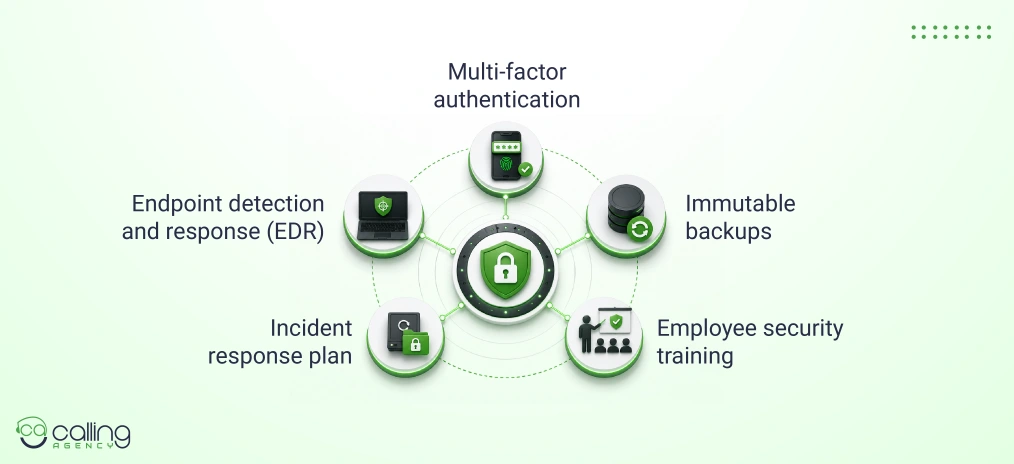
| Control | Why It’s Required | Buying Trigger |
| Multi-factor authentication | Reduces credential-based breach risk | MFA rollout project |
| Endpoint detection and response (EDR) | Faster threat detection and containment | EDR/MDR vendor evaluation |
| Immutable backups | Ransomware recovery assurance | Backup infrastructure upgrade |
| Incident response plan | Faster containment, lower claim payouts | IR retainer or tabletop exercise |
| Employee security training | Reduces phishing-related claims | Security awareness program |
The 60-90 Day Renewal Window
Most cyber insurance renewals surface security gaps 60 to 90 days before the policy expires. This creates a dated, predictable window where IT leaders must act, not because they chose to research vendors, but because the underwriter’s requirements force a decision.
How to Track This Signal
- Monitor public filings and press releases mentioning insurance renewal cycles
- Watch for job postings tied to security control implementation (MFA rollout, EDR deployment)
- Note LinkedIn posts from IT leaders discussing insurance questionnaire pain points
- Cross-reference renewal timing with industry-standard annual cycles
CallingAgency also books these conversations for cybersecurity and managed IT service providers. Our B2B appointment scheduling campaign for Slick Cyber Systems booked 75 sales-qualified IT meetings in 13 months. Tighter pre-screening lifted the close rate to 22% based on first-party campaign data.
The 100-day window: IT Leadership Changes as Buying Signals
IT leadership changes create a buying signal because new CIOs and CISOs typically re-evaluate vendor relationships within their first 100 days, making this window the highest-probability period for switching MSPs or security vendors.
Why the First 100 Days Matter?
New leaders arrive with a mandate to assess existing infrastructure, contracts and vendor performance. Most make key vendor decisions early to establish their own strategic direction rather than inherit the previous leader’s relationships.
The 100-Day Timeline
| Phase | Days | Activity |
| Assessment | 0 to 30 | Reviewing current vendors, contracts and pain points |
| Evaluation | 31 to 60 | Comparing alternatives, gathering internal feedback |
| Decision | 61 to 100 | Making initial vendor or strategy changes |
How to Track This Signal?
- Monitor LinkedIn for new CIO, CISO or VP of IT announcements
- Set alerts for press releases mentioning IT leadership hires
- Check company “newsroom” pages for executive appointment news
Outbound within 30 days of appointment puts a vendor on the new leader’s radar early, before they’ve committed to anyone else, while outreach timed to days 30 to 60 hits the evaluation phase when they’re actively comparing options. This makes IT leadership change one of the most reliable, dated triggers for MSP and IT services outreach.
MSA Renewal Windows: When to Time Competitive Displacement?
MSA renewal windows create the best competitive displacement opportunity because the incumbent provider’s contract terms, pricing and SLAs are already open for review, making it the one time a company is actively comparing alternatives instead of defaulting to auto-renewal.
Why Renewal Timing Matters for Displacement?
Most managed services agreements run 1 to 3 years with auto-renewal clauses. Once auto-renewal triggers, switching costs and inertia make displacement far harder. The real opportunity window sits before that trigger date, while the buyer still has leverage to negotiate or switch.
The Ideal Outreach Timeline
| Timing | Buyer Status | Outreach Focus |
| 6 to 9 months before expiration | Not yet evaluating | Build awareness, share differentiators |
| 3 to 6 months before expiration | Actively reviewing options | Competitive comparison, pricing benchmarks |
| 1 to 3 months before expiration | Finalizing decision | Direct proposal, migration plan |
How to Find MSA Renewal Timing?
- Ask during discovery calls when the current contract started
- Check public RFP postings referencing existing vendor relationships
- Monitor procurement announcements or vendor consolidation news
Funding, Hiring And Headcount Growth Signals for IT services
Funding, hiring and headcount growth create IT services buying urgency because rapid scaling outpaces existing IT infrastructure and support capacity, forcing companies to add managed services or security vendors faster than internal teams can hire.
Why Growth Signals Predict IT Spend?
Companies that raise capital or grow headcount quickly hit operational bottlenecks fast. New employees need onboarding, devices and security controls. Existing IT teams, sized for the previous headcount, can’t absorb this load without outsourcing to an MSP.
Key Growth Triggers to Track
| Signal | Buying Trigger |
| Series A/B/C funding | IT infrastructure and security buildout |
| 20%+ headcount growth in 6 months | MSP or IT support contract |
| New office opening | Network setup, security, connectivity |
| CTO or VP Eng hire | Vendor re-evaluation |
Why Funding Announcements Matter Most?
Funding rounds are dated and public, typically announced via press release or Crunchbase. Companies usually deploy new capital within 3 to 6 months, making this the ideal outreach window.
How to Track These Signals?
- Monitor Crunchbase and PitchBook for funding rounds
- Set LinkedIn alerts for hiring and headcount milestones
- Track job postings for IT, DevOps and security roles
RFP Posting Patterns for Managed IT and Cybersecurity
Public RFP postings are the clearest IT services buying signal because the company has already confirmed budget approval and active intent to purchase, removing all guesswork about timing.
Why RFPs Are the Strongest Signal?
Unlike inferred triggers, an RFP means procurement is already underway. Budget is approved, requirements are documented and a decision timeline is set. This makes RFPs a late-stage signal, not an early-warning one.
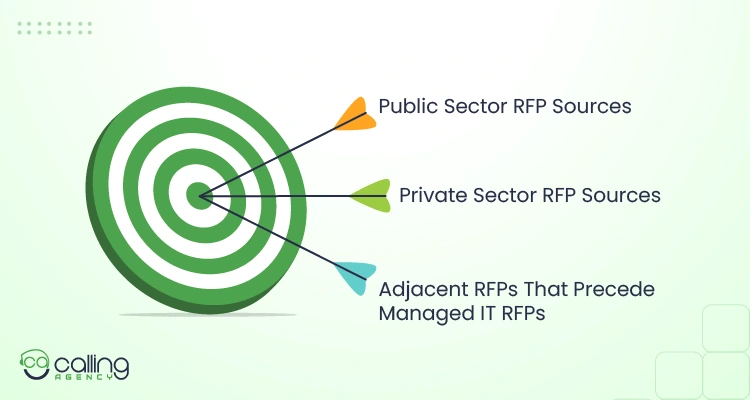
Public Sector RFP Sources
- gov (federal contract opportunities)
- State procurement portals (varies by state)
- Local government eProcurement sites (city and county level)
- BidNet and DemandStar (aggregated public sector listings)
- Education procurement cooperatives (for school district IT contracts)
Private Sector RFP Sources
- Company procurement or vendor portal pages
- RFPMart and RFPdb (aggregated private RFP listings)
- Industry association job boards and bulletins
- Trade publication classifieds (healthcare IT, finance IT verticals)
- LinkedIn posts from procurement or IT leadership announcing open RFPs
Adjacent RFPs That Precede Managed IT RFPs
Some RFP categories often signal a managed IT RFP is coming next:
- Cloud migration or infrastructure assessment RFPs
- Cybersecurity audit or penetration testing RFPs
- ERP or CRM implementation RFPs
- Network infrastructure upgrade RFPs
- IT staffing or staff augmentation RFPs
Where RFPs for Managed IT and Cybersecurity Appear
| Source | Best For |
| Government procurement portals | Public sector managed IT contracts |
| Industry-specific RFP aggregators | Healthcare, education, finance verticals |
| Company procurement pages | Direct enterprise RFP postings |
| Trade publications | Cybersecurity-specific RFPs |
Timing Patterns Worth Tracking
Government and education RFPs often cluster around fiscal year-end (June or September, depending on jurisdiction), while private-sector RFPs spike after Q1 budget approvals.
How to Respond Effectively?
Since RFPs are public and often competitive, response speed and specificity matter more than relationship-building. Address stated requirements directly rather than generic capability pitches.
Signal Decay: How Long Each Signal Stays Actionable?
Buying signals in managed IT and cybersecurity don’t stay useful forever. Each one has a window where outreach feels timely and relevant and a point after which the same message reads as stale or opportunistic. Breach and incident-based signals decay fastest (30–90 days) because they trigger urgent, time-boxed budget approval. Organizational signals like leadership hires or funding rounds stay actionable longer (90–180 days) since they reflect strategic shifts rather than emergencies.
Signal Decay Table
| Signal Type | Actionable Window | Why It Decays |
| Breach filing/incident disclosure | 30–90 days | Incumbent MSSP or breach-response firm consolidates the retainer |
| Ransomware leak-site listing | 30–60 days | Crisis response wraps up; budget gets allocated fast |
| SEC 8-K Item 1.05 filing | 30–90 days | Remediation vendor selection typically closes within this range |
| RFP posting (public or private) | Until award date, usually 30–60 days | Decision closes once a vendor is selected |
| Cyber insurance renewal/assessment | 60–90 days pre-renewal | Budget and vendor decisions finalize before renewal date |
| Compliance audit finding (SOC 2, HIPAA, PCI) | 60–120 days | Remediation projects get scoped and budgeted quickly |
| New CISO or IT leadership hire | 100 days | New leader sets vendor strategy within their first 100 days |
| Funding round / M&A announcement | 90–180 days | IT infrastructure decisions follow integration or scaling plans |
| Cloud migration or ERP project RFP | 60–120 days | Adjacent IT and security needs surface during implementation |
| Headcount growth in IT/security roles | 90–180 days | Reflects a slower, budget-cycle-driven expansion |
What Looks Like A Buying Signal But Isn’t?
A real buying signal always has three things attached — a trigger event, a budget window and a decision-maker. A false signal has keywords but no event, no timeline and no organizational pressure. Before treating anything as a buying signal, check for a decay window and a named stakeholder. If neither exists, it’s background noise, not intent.
| Apparent Signal | Why It Looks Buyable | Why It Usually Isn’t |
| “Cybersecurity awareness month” post | Uses security keywords, feels topical | No incident, no budget line, no urgency |
| Scheduled SOC 2 or ISO renewal | Compliance activity in motion | Recurring cycle, already budgeted, same vendor usually retained |
| IT job posting (backfill role) | New hire signals org movement | Replacing existing headcount, not expanding scope |
| Old breach story resurfacing | Breach = high urgency | Decay window closed, incumbent already engaged |
| “Top vendors” listicle mention | Industry visibility, feels relevant | No internal trigger event tied to it |
| “Digital transformation” press release | Sounds like new IT spend | Often branding language, no procurement timeline |
| Webinar or conference sign-up | Shows topic engagement | Research stage only, no decision authority involved |
| Minor CVE mention, no confirmed exploit | Security keyword present | No proof of compromise or incident response spend |
| Generic LinkedIn hiring announcement | Company seems to be growing | Growth ≠ new vendor need without a specific gap |
| Vendor comparison blog visit | Shows research activity | Too early-stage, no budget or timeline confirmed |
How to Stack Free Signals to Approximate Paid Intent Data?
Paid intent data platforms are expensive and often noisy. But when free public signals are layered correctly, they can provide a similar view of buying intent without the subscription cost. This signal-stacking approach helps modern sales development representative teams prioritize daily outreach and focus on mid-market accounts showing genuine buying activity.
The Three-Signal Minimum for Qualifying an Account
One signal alone rarely means much. A hiring post may only indicate a backfill while a breach filing may already be outdated. Reliable lead qualification requires at least three overlapping signals: one trigger event, one firmographic fit and one behavioral or organizational signal before an account enters outbound outreach.
The Free-Source Stack
| Layer | Source | What It Confirms |
| Trigger event | Breach filings, RFPs, compliance deadlines | Timing and urgency |
| Firmographic fit | Revenue, headcount, vertical, tech stack | ICP match |
| Organizational movement | Hiring, leadership changes, funding rounds | Sustained investment appetite |
| Digital engagement | Website visits, content downloads, job postings | Active research behavior |
When two or more layers overlap on the same account, confidence rises sharply.
When Paid Intent Data Pays Back?
Free signal stacking works well for small to mid-sized pipelines, but maintaining accurate data takes manual effort. Paid intent tools become worthwhile when:
- Outbound volume exceeds what the research team can track manually
- Speed to first contact becomes a competitive advantage
- The target account list grows beyond 500 accounts
At that stage, combining automated intent scoring with custom list building services can save more in rep hours than the subscription costs.
Signal to Cadence Mapping And Opener Templates
Cadence speed should scale with signal urgency, not rep convenience. High-urgency signals like breaches need phone contact within 72 hours because the buying window closes fast; low-urgency signals like funding rounds can sit in a slower nurture track because the decision timeline is longer. Every opener should reference the triggering event specifically, skip any mention of how the signal was found and lead with a free resource instead of a sales task.
Why Urgency Tier Should Drive Cadence?
Not every signal deserves the same speed of follow-up. A breach or ransomware event needs contact within 72 hours because the decay window is short and competitors move fast. A funding announcement or hiring surge can sit in a slower nurture track because that buying window stretches over months, not days. Treating every signal with the same cadence wastes urgency where it matters and rushes prospects where it doesn’t.
Cadence Framework by Urgency Tier
| Urgency Tier | Channel | Message Count | Gap Between Touches | Exit Criteria |
| Highest (breach, ransomware) | Phone + email | 3 touches | 24–72 hours | Meeting booked or 5-day no-response |
| High (compliance deadline, cyber insurance, EOL passed, leadership change) | Email + LinkedIn + phone | 5 touches | 3–7 days | Meeting booked or 21-day no-response |
| Medium-high (MSA renewal, EOL approaching) | Email + LinkedIn | 5 touches | 7–10 days | Meeting booked or 45-day no-response |
| Medium (funding, hiring, technographic) | Email nurture | 6 touches | 10–14 days | Meeting booked or 60-day no-response |
Building Openers That Don’t Sound Templated
The single rule that holds every template together: reference the event, never the source that surfaced it. Mentioning a leak site, an AG portal or “we saw you researching” instantly signals surveillance-based outreach and kills reply rates.
Breach filing: “Saw the news about the incident. Not sending a pitch, sending the tabletop template we use with clients for post-incident retros. No ask attached.”
Software EOL approaching: “Windows 10 EOS is October 14, 2025. Most mid-market accounts we work with still have 40–60% of their fleet on Win 10 with no migration plan. Happy to send the fleet inventory template we use to scope this.”
Compliance deadline: SOC 2 renewal audit coming up? If a control gap turned up in the last review, happy to send the remediation checklist we use to close gaps before auditors return. Send it over?”
Cyber insurance renewal: “Carrier’s probably asking for MFA and EDR evidence this renewal. If you need to prove backup restore or incident response plans, happy to send the evidence checklist we use, no ask attached.”
New IT leadership: “Saw you joined [Company] as [Title]. First 100 days are chaos, happy to send the 30-day IT landscape review template we’ve used with new CIOs. Just a template.”
MSA renewal window: “Most MSA renewals this year are seeing a 15–25% price bump. Happy to run a no-cost benchmark on scope and pricing before your window closes. If not, ignore this.”
Funding + hiring surge: “Congrats on the [Series X] raise. If the [Head of IT/Security] hire is landing soon, happy to send our 30-day tech stack audit template to hand off. No ask.”
Public RFP: Respond through the official procurement channel and separately reach buying committee members with a “beyond the RFP” perspective rather than duplicating the formal pitch.
Language That Undermines the Approach
A few phrases reliably mark outreach as templated and volume-based, regardless of how well-timed the signal is:
- “Intent data,” “buying signals,” or “we saw you researching”
- Any demo ask in the opener
- Naming the SEC filing, leak site or AG portal directly
- “I hope this finds you well”
- “In today’s cybersecurity landscape”
Which Prospecting Tools Fit IT Services Firms?
IT services and cybersecurity firms typically need three tool categories working together: signal/intent data (ZoomInfo, Bombora or public sources like SEC EDGAR), contact data and enrichment (Apollo.io, Clearbit) and a sequencing platform (Outreach, SalesLoft) to execute cadences at the right timing. Public sector-focused firms should add GovSpend or SAM.gov for RFP tracking. No single tool covers all layers, so most mature GTM (go-to-market) teams stack two to three tools rather than relying on one platform.
Prospecting Tools by Function
| Category | Tools | Best For |
| Intent & signal data | ZoomInfo, Bombora, 6sense | Tracking technographic and behavioral buying signals at scale |
| Contact & firmographic data | Apollo.io, ZoomInfo, Clearbit | Building ICP-matched contact lists with revenue and headcount filters |
| Public sector RFP tracking | GovSpend, BidNet, SAM.gov | Monitoring government and education procurement postings |
| Breach & compliance monitoring | SEC EDGAR, state AG portals, Have I Been Pwned (aggregated) | Tracking disclosure-based trigger events |
| Outreach & sequencing | Outreach, Salesloft, Apollo.io | Running multi-touch cadences across email, LinkedIn and phone |
| LinkedIn-based prospecting | Sales Navigator, Lusha | Finding buying committee members and warm-intro paths |
| CRM & pipeline tracking | HubSpot, Salesforce, Pipedrive | Managing account status through the signal decay window |
| Website visitor tracking | Leadfeeder, Clearbit Reveal | Identifying anonymous inbound research activity |
| Job posting monitoring | LinkedIn Talent Insights, manual tracking | Spotting leadership hires and headcount growth signals |
FAQ
How do MSPS find new prospects without paid intent data?
MSPs can stack free signals like SEC filings, state AG breach portals, RFP postings, job listings and compliance deadlines. Combining three or more overlapping signals per account approximates paid intent data at no subscription cost.
What is the difference between a buying signal and a trigger event?
A trigger event is a specific occurrence, like a breach or leadership hire. A buying signal is broader evidence of intent, often built from multiple trigger events plus firmographic fit and behavioral data combined together.
What indicates a company needs a managed IT services provider?
Key indicators include a recent breach, upcoming compliance deadlines, software reaching end-of-life, MSA renewal windows, rapid headcount growth or a new IT/security leadership hire signaling changing vendor strategy and budget priorities.
How do you reach a prospect after a breach without sounding opportunistic?
Wait 4 to 14 days, lead with a free artifact like a retro template, avoid naming the breach source, skip any demo ask and route the first outreach through the COO or CFO, not the CISO.
Final Words
Buying signals only create pipeline when they’re acted on with the right timing, the right channel and the right message. A breach filing, an RFP or a leadership change means nothing if outreach arrives too late or too generic to stand out.
The firms winning in IT services and cybersecurity right now aren’t the ones with the biggest lists. They’re the ones tracking these nine signals consistently, respecting each decay window and leading with value instead of a pitch.
Start with one or two signal sources, build a simple tracking process and match cadence to urgency. The framework matters more than the tool stack.