

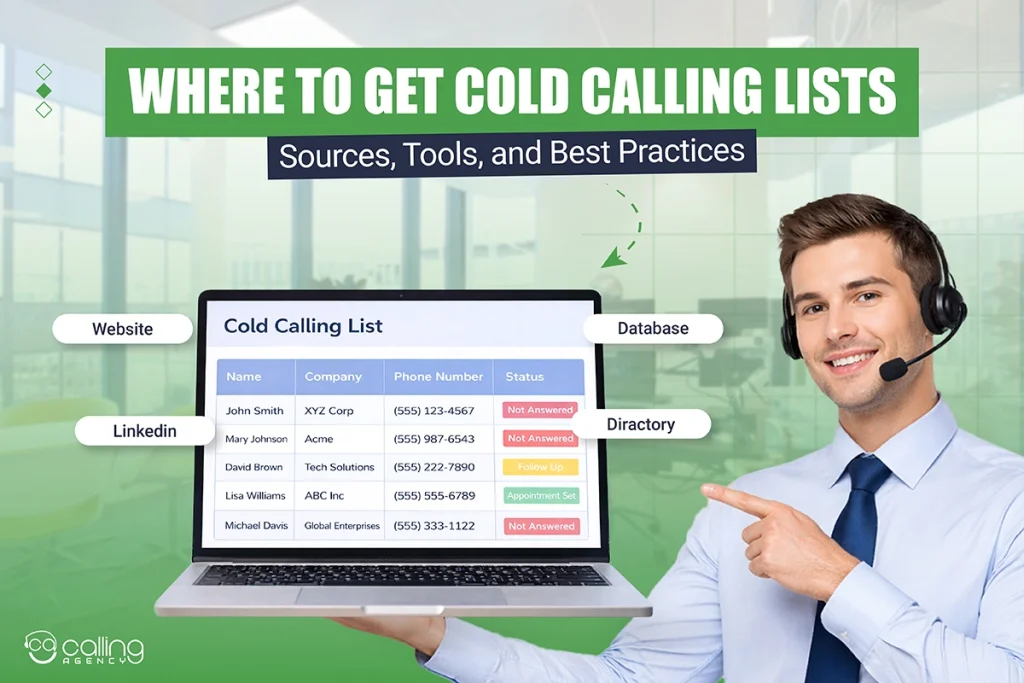
Cold calling starts with a strong prospect list. If you are new to cold calling, you may wonder where sales teams get the contact lists they use. A cold calling list is typically constructed based on such sources as B2B lead databases, LinkedIn, web-based business directories, company websites, and industry databases.
Such sources will contain valuable information like names, phone numbers, job titles, and company information. It is also common for many salespeople to use a combination of sources to come up with a better list. Using reliable data helps sales teams reach decision-makers, improve connection rates, and generate more qualified leads through cold calling.
What Is A Cold Calling List?
A cold calling list is a list of predefined potential customers containing phone numbers and simple business information that sales teams use to make unsolicited sales calls. It typically contains the company name, contact, occupation, phone number and occasionally email. It is used by sales people to access new prospects and create leads.
What A Cold Calling List Should Include?
A cold calling list must contain clear contact information in order to shortcut the salespeople to the necessary decision-maker.
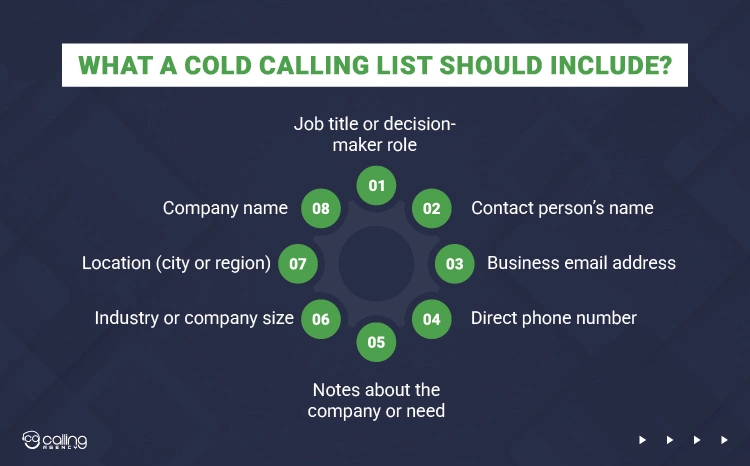
- Company name
- Contact person’s name
- Job title or decision-maker role
- Direct phone number
- Business email address
- Industry or company size
- Location (city or region)
- Notes about the company or need
Top 4 Sources For Cold Calling Lists
A successful cold calling relies on how well your list is. The list will have incorrect companies or contacts that are not up to date thus the calls will fail. The best cold calling list sources help you identify the right companies and connect with the correct decision-makers, which is essential for effective B2B lead generation. The vast majority of sales teams use four viable sources to compile lists; these include B2B data vendors, LinkedIn research, industry directories, and pre-fabricated data lists.
1. Paid B2B Data Providers
The quickest method of creating a huge and specific cold calling list is through paid B2B databases. Business contact information is gathered on these platforms and advanced filtering is made possible. The most widely used tools are ZoomInfo, Apollo.io, and Cognism.
How to use them:
- Sort filter companies by industry, size of employees and location.
- Choose the job titles of decision-maker, including CEO, Founder, Head of Sales.
- Export contacts with direct telephone contacts and emails.
- Eliminate front line jobs prior to placement.
Example:
In the case of accounting software being sold to small businesses, it is possible to filter by companies with 10-50 employees and by export contacts with the titles of Finance Manager or Owner. It takes just minutes to prepare a ready cold calling list using this method.
2. Linked In And LinkedIn Sales Navigator.
One of the most suitable locations to find the actual decision-makers within companies is LinkedIn. You are able to search companies and find out the name of the person who is in charge of every department. B2B Sales teams tend to upgrade to LinkedIn Sales Navigator to do more filtering.
How to use them:
- Search industry and company size.
- Narrow down to job titles (CEO, Operations Manager, Marketing Director)
- Save the leads
- Get phone numbers or emails using an enrichment tool.
The technique will involve calling the right person rather than random workers.
3. Industry Associations And Directories
Directories of the industry are usually overlooked, as they are good sources of directed leads. A great number of associations release member lists or business directories.
How to use them:
- Download or copy member company list.
- Visit each company website
- Select the department head or owner.
- leave your contact details in your call list.
Example:
When selling restaurant equipment, a restaurant association directory will list hundreds of restaurant owners in a short period.
4. Buying A Pre-Built List From A Data Broker
Other companies offer prospect lists which are ready-made. The lists are developed under the influence of definite targeting filters.
The common targeting can be:
- Industry
- Location
- Company size
- Job titles
Example:
You can buy a list of marketing agencies in New York with 5-30 employees.
Before buying, always check:
- When the data was last updated
- If phone numbers are direct dials
- Whether the list contains duplicate contacts
Most successful sales teams buy a base list and then verify it using LinkedIn before starting calls. This keeps the list accurate and improves connection rates.
How To Build Your First Cold Calling List From Scratch?
A cold calling list is just a list of companies and decision-makers that you intend to call. It is not aimed at getting thousands of random numbers. Instead, the goal is to build a smaller, highly targeted list of people who are more likely to need your cold calling service. This is aimed at developing a small, focused list of individuals that are likely to require your service. These are the steps that will help you to create your first list.
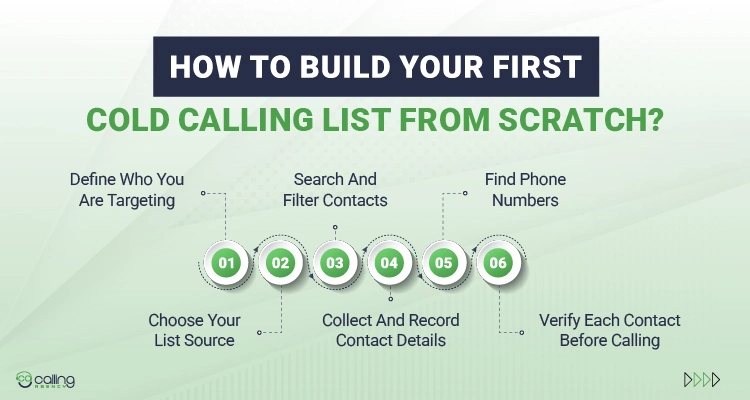
Step 1 — Define Who You Are Targeting
Start by clearly defining your ideal customer. Without this step, your list will be random and your calls will fail.
Answer these questions first:
- What industry do you want to target?
- What company size fits your product?
- Who is the decision-maker (owner, manager, director)?
- Which location are you targeting?
Example: If you sell digital marketing services, your target could be:
- Local e-commerce companies
- 10–50 employees
- Marketing Manager or Founder
This clarity makes the rest of the process much easier.
Step 2 — Choose Your List Source
Next, decide where you will find your prospects. Good sources include:
- LinkedIn Sales Navigator
- Industry directories and association websites
- B2B data tools like Apollo.io
Choose one main source first. Trying too many sources at once will slow you down.
Step 3 — Search And Filter Contacts
Now start searching based on the criteria you defined.
For example, search filters like:
- Job title: Founder, Operations Manager, Marketing Director
- Industry: SaaS, restaurants, construction
- Location: specific city or country
Your goal is to build a focused list of 50–100 prospects, not thousands.
Step 4 — Collect And Record Contact Details
Create a simple spreadsheet to organize your list.
Include columns such as:
- Company name
- Contact name
- Job title
- Website
- LinkedIn profile
- Phone number
- Notes
As you find each prospect, add them to this sheet immediately. This keeps your list organized for calling later.
Step 5 — Find Phone Numbers
Many profiles will not show phone numbers directly. In this case, you need to find them using data tools or company websites.
Common places to check:
- Company contact page
- Business directories
- Data tools like Lusha
Always prioritize direct phone numbers or company main numbers that connect you to the decision-maker.
Step 6 — Verify Each Contact Before Calling
Before starting your calls, quickly verify every contact.
Check:
- Is the company still active?
- Does the person still work there?
- Is the phone number valid?
Visit the company website or LinkedIn page to confirm the information. This small step saves time and improves your connection rate.
When done correctly, your first cold calling list will contain 50–100 verified prospects, making your calls more relevant and increasing your chances of starting real business conversations.
Where To Find Phone Numbers For Cold Calling?
One of the most crucial tasks of constructing a cold calling list is the search of the correct phone numbers. Most of the given profiles of prospects just display their name and business information, and in this case, you would have to find effective methods of finding direct or company telephone numbers. Two of the dependable methods of sales teams are given below.
Phone Enrichment Tools
Phone enrichment tools are used to locate business phone numbers of certain individuals or businesses. Such websites as Lusha, Apollo.io, and ZoomInfo search huge databases and add phone numbers to business accounts.
A practical workflow looks like this:
- Locate the potential on LinkedIn.
- Click on the extension of the enrichment tool.
- Get the available phone number and email.
- Enter the information in your calling sheet.
There is always the question of whether the number is direct or switchboard. Direct numbers tend to provide a good connection rate.
Free Methods For Finding Phone Numbers
Phone numbers are also available free of charge provided one has a basic research process.
Check these sources:
- Contact page of company web site.
- Google business listings
- Business Tables Internet.
- About or team pages
Example: If you find a company on LinkedIn, visit their website and copy the main office number. When calling, ask the receptionist to connect you to the specific person.
Combining enrichment tools with manual research helps you collect accurate phone numbers for cold calling and reach the right decision-makers faster.
How To Check If Your List Is Good?
A cold calling list is only useful if the contacts are accurate and relevant. Before starting your calls, run a few quick checks to make sure your list contains real businesses and the right decision-makers.
The Five Quality Checks Every Beginner Should Run
Check all your contacts before calling:
- Decision-maker position- ensure that the individual is in authority (owner, CEO, director or manager).
- Industry match – ensure that the company is in the industry that you are targeting.
- Company activity – verify whether company website and social profiles are in operation.
- Right company size – make sure the business is appropriate to your offer.
- Check on the current employee- use LinkedIn to confirm that he/she is still working there.
These checks are less than one minute per contact, and stop numerous unsuccessful calls.
How To Remove Bad Contacts From Your List?
Cleaning your list regularly improves call results.
Remove contacts if:
- The person changed jobs or left the company
- The company does not match your target market
- The phone number does not work or goes to the wrong department
- The role cannot influence purchasing decisions
After removing weak contacts, replace them with new prospects that better match your criteria.
What Connect Rate Tells You About List Quality?
Your connect rate shows whether your list is good or bad.
Example:
If you call 50 numbers and 10 people answer, your connect rate is 20%, which is reasonable for cold calling.
If only 1–2 calls connect, the list likely contains outdated or incorrect numbers.
How Often To Refresh Your List
Business data changes often. Employees change their jobs and businesses update contact details.
One of the guidelines that can be put into practice is to revise and update your list every 1-2 months. Introduce fresh opportunities, change job titles and eliminate dormant contacts to maintain an effective cold calling list.
Simple Rules To Stay Legally Safe As A Beginner
Cold calling is not prohibited in numerous locations, still, you should not neglect the simple rules to prevent any complaints and penalties. As an apprentice, you are aiming at nothing more than dialing the correct companies, honouring the opt-out calls, and not using blocked numbers. These tips can make your outreach secure by a few rules.
The Do-Not-Call Registry
He/she should always confirm that the Do-Not-Call (DNC) registry has been checked before calling. Individuals put their name down to prevent calls of being marketed. There is a risk of being fined after calling such numbers.
Practical steps:
- Check the numbers on the list of DNCs in your country.
- Have a do not call list of those who request you not to call.
- Immediately update your CRM when one chooses not to.
This routine will keep your list clean and will secure your business.
A Rapid GDPR Notice To UK and EU Contacts.
In contacting individuals in UK or EU, you have to adhere to the General Data Protection Regulation. Gather all business contacts through the publicly available sources such as company websites or LinkedIn.
Practical steps:
- Provide a clear explanation on who you are and why you are calling.
- IM requests to be removed from disrespect: delete the contacts instantly.
- If you comply, record the source of every contact.
With an adherence to these rules, beginners are able to reach prospects safely and legally, as well as earn trust.
Conclusion
It is imperative to create a quality cold calling list in order to sell. In the case of cold calling where the individual making the call is new, it is best to use credible sources such as B2B database, LinkedIn, business directories, and websites of companies to obtain the correct contact information.
Verified lists enable the sales teams to access decision-makers, save time, enhance connection and conversion rates. The list will be more efficient with several sources and frequent updates to data.
With accuracy, targeting the correct audience and proper organization of the prospects, beginners can conduct a more effective cold calling campaign. An effective outreach and improved sales outcomes are based on a prepared list.
FAQs
What is the ideal customer profile (ICP)?
ICP targets the audience, according to industry, size of the company, place and position. It assists in building targeted and pertinent cold calling lists.
How frequently do I need to update my list?
Check the list of contacts frequently and delete the old ones. New lists enhance the connection rates and cold calling success.
What is the structure of a cold calling list?
Segment leads using spreadsheets or CRM systems by industry, position and size of company. Systematized catalogs are easy to follow up and enhance the sales process.
Are cold calling lists possible using company websites?
Yes, contacts and team pages have got the correct contact numbers and emails. Web research is done manually; this makes sure that you get the right decision-makers.
Is LinkedIn an effective cold calling tool?
Yes, LinkedIn offers acquaintances, career titles, and company information. LinkedIn Sales Navigator will be the right tool to ensure that a B2B sales team targets the decision-makers.